
For most of human history, moving goods between Europe and Asia was a slow and expensive journey.
Ships leaving Europe had to travel around the southern tip of Africa, navigating thousands of extra kilometers before reaching markets in Asia. The route was long, dangerous, and costly. A single voyage could take months, tying up ships, crews, and valuable cargo.
Then, in the nineteenth century, engineers proposed a bold idea.
What if ships could sail directly between the Mediterranean Sea and the Red Sea?
What if a canal could cut through the deserts of Egypt and create a shortcut between Europe and Asia?
The result was the Suez Canal, one of the most important engineering projects in human history.
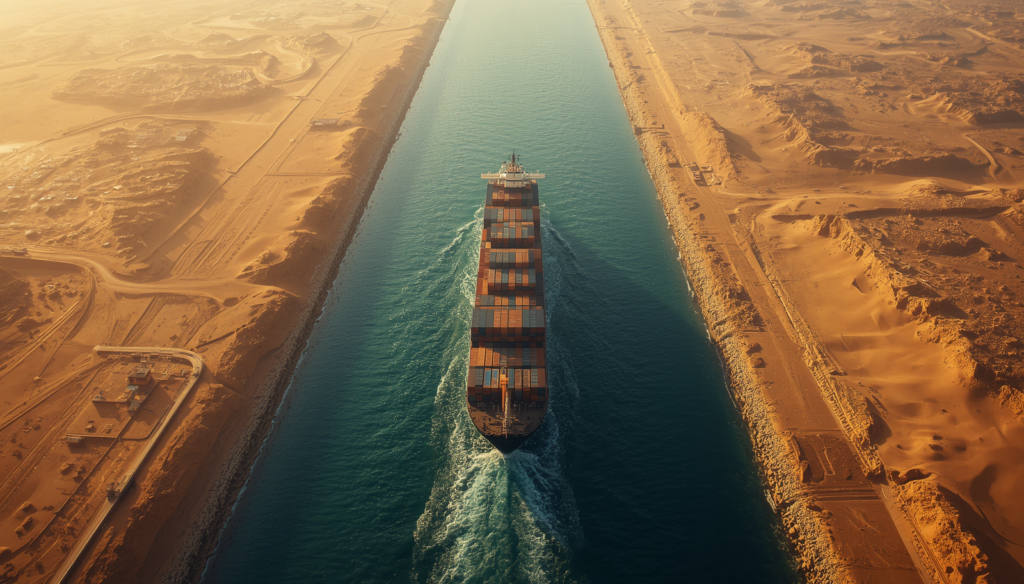
Today, it remains one of the world’s busiest waterways, carrying billions of dollars’ worth of goods and connecting continents through a narrow strip of water that transformed global trade forever.
🗺️ A Dream Older Than the Canal Itself
The idea of connecting the Mediterranean and the Red Sea is surprisingly ancient.
Thousands of years before the modern Suez Canal existed, rulers in ancient Egypt explored ways to link waterways through canals.
Several versions were built and rebuilt over the centuries, connecting parts of the Nile River system to the Red Sea.
However, these early canals were limited in scope and often fell into disrepair.
The dream of a direct sea-to-sea connection persisted.
Generations of traders, explorers, and rulers understood the enormous advantages such a route could provide.
The challenge was finding the technology, resources, and political support needed to make it happen.
🏜️ Building a Canal Through the Desert
The modern Suez Canal owes much of its existence to Ferdinand de Lesseps, a French diplomat who championed the project during the 19th century.
Construction began in 1859.
The task was enormous.
Workers faced:
- harsh desert conditions
- extreme temperatures
- difficult excavation work
- logistical challenges in a remote environment
Tens of thousands of laborers participated in the project over its decade-long construction period.
Much of the early work was performed manually before large-scale machinery became more widely available.
The canal gradually took shape across the Egyptian landscape, linking two major bodies of water for the first time.
🚢 The Grand Opening
In 1869, after ten years of construction, the Suez Canal officially opened.
The event attracted international attention.
Leaders, diplomats, and dignitaries recognized that this was not merely an engineering achievement—it was a transformation of global transportation.
For ships traveling between Europe and Asia, the impact was immediate.
Instead of sailing around Africa, vessels could now take a far shorter route through Egypt.
The savings in time and distance were dramatic.
Suddenly, trade between continents became faster, cheaper, and more efficient.
🌍 Why the Canal Changed Everything
The importance of the Suez Canal lies in a simple concept: distance matters.
The shorter a shipping route, the lower the costs.
Reduced travel times mean:
- less fuel consumption
- lower operating expenses
- faster deliveries
- more efficient trade networks
The canal quickly became one of the world’s most strategically important waterways.
Goods flowing between Europe, Asia, and parts of Africa increasingly depended on this shortcut.
Everything from textiles and machinery to food and raw materials moved through the canal.
It became a critical artery of global commerce.
⚓ A Canal Without Locks
One of the most interesting features of the Suez Canal is what it lacks.
Unlike the Panama Canal, which uses a complex system of locks to raise and lower ships, the Suez Canal operates at sea level.
The Mediterranean Sea and the Red Sea are connected directly through the canal.
As a result, ships can travel continuously from one end to the other without passing through lock chambers.
This simplifies operations and allows a steady flow of maritime traffic.
The design reflects the unique geography of the region and contributes to the canal’s efficiency.
📈 The Growth of Global Shipping
As international trade expanded during the twentieth century, the Suez Canal became increasingly important.
Modern container ships, oil tankers, and bulk carriers regularly transit the waterway.
Each year, thousands of vessels pass through the canal carrying goods destined for markets around the globe.
For many shipping companies, the canal represents the most efficient route between Europe and Asia.
Its role in global supply chains makes it one of the most economically significant pieces of infrastructure on Earth.
In many ways, the canal serves as a bridge between continents.
🚧 When the World Was Reminded of Its Importance
In 2021, the world received a dramatic reminder of how vital the Suez Canal had become.
A massive container ship called the Ever Given became stuck in the canal after losing control during difficult conditions.
The ship blocked traffic in both directions.
Images of the enormous vessel wedged across the canal quickly spread around the world.
Hundreds of ships were forced to wait while engineers worked to free the vessel.
The incident lasted only a few days, yet it disrupted global supply chains and highlighted how dependent modern trade has become on this narrow waterway.
For many people, it was the first time they realized how much of the world’s commerce passes through the Suez Canal.
🌐 A Strategic Lifeline
Beyond commerce, the canal has immense geopolitical importance.
Because it connects major regions of the world, control and access to the canal have long been matters of international significance.
Throughout its history, the canal has played roles in diplomacy, conflict, and global politics.
Nations recognize that disruptions to traffic can affect trade, energy supplies, and economic stability far beyond the Middle East.
This strategic importance makes the canal one of the world’s most closely watched waterways.
🚀 The Future of the Canal
As global trade continues to grow, the Suez Canal continues evolving.
Expansion projects have increased capacity and improved traffic flow.
Engineers and planners constantly seek ways to accommodate larger ships and rising cargo volumes.
The canal’s future will likely remain closely tied to the future of international commerce itself.
As long as goods move between continents, the demand for efficient shipping routes will continue.
And few routes are more important than this one.
💡 The Waterway That Brought Continents Closer
Some engineering projects solve local problems.
Others reshape the world.
The Suez Canal belongs in the second category.
By creating a shortcut between Europe and Asia, it reduced travel times, lowered transportation costs, and accelerated global trade on a scale few could have imagined.
More than 150 years after its opening, ships continue passing through its waters every day.
The canal may appear as a simple line on a map, but its influence reaches every corner of the global economy.
It is a reminder that sometimes the shortest distance between two points can change the course of history.
🔍 You Might Also Enjoy
If you enjoyed learning about the infrastructure that powers global trade, don’t miss our previous post:
👉 The Box That Changed Global Trade
Discover how the humble shipping container revolutionized transportation, transformed supply chains, and helped create the modern global economy.
📬 Stay Connected with Trivialwiki
👉 Facebook: https://facebook.com/Trivialwiki
👉 Instagram: https://instagram.com/trivialwiki
👉 YouTube: https://youtube.com/@trivialwiki
👉 Pinterest: https://pinterest.com/Trivialwiki
Learn. Explore. Discover.
The Suez Canal transformed world trade by creating a shortcut between Europe and Asia. If you could witness one great engineering project being built in history, which would you choose and why? Share your thoughts in the comments! 🚢🌍
1 thought on “The Shortcut That Reshaped World Trade”