
Bubble wrap is one of those everyday materials that seems almost too ordinary to deserve a history. It appears around new electronics, inside delivery boxes, between fragile dishes, and sometimes in the hands of someone who is far more interested in popping it than in protecting the package.
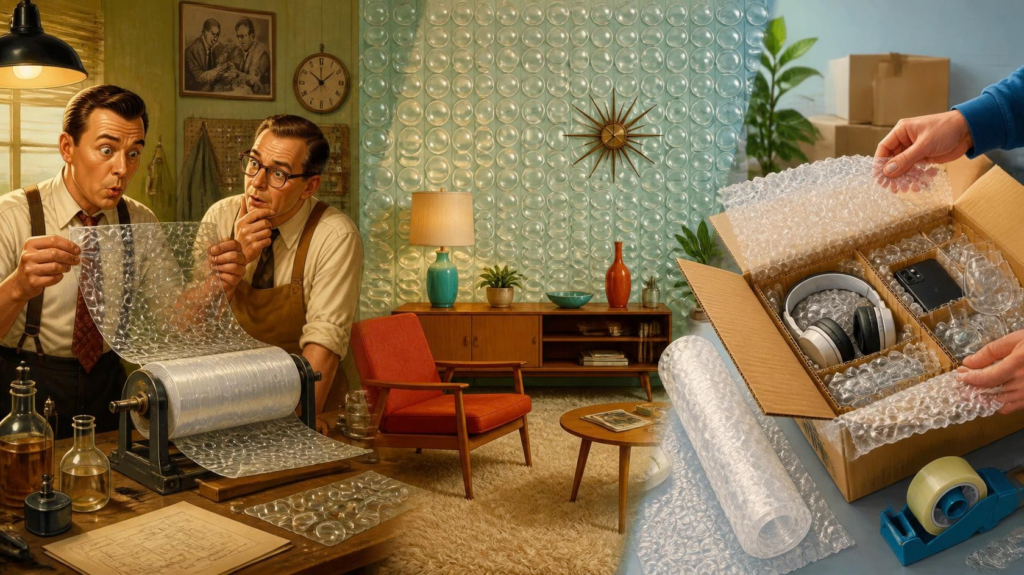
But bubble wrap has a surprisingly strange origin. It was not invented to protect parcels, cushion glassware, or make moving house less stressful. Its creators were actually trying to develop a fashionable new kind of three-dimensional wallpaper.
That first idea failed. The next idea also failed. Yet the material eventually became one of the most recognizable packaging inventions in the world.
The story of bubble wrap is a wonderful reminder that an invention does not always become successful because it achieves its original purpose. Sometimes, success arrives only after the original plan goes completely wrong.
Bubble Wrap: The Failed Wallpaper That Became Everyone’s Favorite Packaging
Bubble wrap is one of those everyday materials that seems almost too ordinary to deserve a history. It appears around new electronics, inside delivery boxes, between fragile dishes, and sometimes in the hands of someone who is far more interested in popping it than in protecting the package.
But bubble wrap has a surprisingly strange origin. It was not invented to protect parcels, cushion glassware, or make moving house less stressful. Its creators were actually trying to develop a fashionable new kind of three-dimensional wallpaper.
That first idea failed. The next idea also failed. Yet the material eventually became one of the most recognizable packaging inventions in the world.
The story of bubble wrap is a wonderful reminder that an invention does not always become successful because it achieves its original purpose. Sometimes, success arrives only after the original plan goes completely wrong.
The Invention That Started With Two Shower Curtains
The story began in 1957, in Hawthorne, New Jersey, in the United States. The inventors were Alfred W. Fielding, an engineer, and Marc Chavannes, a Swiss-born inventor and chemical engineer.
They were experimenting with plastic sheets and wanted to create a new type of decorative wall covering. Traditional wallpaper could be difficult to clean and could become outdated quickly. The pair imagined something more modern: a textured plastic wallpaper with a three-dimensional surface that could be wiped clean.
Their experiment involved sealing two thin plastic sheets together in a way that trapped small pockets of air between them. The result was a strange transparent sheet covered with raised bubbles.
Technically, the experiment had worked. They had created a material with a textured surface and pockets of trapped air.
Commercially, however, it was a disaster.
The product did not look like the stylish wallpaper people were hoping to put on their walls. Instead of creating a fashionable interior, it seemed to cover a room with rows of plastic blisters. The inventors had produced something unusual, but unusual does not always mean desirable.
The world was not ready to decorate its living rooms with bubble-covered plastic.
A Failed Wallpaper Idea Becomes a Greenhouse Experiment
Many inventors might have abandoned the project at this stage. Fielding and Chavannes, however, noticed that their material had an interesting property: it contained thousands of tiny pockets of air.
Air trapped between layers can help slow the movement of heat. This is one reason why air gaps are used in insulation, double-glazed windows, winter clothing, and building materials.
The inventors wondered whether their bubbly plastic sheet could be used to insulate greenhouses. Perhaps the material could help keep heat inside during cold weather while allowing sunlight to enter.
It was a reasonable idea. The same feature that made the material look strange—the trapped air—might also make it useful.
But the greenhouse idea did not become a successful business either. The material was not effective enough for the application, and greenhouse operators were not eager to replace established methods with an unfamiliar plastic product.
The invention had now failed as wallpaper and failed as greenhouse insulation.
Yet the bubbles were still waiting for their real purpose.
The Moment Someone Realized It Could Protect Things
The breakthrough came when the inventors began considering the material as a form of protective packaging.
The logic was simple. A fragile object placed inside a box could be damaged when the box was dropped, shaken, or hit against another package. Traditional packing materials included shredded paper, sawdust, and other loose materials. These could provide cushioning, but they were messy, abrasive, and sometimes unreliable.
Bubble wrap offered something different: a lightweight sheet filled with air.
The bubbles could surround an object, creating a protective layer between the item and the outside world. If the package experienced a bump, some of the force could be absorbed by the flexible plastic and compressed air pockets instead of being transferred directly to the object.
This was a much better match for the material’s natural properties.
In 1960, Fielding and Chavannes founded the Sealed Air Corporation, with the bubbly plastic material as one of its key products. But the company still had to convince businesses that this strange-looking invention was worth paying for.
After all, companies had long used cheap or discarded materials to fill boxes. Why should they spend money on transparent plastic bubbles?
The answer arrived through the computer industry.
How IBM Helped Bubble Wrap Find Its Purpose
During the early years of commercial computing, computers were expensive, delicate, and difficult to transport. They contained sensitive components that could be damaged by shocks and vibration.
When IBM introduced the IBM 1401, a widely used business computer, the company needed reliable ways to ship its equipment without damage.
Bubble wrap offered an attractive solution. It was lighter and cleaner than many traditional packing materials, and its air-filled pockets could cushion fragile equipment during transportation.
This gave the inventors a valuable opportunity. Instead of selling bubble wrap as an unusual wall covering or an experimental greenhouse material, they could present it as a practical solution to a real industrial problem.
The product finally had a clear purpose.
Once companies began using it to protect computers and other valuable equipment, its usefulness became easier to understand. Other businesses soon recognized that the same material could protect televisions, glassware, laboratory equipment, furniture, electronics, and countless other products.
Bubble wrap had finally found the market it had been searching for.
Why Do the Bubbles Protect Fragile Objects?
Bubble wrap looks simple, but its protective ability comes from a combination of materials science and basic physics.
Each bubble is a small pocket of air sealed between layers of flexible plastic. When an object is wrapped in bubble wrap and experiences an impact, the bubbles can compress and deform.
That deformation helps spread the force over a larger area and over a slightly longer period of time. Instead of the full impact reaching the object instantly, some of the energy is absorbed by the plastic and the air pockets.
The bubbles also create a small space between the wrapped object and the outside surface of the package. This reduces the chance that a direct hit on the cardboard box will immediately strike the fragile item inside.
Of course, bubble wrap is not magic. Very heavy impacts can crush the bubbles or damage the object. Proper packaging usually requires the right combination of bubble wrap, a strong box, padding, and enough empty space to prevent movement.
Different bubble sizes are also designed for different purposes. Small bubbles are useful for protecting surfaces and cushioning lighter objects, while larger bubbles can provide additional padding around bigger items.
The basic idea remains the same: air trapped inside flexible plastic becomes a lightweight shock-absorbing layer.
From Industrial Packaging to Household Essential
Once bubble wrap became commercially successful, it quickly spread beyond specialized industrial packaging.
People began using it to protect almost anything that could break or become scratched. It appeared in moving boxes, postal packages, storage containers, gift packaging, and shipping departments.
It became especially useful for items such as:
- Glass bottles and drinking glasses
- Ceramic plates and decorative objects
- Electronic devices
- Picture frames and mirrors
- Laboratory instruments
- Collectibles and antiques
- Small furniture and household decorations
Bubble wrap had several advantages over older materials. It was lightweight, easy to cut, flexible, relatively clean, and capable of wrapping objects with unusual shapes.
It could also be reused. Someone unpacking a fragile item could fold the material and save it for another move or shipment.
Over time, bubble wrap became so familiar that many people stopped thinking of it as an invention at all. It became simply “the plastic with bubbles.”
The Name “Bubble Wrap” Is More Than a Description
The material became strongly associated with the brand name Bubble Wrap, which is connected to Sealed Air.
The name was memorable because it described exactly what the product looked like. It was wrap made of bubbles.
As the product became widely used, the name entered everyday language. People began using “bubble wrap” to describe similar air-filled packaging materials, even when those products were made by other manufacturers.
The name’s popularity also helped turn the material into a cultural object. It was no longer only something used by factories and shipping departments. It became something people recognized instantly, even when they encountered it outside a package.
Why Is Popping Bubble Wrap So Satisfying?
Bubble wrap was designed to protect objects, but it developed a second life as a source of entertainment.
The familiar popping sound comes from the sudden collapse of an air pocket. When pressure is applied to a bubble, the plastic stretches and the trapped air pressure changes. Eventually, the bubble gives way, producing the small popping sound that people find so satisfying.
The experience combines several sensory rewards.
There is the feeling of pressure building under your finger. There is the anticipation of knowing that the bubble is about to burst. Then comes the sound and the immediate feeling that something has been completed.
Popping one bubble often makes people want to pop another. A sheet of bubble wrap turns into a small sequence of tasks, with each successful pop providing a tiny moment of satisfaction.
This may also explain why people often describe bubble wrap as calming or stress-relieving. It gives the hands something repetitive to do and provides immediate feedback. The activity is simple, predictable, and requires almost no concentration.
Of course, bubble wrap is not a medical treatment for stress. But as a small sensory distraction, it can be surprisingly enjoyable.
Bubble Wrap Became a Cultural Icon
Bubble wrap eventually moved far beyond packaging warehouses.
It appeared in art projects, classroom activities, novelty products, party decorations, toys, and stress-relief products. Some people used it to create prints and patterns, while others turned it into costumes, sculptures, or unusual design experiments.
The material also became a symbol of modern consumer culture. A delivery box often represents anticipation: something purchased online has finally arrived. Bubble wrap becomes part of that experience, protecting the product while also creating an entertaining moment during unboxing.
In a curious twist, people sometimes value bubble wrap even when they have no fragile item to protect. The material’s entertainment value can become more important than its original purpose.
That is an unusual journey for a product that began as an unsuccessful wallpaper experiment.
A Lesson in Accidental Innovation
The history of bubble wrap is often described as an accidental invention, but the story is slightly more interesting than simply saying that the inventors “got lucky.”
Fielding and Chavannes did not stop after their first idea failed. They experimented with different uses, studied the material’s properties, and kept looking for a problem that the invention could solve.
The material itself did not change dramatically between its failed applications. What changed was the way people understood it.
As wallpaper, the bubbles were a visual problem.
As greenhouse insulation, they were an insufficient solution.
As protective packaging, they became the product’s greatest strength.
This is an important lesson in innovation. A failed product idea does not always mean the underlying technology is useless. Sometimes the real opportunity appears only when an invention is moved into a completely different environment.
Bubble wrap was not successful because it became better wallpaper. It was successful because someone eventually realized that its most unusual feature—the trapped air—was exactly what fragile objects needed.
The Next Time You Receive a Package
The next time you open a delivery box and find a sheet of bubble wrap inside, take a moment before immediately popping it.
You are looking at the result of a failed decorating idea, an unsuccessful greenhouse experiment, a new packaging business, and a major shift in how fragile products are transported.
A pair of inventors tried to make walls more interesting. Instead, they helped make shipping safer.
And somewhere along the way, they also created one of the world’s most universally loved distractions.
Not every failed idea is a failure forever. Sometimes, it is simply waiting for the right box.
Continue Your Journey
If you enjoyed discovering how an ordinary product can have an unexpected past, continue with:
The Curious History of Ketchup
From an unusual early sauce to a familiar kitchen staple, ketchup also has a much stranger history than most people imagine.
Stay Curious with Trivialwiki
Discover more fascinating stories behind everyday objects, surprising inventions, unusual places, science, history, and the little details that make our world interesting.
One Last Question
If bubble wrap had actually become successful as wallpaper, would you decorate one room in your house with it—or would you still prefer to keep it inside a delivery box?
1 thought on “Bubble Wrap: The Failed Wallpaper That Became Everyone’s Favorite Packaging”