
More than 2,000 years ago, long before electronic computers, smartphones, or even mechanical clocks became common, someone built a device filled with carefully arranged gears that could model movements in the sky.
It was not powered by electricity. It had no screen, no battery, and no digital display. Instead, it used bronze gears, pointers, scales, and mathematical relationships to track astronomical cycles.
This extraordinary object is known as the Antikythera Mechanism—and it was discovered not in an ancient library or royal palace, but inside a shipwreck beneath the Mediterranean Sea.
The device has become one of the most remarkable discoveries in the history of science because it suggests that ancient Greek engineers possessed a level of mechanical and astronomical knowledge far more advanced than many people once imagined.
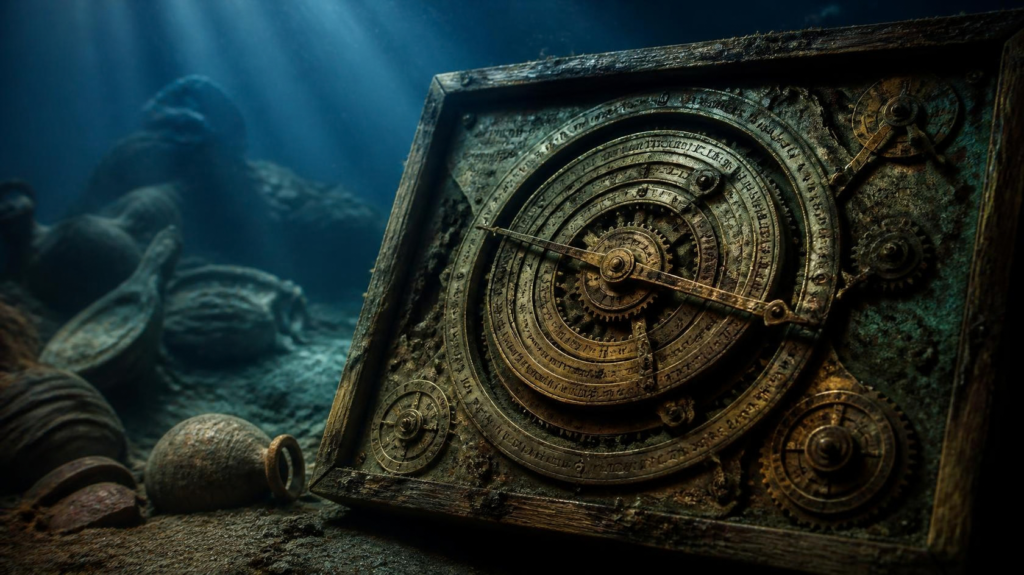
The Antikythera Mechanism: The Ancient Computer Lost Beneath the Sea
More than 2,000 years ago, long before electronic computers, smartphones, or even mechanical clocks became common, someone built a device filled with carefully arranged gears that could model movements in the sky.
It was not powered by electricity. It had no screen, no battery, and no digital display. Instead, it used bronze gears, pointers, scales, and mathematical relationships to track astronomical cycles.
This extraordinary object is known as the Antikythera Mechanism—and it was discovered not in an ancient library or royal palace, but inside a shipwreck beneath the Mediterranean Sea.
The device has become one of the most remarkable discoveries in the history of science because it suggests that ancient Greek engineers possessed a level of mechanical and astronomical knowledge far more advanced than many people once imagined.
A Strange Discovery Beneath the Mediterranean
The story began in 1900, when a group of sponge divers from the Greek island of Symi discovered the remains of an ancient shipwreck near the island of Antikythera, located between the Greek mainland and Crete.
The wreck contained an astonishing collection of objects, including statues, pottery, coins, jewellery, glassware, and other treasures. The ship was probably a Roman-era merchant vessel carrying valuable goods across the Mediterranean.
Among the objects recovered from the seabed was a heavily corroded lump of bronze and wood. At first, it did not appear particularly impressive. Compared with large marble statues and beautiful ancient artefacts, the damaged bronze object looked like little more than a mysterious piece of debris.
Its importance was not immediately understood.
In 1902, archaeologist Valerios Stais noticed that one of the fragments contained a gear wheel. That discovery changed the way researchers viewed the object. What first appeared to be an ordinary lump of corroded material was actually part of a sophisticated mechanical device.
The object became known as the Antikythera Mechanism, named after the island near which the shipwreck was found.
What Exactly Was the Antikythera Mechanism?
The Antikythera Mechanism was a hand-operated astronomical calculator made using bronze gears, axles, dials, pointers, and inscriptions.
It was probably constructed sometime during the second century BC, although the exact date remains uncertain. The ship carrying it sank around the first century BC, meaning the device was already an old and valuable object—or at least an object that had been in existence for some time—when it ended up on the seabed.
The mechanism was roughly the size of a modern shoebox. That may not sound particularly impressive today, but the complexity packed into such a small object was extraordinary for the ancient world.
Researchers have identified at least 30 bronze gears, while only a portion of the original device survives. The surviving remains are divided into several major fragments, with many smaller pieces broken away or lost.
The gears were not arranged randomly. They formed carefully designed systems that represented repeating cycles involving the Sun, Moon, calendars, eclipses, and possibly the known planets.
In simple terms, the device transformed astronomical knowledge into mechanical movement. Instead of merely writing down that a particular cycle repeated after a certain number of months or years, its makers created a machine that could represent those relationships physically.
Why Do People Call It the World’s First Computer?
The Antikythera Mechanism is often described as the world’s oldest known analogue computer.
That does not mean it was a computer in the modern electronic sense. It could not run software, connect to the internet, store digital files, or display photographs. It was an analogue computer because it used physical components to represent and calculate changing quantities.
Modern analogue computers can use electrical signals, rotating parts, or other continuously changing systems to model real-world processes. The Antikythera Mechanism did something similar using gears.
When a person turned a handle, the movement was transferred through a complicated arrangement of gear wheels. Each gear represented a mathematical relationship. A gear with one number of teeth turning against another gear with a different number of teeth could convert one cycle into another.
For example, a gear system could translate the length of a lunar cycle into a longer calendar cycle. Other arrangements could represent the repeating patterns associated with eclipses or the dates of major athletic festivals.
The device was therefore not simply a clock. It was a mechanical model of the heavens, designed to help people understand and predict astronomical patterns.
It Could Track the Moon
One of the most impressive functions of the Antikythera Mechanism was its ability to model the Moon’s movements.
The Moon does not complete its orbit around Earth in exactly the same amount of time that it takes to move from one identical phase to the next. Different lunar cycles have slightly different lengths, and ancient astronomers had to account for these differences when creating calendars.
The mechanism included systems that represented the Moon’s phases and its position within the lunar cycle. A small display on the front is believed to have shown whether the Moon was new, waxing, full, or waning.
Some reconstructions also include a small rotating lunar sphere, with one side light and the other dark, to show the changing appearance of the Moon.
The device went beyond a simple circular calendar. Its gearing appears to have represented the Moon’s irregular motion across the sky. The Moon does not move at a perfectly uniform speed because its orbit is elliptical rather than a perfect circle.
To reproduce this irregular movement mechanically, the mechanism used a clever arrangement involving a pin and slot. This allowed a rotating component to produce a changing speed, creating a physical model of the Moon’s uneven motion.
That is a remarkable achievement because it shows that the designers were not simply copying a basic repeating cycle. They were attempting to reproduce a more complicated astronomical behavior.
It Could Predict Eclipses
The Antikythera Mechanism could also predict the possibility of solar and lunar eclipses.
An eclipse occurs when the Sun, Earth, and Moon line up in a particular way. Solar eclipses happen when the Moon passes between Earth and the Sun. Lunar eclipses happen when Earth’s shadow falls across the Moon.
Eclipses do not happen every month because the Moon’s orbit is tilted relative to Earth’s orbit around the Sun. The necessary alignment occurs only during certain parts of the lunar cycle.
Ancient astronomers discovered that eclipses followed repeating patterns. The Antikythera Mechanism used one of these patterns, known as the Saros cycle.
The Saros cycle lasts approximately 18 years, 11 days, and 8 hours. After one Saros cycle, eclipses occur in a similar pattern, although the extra fraction of a day means that the next eclipse in the sequence is visible from a different part of Earth.
The mechanism’s back dial contained a spiral calendar representing a 223-lunar-month cycle. Markings on the dial indicated when eclipses were expected, and additional information could identify whether an eclipse would be solar or lunar.
This did not mean that the machine could predict every detail with the precision of a modern astronomical observatory. It was a practical representation of known repeating patterns, created using the astronomical knowledge available at the time.
Still, the ability to encode eclipse cycles into a compact mechanical device was extraordinary.
The Back of the Device Contained Giant Spiral Dials
The front of the Antikythera Mechanism displayed astronomical information, but the back contained two especially interesting spiral dials.
The upper back dial represented the Metonic cycle, a period of 19 years that closely matches 235 lunar months. Ancient calendar-makers used this relationship to reconcile lunar months with the solar year.
A lunar calendar is based on the phases of the Moon, while a solar calendar is based on the Earth’s journey around the Sun. These cycles do not fit together perfectly. A calendar based only on lunar months would gradually drift away from the seasons.
The Metonic cycle provided a useful way to bring the two systems back into alignment. Over a period of 19 solar years, the phases of the Moon occur on nearly the same dates.
The lower back dial represented the Saros eclipse cycle. Smaller subsidiary dials also appear to have tracked the timing of the Panhellenic Games, a group of major athletic festivals in the ancient Greek world.
These included the ancient Olympic Games and other important competitions. The mechanism may therefore have been useful not only for astronomy but also for organizing religious, political, and cultural life.
It May Have Displayed the Planets
One of the most intriguing aspects of the Antikythera Mechanism is the possibility that it displayed the positions of the known planets.
Ancient Greek astronomers recognized the visible planets as wandering objects in the sky. Unlike the fixed stars, planets appeared to move against the background of the zodiac.
The mechanism’s inscriptions contain references to astronomical bodies and planetary displays. Researchers have proposed that the front of the device originally included indicators for the Sun, Moon, and five planets visible to the naked eye: Mercury, Venus, Mars, Jupiter, and Saturn.
However, the surviving fragments do not preserve the entire front display. As a result, there is still uncertainty about exactly how the planetary system looked and how completely it worked.
Some reconstructions show a highly sophisticated planetarium-like arrangement. Others are more cautious, emphasizing that certain details remain hypothetical.
This is an important distinction. Researchers are confident that the mechanism was an astronomical calculator, but they are still debating some of its precise functions, appearance, and construction.
How Did the Gears Work?
The mechanism worked through a network of interlocking gears.
Each gear had a particular number of teeth. When one gear turned, it caused another gear to turn at a different speed. By combining many gears, the device could reproduce relationships between astronomical cycles.
Imagine a simple gear with 10 teeth connected to another gear with 20 teeth. When the smaller gear makes two complete turns, the larger gear makes one. This difference in speed can be used to represent different lengths of time.
The Antikythera Mechanism used this principle on a much more complicated scale.
Its designers also used special gear arrangements to reproduce irregular motion. The pin-and-slot mechanism associated with the Moon is especially famous because it could transform steady rotation into a movement that sped up and slowed down.
The device also contained inscriptions that helped explain its operation. These inscriptions were written in ancient Greek and included information about calendars, astronomical cycles, and the meaning of different displays.
The inscriptions were crucial because the surviving gears alone could not tell the complete story. By reading the text and studying the internal structure with modern imaging technology, researchers have been able to reconstruct more of the machine’s original purpose.
The Device Was Almost Lost to Corrosion
The Antikythera Mechanism survived for centuries beneath seawater, but the environment severely damaged it.
The bronze components corroded, and the original wooden case deteriorated. Over time, the mechanism broke into fragments and became covered with layers of mineral deposits and corrosion.
When the object was first recovered, researchers could not easily see the internal gears. The outer surface looked like a solid, damaged mass.
For decades, scientists studied the visible fragments using photography, careful examination, and X-ray techniques. The invention of more advanced imaging methods eventually changed everything.
X-ray imaging allowed researchers to look inside the corroded pieces without destroying them. Later, high-resolution computed tomography revealed hidden gears, inscriptions, and structural details that could not be seen from the outside.
Modern researchers have used these images to create digital reconstructions and working models. Each new scan has helped answer some questions while also revealing new mysteries.
The Antikythera Mechanism is therefore a rare example of archaeology and engineering working together. It is not only an ancient artefact; it is also a technical puzzle that modern scientists are still trying to solve.
Who Built the Antikythera Mechanism?
This remains one of the great unanswered questions.
The device was clearly made by people with advanced knowledge of astronomy, mathematics, metalworking, and mechanical engineering. But no surviving inscription identifies the individual craftsman or workshop with certainty.
Some researchers have suggested connections with important centres of ancient Greek science, including Rhodes, Corinth, and other locations in the Hellenistic world.
The astronomer Hipparchus, who worked on the island of Rhodes, is sometimes mentioned because the mechanism appears to reproduce aspects of lunar theory associated with his work. That does not prove that Hipparchus built the machine. It simply suggests that ideas developed by astronomers such as Hipparchus may have influenced its design.
Another popular theory connects the mechanism with the scientific tradition of Archimedes. Archimedes was famous for mathematics, astronomy, and mechanical inventions, and ancient writings describe devices that represented the movements of celestial bodies.
However, there is no reliable evidence that Archimedes himself made the Antikythera Mechanism. He lived earlier than the most likely construction date, and the exact maker remains unknown.
The most reasonable conclusion is that the device emerged from a broader Greek tradition of mathematical astronomy and mechanical craftsmanship. It may have been made by a highly skilled workshop whose name has been lost to history.
Why Was Such an Advanced Device Not Common?
The Antikythera Mechanism raises an even bigger historical question: if ancient engineers could build something so sophisticated, why did similar machines not become widespread?
The answer is not completely known.
Ancient Greek and Roman societies possessed advanced mathematical knowledge, skilled metalworkers, complex water-powered machines, and impressive architectural techniques. However, much of this knowledge was not preserved in a continuous technological tradition.
A device like the Antikythera Mechanism required several specialized skills to come together. Its maker needed to understand astronomical cycles, calculate gear ratios, manufacture small metal components, engrave inscriptions, and assemble everything accurately.
It is possible that other advanced devices existed but were lost, destroyed, or never discovered. The Antikythera Mechanism may be the surviving example of a larger tradition of ancient geared instruments.
It is also possible that such machines were rare luxury objects made for wealthy patrons, scientific institutions, or religious and political leaders. A complicated device that required considerable time and skill to build would not necessarily have been produced in large numbers.
Whatever the explanation, the mechanism reminds us that the archaeological record is incomplete. The objects that survive are not always a complete representation of what people in the past knew how to do.
Was It Used for Navigation?
Because the Antikythera Mechanism was found on a ship, some people assume that it must have been a navigation instrument.
However, the strongest evidence points to an astronomical and calendrical purpose rather than a practical navigation tool.
The mechanism appears to have been designed to calculate and display cycles involving the Sun, Moon, eclipses, calendars, and athletic festivals. It was not a compass, a map, or a device for directly determining a ship’s position.
That does not mean it had no connection with travel. Astronomical knowledge was important to ancient sailors, and the ship carrying the mechanism may have been transporting it to a wealthy customer or collector.
But the evidence does not support the idea that the mechanism was primarily a device for steering a ship across the Mediterranean.
It is better understood as a scientific instrument—a machine created to represent the structure and rhythm of the heavens.
The Antikythera Mechanism Changed Our View of Ancient Technology
Before its discovery and detailed study, many people imagined ancient technology as consisting mainly of simple tools, weapons, buildings, and basic machines.
The Antikythera Mechanism complicated that picture.
It showed that ancient engineers could combine theoretical astronomy with precision mechanical design. They could take abstract mathematical relationships and turn them into moving parts that displayed information.
The device also revealed that ancient science was not only about observing the sky and writing down descriptions. At least some ancient thinkers attempted to build physical models of astronomical systems.
That is a major intellectual achievement.
The mechanism also reminds us that technological progress is not always a straight line. A society can develop an astonishing invention and then lose the knowledge required to reproduce it. Political upheaval, war, changing priorities, the destruction of workshops, and the loss of written records can all interrupt technological traditions.
The Antikythera Mechanism may therefore represent both the brilliance of ancient engineering and the fragility of human knowledge.
A 2,000-Year-Old Message From the Past
The Antikythera Mechanism is fascinating because it connects several worlds that we usually imagine as separate.
It is an archaeological treasure, a scientific instrument, a mathematical puzzle, an engineering achievement, and a reminder of how much knowledge may have disappeared from history.
A person in the ancient world could turn a handle and watch pointers move across carefully marked dials. The device could represent the phases of the Moon, the timing of eclipses, the relationship between lunar and solar calendars, and perhaps the movements of the planets.
Today, we use computers and software to perform similar calculations in a fraction of a second. But the underlying idea is surprisingly familiar: represent the rules of the universe using a system that can calculate and display the results.
The Antikythera Mechanism proves that the history of computing did not begin with electricity. It began much earlier, with people who used mathematics, metal, and imagination to build a machine that could imitate the heavens.
And somewhere beneath the Mediterranean Sea, that machine waited nearly two thousand years before the modern world was ready to understand it.
Continue Your Journey
If you enjoyed exploring this ancient astronomical computer, continue your journey through history with another invention that transformed human knowledge: the printing press, the technology that helped books and ideas spread across the world.
Stay Curious with Trivialwiki
Follow Trivialwiki for more fascinating stories about science, history, technology, animals, geography, and the hidden facts behind the world around us.
- Facebook: https://facebook.com/Trivialwiki
- Instagram: https://instagram.com/trivialwiki
- YouTube: https://youtube.com/@trivialwiki
- Pinterest: https://pinterest.com/Trivialwiki
What do you think is more amazing—the astronomical knowledge behind the Antikythera Mechanism, or the engineering skill needed to build it more than 2,000 years ago? ⚙️
1 thought on “The Antikythera Mechanism: The Ancient Computer Lost Beneath the Sea”