
Imagine walking past a group of crows and noticing that one of them suddenly starts calling loudly. A few seconds later, several more appear, gathering on rooftops, electric wires, or tree branches. It may look like ordinary bird activity—but crows can be paying attention to something very specific: you.
Crows are among the most intelligent birds on Earth. They can solve puzzles, use tools, remember faces, recognize patterns, cooperate with one another, and even appear to understand cause and effect. Their intelligence is so remarkable that scientists often compare some of their abilities with those of great apes.
But what makes crows truly fascinating is not simply that they are clever. It is that they seem to remember experiences and use those memories later. A crow may learn that a particular person is dangerous, remember that person’s face for years, and warn other crows about the threat.
Let’s explore the surprisingly complex world of these intelligent black birds.
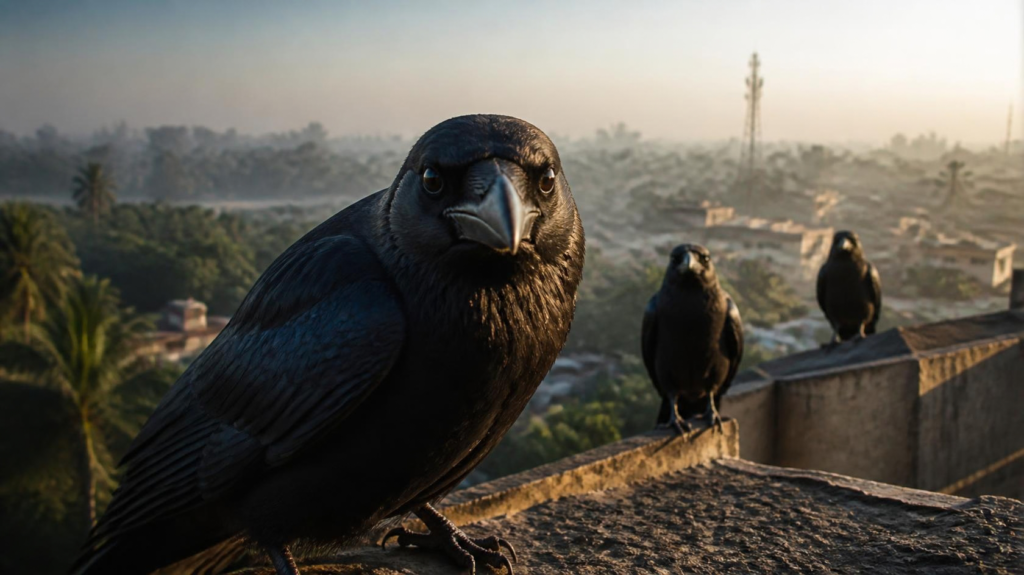
Crows: The Birds That Remember Human Faces
Imagine walking past a group of crows and noticing that one of them suddenly starts calling loudly. A few seconds later, several more appear, gathering on rooftops, electric wires, or tree branches. It may look like ordinary bird activity—but the crows may be responding to something very specific: you.
Crows are among the most intelligent birds on Earth. They can solve puzzles, use tools, recognize patterns, learn from one another, and remember important experiences. Their intelligence is so remarkable that scientists often compare some of their abilities with those of great apes.
But what makes crows truly fascinating is not simply that they are clever. It is that they can remember what happened in the past and use that memory later. A crow may learn that a particular person is dangerous, remember that person’s face for years, and even help other crows recognize the same threat.
Let’s explore the surprisingly complex world of these intelligent black birds.
A Bird That Can Recognize You
Many people assume that birds see humans as a collection of similar shapes. To a crow, however, individual people can be very different.
Researchers studying wild American crows discovered that the birds could learn to recognize the face of a person associated with danger. In the experiment, researchers wore a distinctive mask while capturing, tagging, and releasing crows. Afterward, the birds reacted strongly whenever they saw that same mask, even when it was worn by different people.
The response was not limited to the original researcher. The crows scolded and gathered around people of different heights, ages, and walking styles as long as they wore the threatening mask. This suggested that the birds were paying attention to the face itself rather than simply remembering a particular body shape or movement.
Even more surprising, the crows continued to recognize the threatening face for at least 2.7 years. That is an extraordinary memory for an animal that many people casually regard as just another city bird.
This ability may explain why crows sometimes seem to hold grudges. A person who has frightened, trapped, or harmed a crow may continue to receive hostile calls from the bird long after the original event has ended.
Of course, the crow is not necessarily thinking about revenge in the human sense. It is more accurate to say that the bird has learned to associate a particular visual appearance with danger. Remembering that appearance helps it avoid repeating a potentially harmful experience.
Crows Can Teach Other Crows About Dangerous People
The story becomes even more interesting because crows do not always need to experience danger personally.
In another study, researchers found evidence that crows can learn about dangerous humans through social information. When one crow discovers that a particular person is a threat, other crows nearby may observe the reaction and begin responding to that person as well.
This is a useful survival strategy. Learning directly can be risky. A crow that approaches a dangerous person to discover whether the person is safe may pay a heavy price for that mistake. Watching another crow react provides information without requiring the observer to experience the danger firsthand.
This kind of learning is sometimes described as social learning. It means that an animal can gain knowledge by watching the behavior of others rather than relying only on personal experience.
In a crow community, information about danger can therefore spread from one bird to many. A single frightening encounter may become a lesson remembered by an entire group.
Their Intelligence Is Not Just About Memory
Crows are famous for their memory, but their abilities go far beyond recognizing faces.
Some species of crows use tools to obtain food. The best-known example is the New Caledonian crow, which can shape plant material into hooks or probes to pull insects and other food items from difficult-to-reach places.
Using a tool is impressive by itself, but some New Caledonian crows can use several tools in sequence. In laboratory experiments, researchers tested crows on tasks that required them to use up to three different tools to reach food. The birds had to perform a series of actions rather than simply pick up one object and use it immediately.
This suggests that crow intelligence includes more than instinctive behavior. It involves learning, flexibility, and an ability to respond to a problem based on the objects and conditions available.
A crow does not necessarily plan in exactly the same way a human does, and scientists are careful not to assume that animal intelligence is identical to human intelligence. Still, the ability to manipulate objects, select tools, and complete multi-step tasks shows that these birds are capable of surprisingly sophisticated behavior.
Crows Understand That Objects Can Be Useful
A crow looking at a stick may not see it as just a stick.
Depending on the situation, it may recognize that the object can be used to reach food, move something, or investigate a hidden space. This ability to understand that an ordinary object can serve a purpose is an important part of problem-solving.
Crows have also been observed bending, shaping, and modifying materials. In the wild, New Caledonian crows may use leaves, twigs, and plant fibers as tools. The exact technique varies depending on the task, but the basic principle is remarkably familiar: find or create an object that helps solve a problem.
This is one reason crows are often discussed in studies of animal cognition. They demonstrate that advanced problem-solving did not evolve only in mammals. Birds, despite having very different brains from humans, can also develop complex ways of interacting with the world.
Do Crows Really Understand Human Faces?
The answer is yes—but with an important scientific qualification.
Research has shown that crows can distinguish between human faces and associate particular faces with positive or negative experiences. Brain-imaging studies found that different regions of a crow’s brain became active when the birds saw faces associated with capture compared with faces associated with feeding and care.
Threatening faces activated brain systems connected with attention, fear, motivation, and escape behavior. Caring faces activated regions associated with positive learned associations and motivation. This means that crows do not merely see a face as a neutral picture. They can connect that visual information with what happened during previous encounters.
However, scientists do not claim that crows process faces exactly as humans do. Humans have a specialized way of recognizing faces, and experiments suggest that crows may rely on a combination of facial details, color, body shape, and other visual cues.
In one study involving jungle crows, the birds learned to distinguish photographs of human faces according to sex. Color appeared to be especially important, although some birds also used facial contours and other features.
So, when a crow recognizes a person, it may not be using only the same face-processing system that humans use. Instead, it may combine several visual clues into a reliable memory of that individual.
Crows Pay Attention to Where You Look
Crows may also pay attention to human eye contact.
Researchers studying wild American crows compared how the birds reacted when a person approached while looking directly at them versus looking away. The crows generally fled sooner and showed a more urgent escape response when the person was looking directly at them.
This suggests that crows may treat a person’s gaze as useful information. A human who is staring directly at a crow may be more likely to notice, approach, or threaten it than someone who is looking elsewhere.
Interestingly, the same study found that the crows did not respond as differently to smiling and scowling facial expressions as they did to direct versus averted gaze. In other words, the direction of a person’s attention appeared to be a more reliable signal than the emotional expression on the person’s face.
This is especially useful for birds living in cities, where humans are everywhere. Understanding whether a person is paying attention can help a crow decide whether to remain nearby, move away, or return later.
Why Are Crows So Intelligent?
There is no single reason why crows developed such impressive abilities. Their intelligence likely comes from a combination of factors.
First, many crows are highly social. They live, feed, communicate, and sometimes cooperate around other crows. Social living creates pressure to remember individuals, understand relationships, recognize danger, and learn from others.
Second, crows are flexible feeders. They eat a wide range of foods and often live in changing environments. A crow may need to search through soil, open a container, investigate rubbish, find insects, or take advantage of food left by humans. Being able to adapt to new situations is valuable when food sources are unpredictable.
Third, crows have relatively large brains for birds, especially in regions associated with learning, memory, and problem-solving. Their brains are organized differently from mammalian brains, but different biological structures can still produce complex cognitive abilities.
Finally, crows are long-lived compared with many other birds. Remembering useful information over long periods can provide a major survival advantage. Knowing which places contain food, which animals are dangerous, and which humans should be avoided can make a real difference.
Are Crows Actually Smarter Than Dogs or Monkeys?
It is tempting to ask whether crows are smarter than dogs, cats, monkeys, or even humans. But intelligence is not one simple ability that can be measured with a single score.
A dog may be excellent at understanding human gestures and social signals. A monkey may be highly skilled at manipulating objects. A crow may be especially good at remembering faces, solving physical problems, or using tools.
These abilities evolved in response to different lifestyles and environments. Comparing them directly is difficult because each species has different strengths.
What scientists can say is that crows show several abilities once thought to be especially associated with primates. These include flexible problem-solving, tool use, social learning, memory, and the ability to use information from previous experiences.
That makes crows a powerful reminder that intelligence has evolved in more than one branch of the animal kingdom.
The Crow Community Is More Complex Than It Looks
A group of crows gathered on a rooftop may appear noisy and chaotic, but their behavior can involve communication and social information.
Crows use a wide range of calls, and their vocal behavior can change depending on the situation. A crow may call to attract other birds, warn of danger, defend food, or respond to another crow.
When several crows gather around a predator or threatening person, they may engage in a behavior called mobbing. This involves approaching, calling at, and sometimes flying around the threat in an attempt to drive it away.
Mobbing can serve several purposes. It may warn other birds, make the predator uncomfortable, and reduce the chance that the predator can approach unnoticed. It also allows other crows to learn about the danger.
The result is a kind of shared awareness. One crow notices something important, and the rest of the group may quickly become involved.
What Should You Do If Crows Remember You?
If crows repeatedly call at you, fly near you, or gather when you pass, they may have learned to associate you with something unpleasant. This does not mean that they are plotting against you, but it does mean that they may remember your appearance.
The safest response is to avoid threatening them, their nests, or their young. Do not throw stones, chase them, disturb nesting areas, or attempt to capture them. If a crow is reacting defensively, give it space and move away calmly.
It is also worth remembering that crows may be reacting to something other than your face. They could be defending a nest, protecting food, responding to a nearby predator, or reacting to a sudden movement.
In most cases, simply leaving the birds alone is enough.
The Bigger Lesson From Crows
Crows challenge the old idea that intelligence belongs mainly to humans and a few closely related mammals.
They can remember individual people, learn from experience, share information about danger, use tools, and adapt their behavior to changing situations. Their brains are not built like ours, yet they have developed abilities that can look surprisingly familiar.
The next time you see a crow sitting quietly on a wall or watching you from a tree, it may be doing much more than simply resting. It could be observing the world, remembering what happened yesterday, learning from another crow, or deciding whether you are worth watching.
And if it suddenly starts calling as you walk past, perhaps you have just become part of its memory.
Continue Your Journey
If you enjoyed discovering how crows use intelligence and memory, continue exploring another remarkable animal: the Arctic Tern, the bird that travels between the Arctic and Antarctic during its incredible annual migration.
Stay Curious with Trivialwiki
Follow Trivialwiki for more fascinating stories about animals, science, history, technology, everyday objects, and the hidden facts behind the world around us.
- Facebook: https://facebook.com/Trivialwiki
- Instagram: https://instagram.com/trivialwiki
- YouTube: https://youtube.com/@trivialwiki
- Pinterest: https://pinterest.com/Trivialwiki
What do you think—are crows simply clever birds, or could they be among the most intelligent animals living alongside humans? 🐦
Great