
Imagine dropping a stone into a lake.
It sinks.
Drop a metal object into the same water, and it sinks too.
Most substances become denser when they freeze. Solid forms are usually heavier and more compact than their liquid counterparts. That’s why solid rock sinks into molten rock and why most frozen materials occupy less space than they did as liquids.
Water, however, does something extraordinary.
When water freezes, it becomes less dense, causing ice to float.
At first glance, this may seem like a trivial scientific curiosity. After all, we’re used to seeing ice cubes floating in a glass or icebergs drifting across the ocean.
Yet this simple phenomenon is one of the most important reasons life can exist on Earth as we know it.
If ice behaved like most other substances, our planet would be a very different place.
🧪 The Rule That Water Breaks
In most materials, molecules move closer together as temperatures fall.
As a liquid cools, its particles lose energy and pack more tightly together. When the substance freezes, the molecules lock into a dense solid structure.
This is why solid materials are usually heavier per unit volume than their liquid forms.
Water refuses to follow this rule.
As liquid water cools, its molecules initially move closer together just like most substances. But something unusual happens as the temperature approaches freezing.
Instead of continuing to become denser, water begins expanding.
This strange behavior is the key to understanding why ice floats.
⚛️ The Secret Lies in Water Molecules
A water molecule is deceptively simple.
Each molecule consists of:
- two hydrogen atoms
- one oxygen atom
Together, they form the familiar chemical formula H₂O.
What makes water special is how these molecules interact with one another.
Water molecules attract each other through forces known as hydrogen bonds.
When water freezes, these bonds arrange the molecules into a rigid crystal structure.
Unlike the tightly packed arrangement found in many solids, this crystal structure contains tiny open spaces between molecules.
The result is a solid that occupies more volume than the liquid it came from.
In simple terms, frozen water spreads out.
🧊 Why Ice Is Less Dense
Because the molecules in ice are spaced farther apart, the same amount of water occupies more space when frozen.
This expansion reduces density.
Density is simply a measure of how much mass exists within a given volume.
Since ice has lower density than liquid water, it floats.
The effect is easy to observe.
Place an ice cube in a glass of water and only part of it remains above the surface. Most of the ice stays submerged because it is still relatively close in density to liquid water.
The same principle allows enormous icebergs to float in polar oceans.
What seems ordinary is actually one of nature’s most unusual behaviors.
🌊 Lakes Would Freeze from the Bottom Up
To understand why floating ice matters, imagine a world where ice sank.
During winter, the surface water of a lake would cool and freeze.
Instead of floating, the ice would sink to the bottom.
New surface water would then freeze and sink as well.
Over time, layer after layer of ice would accumulate.
Many lakes would eventually freeze solid from the bottom upward.
In colder regions, some bodies of water might never completely thaw.
This would create enormous problems for aquatic life.
Fish, plants, and countless microorganisms would struggle to survive.
Entire ecosystems could collapse.
🐟 Floating Ice Protects Life
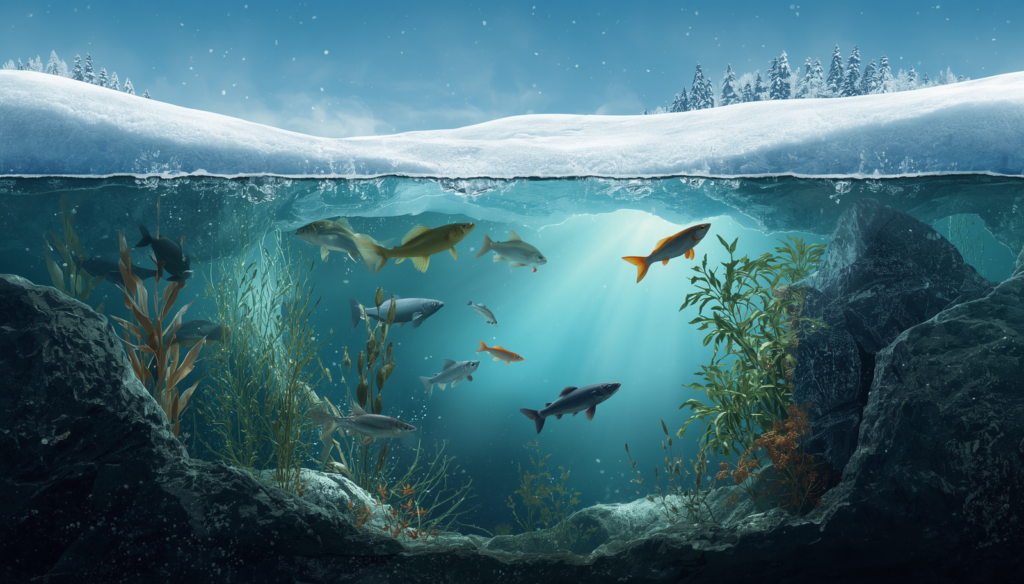
Fortunately, ice remains on the surface.
When a lake freezes, the floating ice forms a protective layer.
This layer acts as insulation, slowing the loss of heat from the water below.
As a result, liquid water often remains beneath the ice even during extremely cold winters.
Fish continue swimming.
Plants continue surviving.
Microorganisms continue carrying out essential biological processes.
The lake remains alive beneath its frozen surface.
Without floating ice, many freshwater ecosystems would not survive seasonal freezing.
🌍 A Planet-Shaping Property
The impact extends far beyond lakes and ponds.
Floating sea ice plays an important role in Earth’s climate system.
Ice reflects a large portion of incoming sunlight back into space, helping regulate global temperatures.
Scientists refer to this reflective property as albedo.
The bright surfaces of polar ice help prevent excessive warming.
Changes in ice coverage can influence weather patterns, ocean circulation, and climate conditions around the world.
A simple molecular quirk affects the entire planet.
🏔️ The Story of Icebergs
Icebergs provide one of the most dramatic examples of floating ice.
These enormous blocks break away from glaciers and drift across oceans.
Only a small portion is visible above the surface.
The majority remains hidden underwater.
This phenomenon gave rise to the famous expression “tip of the iceberg.”
The visible section represents only a fraction of the whole structure.
Although icebergs may appear serene, they are powerful reminders of water’s unusual properties.
If ice were denser, these giant frozen mountains would plunge to the ocean floor instead.
🚀 Water’s Other Strange Behaviors
Ice floating is only one of water’s many unusual characteristics.
Water can:
- absorb large amounts of heat
- dissolve countless substances
- exist naturally as a solid, liquid, and gas
- support complex chemical reactions essential for life
These properties make water one of the most important substances in the universe.
Scientists searching for life beyond Earth often focus on finding liquid water because it plays such a central role in biological systems.
In many ways, water is far stranger than it appears.
🔬 A Discovery Hidden in Everyday Life
One reason the floating-ice phenomenon is so fascinating is that it hides in plain sight.
People encounter it constantly:
- in drinks
- in freezers
- on winter lakes
- in snowy landscapes
Because it is familiar, we rarely stop to consider how unusual it truly is.
Many of the most important scientific principles are like this.
They surround us every day yet remain largely unnoticed.
Water’s behavior is a perfect example.
💡 The Tiny Quirk That Helped Life Thrive
Some scientific discoveries involve distant galaxies or exotic particles.
Others can be observed in a simple glass of water.
The fact that ice floats may seem insignificant, but it has shaped ecosystems, influenced climate, and helped make Earth habitable.
If frozen water sank, countless lakes, rivers, and oceans would behave differently.
The history of life itself might have taken a very different path.
Sometimes the most important features of our world are also the easiest to overlook.
The next time you drop an ice cube into a drink, remember that you’re witnessing one of nature’s most extraordinary exceptions—a tiny molecular quirk that helped make life possible.
❄️ Keep Exploring
If you enjoyed uncovering the surprising science hidden in everyday life, don’t miss our previous post:
👉 Why Do We Hiccup? The Mystery Science Still Hasn’t Solved
Discover why one of the human body’s most common reflexes continues to puzzle scientists and what it might reveal about our evolutionary past.
📬 Stay Connected with Trivialwiki
👉 Facebook: https://facebook.com/Trivialwiki
👉 Instagram: https://instagram.com/trivialwiki
👉 YouTube: https://youtube.com/@trivialwiki
👉 Pinterest: https://pinterest.com/Trivialwiki
Learn. Explore. Discover.
Ice floating on water seems completely ordinary, yet it is one of the most important reasons life thrives on Earth. What other everyday phenomenon do you think hides an amazing scientific story? Share your thoughts in the comments! ❄️🌍
1 thought on “Why Ice Floats: The Strange Quirk That Makes Life Possible”