
For much of modern history, the value of money was tied directly to something tangible.
Not trust.
Not government policy.
But gold.
Under a system known as the gold standard, countries linked their currencies to a specific amount of gold. Paper money could, in theory, be exchanged for actual gold held in national reserves.
This system shaped international trade, financial stability, and economic policy for decades. For a time, it provided the foundation of the global monetary system.
But eventually, the world moved away from it.
Understanding the gold standard reveals how money once worked — and why the global financial system looks very different today.
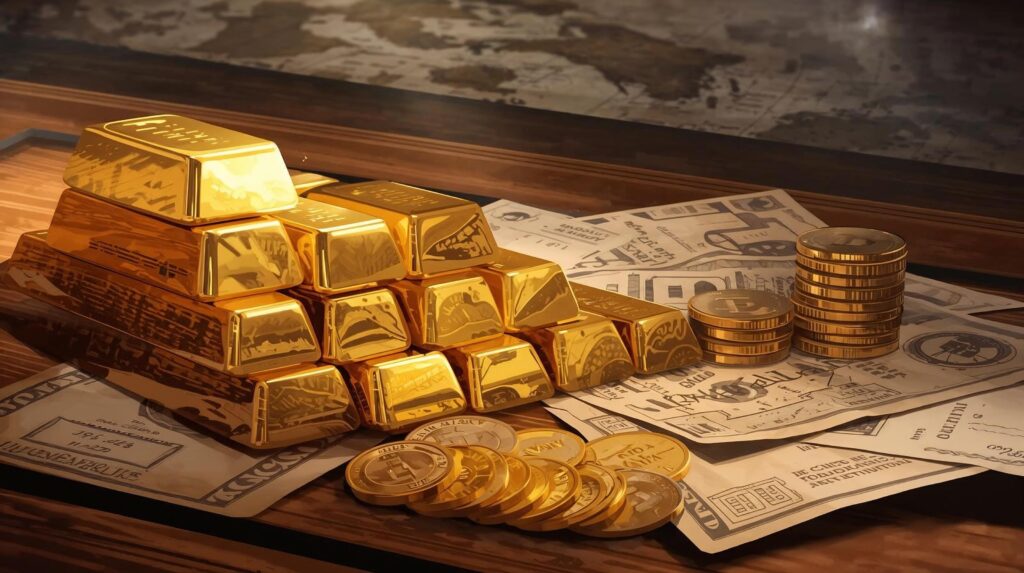
🪙 What Exactly Was the Gold Standard?
The gold standard was a monetary system in which a country’s currency had a fixed value based on gold.
Governments agreed to convert paper currency into a specific amount of gold on demand. This meant that every unit of currency represented a certain quantity of the precious metal.
For example, if a country declared that one unit of its currency equaled a certain weight of gold, the government needed to hold enough gold reserves to back the money in circulation.
This connection between money and gold helped establish trust in currencies.
People believed their paper money had real value because it could be exchanged for something tangible.
🌍 How the Gold Standard Spread Around the World
The modern gold standard began taking shape in the 19th century, with Britain leading the way.
As the British Empire expanded and international trade increased, linking currency to gold helped stabilize exchange rates between nations.
Other countries gradually adopted the system, including major economies such as:
– Germany
– France
– The United States
– Japan
By the late 1800s, much of the global economy operated under some version of the gold standard.
Because currencies were tied to gold, exchange rates between countries became relatively predictable.
This stability encouraged international trade and investment.
⚖️ The Benefits of a Gold-Based System
Supporters of the gold standard believed it offered several important advantages.
First, it limited inflation. Since governments could not print unlimited money without increasing their gold reserves, the system restrained excessive currency creation.
Second, it provided stable exchange rates between countries, which made global trade easier.
Third, it created confidence in money, because currencies were backed by a physical commodity that had long been valued across cultures.
For decades, the gold standard was seen as a symbol of financial discipline.
⚠️ The System’s Hidden Challenges
Despite its stability, the gold standard had significant drawbacks.
One major problem was that the supply of money depended heavily on the supply of gold. If gold production did not grow quickly enough, economies could struggle with limited money circulation.
This sometimes led to deflation, where prices and wages fell, making economic recovery difficult during downturns.
Another issue was flexibility. Governments had limited ability to adjust monetary policy during financial crises because they were bound by the amount of gold they possessed.
In times of economic stress, this rigidity could worsen problems instead of solving them.
📉 The Gold Standard and the Great Depression
The weaknesses of the gold standard became especially clear during the Great Depression of the 1930s.
As economies collapsed and unemployment rose, governments needed to stimulate their economies by increasing money supply and lowering interest rates.
But the gold standard restricted these actions.
Countries that remained tied to gold often found it harder to recover economically.
As a result, many nations began abandoning the system in the 1930s to gain more control over their financial policies.
🇺🇸 The End of the Gold Standard
Even after many countries left the traditional gold standard, gold continued to influence the global financial system.
Following World War II, the Bretton Woods system linked international currencies to the U.S. dollar, and the dollar itself remained convertible to gold.
But this system eventually faced growing pressure.
In 1971, U.S. President Richard Nixon announced that the United States would no longer convert dollars into gold.
This decision effectively ended the last major link between global currencies and gold.
From that moment onward, most currencies became fiat money, meaning their value is based on government authority and economic trust rather than a physical commodity.
💰 The Modern Monetary System
Today, nearly all currencies operate without direct backing by gold or other precious metals.
Their value depends on factors such as:
– Economic performance
– Government policies
– Central bank decisions
– Public confidence
While gold still plays a role in financial markets and national reserves, it no longer determines the value of everyday currency.
The global monetary system has become far more flexible — but also more complex.
💡 A Golden Chapter in Financial History
The gold standard remains one of the most influential systems in the history of money.
For nearly a century, it shaped how nations managed their currencies and interacted through global trade.
Its rise and fall reveal how financial systems evolve as economies grow and change.
Though the world has moved beyond gold-backed currencies, the legacy of the gold standard continues to influence debates about economic stability and monetary policy.
Sometimes the past still shapes how we think about money today.
Continue Exploring on Trivialwiki
If you enjoyed learning about the history of global monetary systems, don’t miss our previous post:
👉 The Library of Alexandria and the Greatest Lost Knowledge in History
Explore the legendary ancient library that once attempted to gather all knowledge of the known world.
📬 Stay Connected with Trivialwiki
👉 Facebook: https://facebook.com/Trivialwiki
👉 Instagram: https://instagram.com/trivialwiki
👉 YouTube: https://youtube.com/@trivialwiki
👉 Pinterest: https://pinterest.com/Trivialwiki
Learn. Explore. Discover.
The gold standard once tied money to precious metal — do you think modern currencies should still be backed by gold, or is today’s system better? Share your thoughts in the comments! 💰
1 thought on “The Gold Standard and the System That Once Controlled Global Money”