
When you sit inside a commercial airplane cruising at 35,000 feet, it’s natural to wonder:
Who is actually flying the plane?
Many passengers imagine pilots constantly controlling the aircraft manually. Others assume the plane is flying entirely on its own.
The truth lies somewhere in between.
Modern aircraft rely heavily on a system called autopilot — a sophisticated technology that can control many aspects of flight. But despite its capabilities, it does not replace pilots.
Instead, autopilot works as a powerful assistant, helping pilots manage complex flights safely and efficiently.
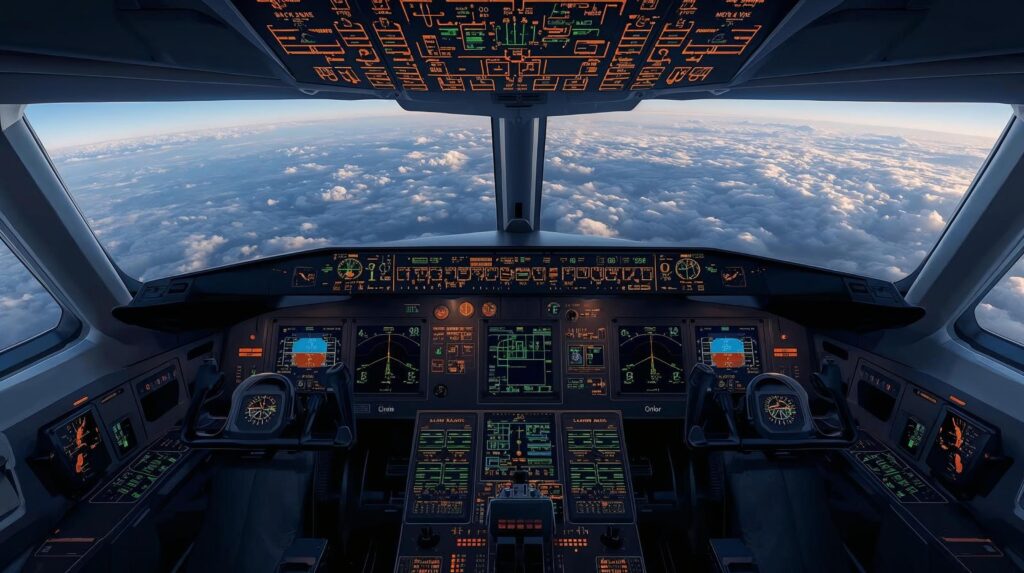
✈️ What Is Autopilot?
Autopilot is a system that allows an aircraft to control its flight automatically under the supervision of pilots.
It can manage:
– altitude
– direction (heading)
– speed
– climb and descent
– navigation along a planned route
Instead of constantly adjusting controls manually, pilots can set desired parameters, and the autopilot maintains them with high precision.
This reduces workload, especially during long flights.
🧠 How Autopilot Works
Autopilot systems rely on a combination of sensors, computers, and control mechanisms.
They continuously receive data from:
– gyroscopes and inertial systems (to detect orientation)
– altimeters (to measure altitude)
– airspeed indicators
– GPS and navigation systems
Using this data, onboard computers calculate how the aircraft should move and send commands to control surfaces such as:
– ailerons (for turning)
– elevators (for climbing or descending)
– rudder (for directional stability)
These adjustments happen many times per second, allowing the aircraft to maintain stable flight.
🛫 When Autopilot Is Used
Autopilot is typically used during the cruise phase of a flight, when the aircraft is flying at a steady altitude over long distances.
It can also assist during:
– climb after takeoff
– descent toward landing
– navigation along complex routes
However, pilots are always in control and can disengage autopilot at any time.
🛬 Can Autopilot Land a Plane?
In some cases, yes.
Many modern aircraft are equipped with autoland systems, which can guide an aircraft during landing under specific conditions, especially in low visibility.
These systems use signals from ground-based navigation equipment to align the aircraft precisely with the runway.
However, even when autoland is used, pilots monitor the process closely and are ready to take control if needed.
👨✈️ Why Pilots Are Still Essential
Despite its advanced capabilities, autopilot does not replace pilots.
Pilots are responsible for:
– making decisions during unexpected situations
– handling emergencies
– communicating with air traffic control
– monitoring weather and conditions
– managing takeoff and many landing scenarios
Autopilot follows instructions, but it cannot think, adapt, or respond creatively like a human pilot.
In aviation, human judgment remains critical.
⚙️ The Evolution of Autopilot
Autopilot systems have evolved significantly over time.
The first basic autopilot system was introduced in 1912, designed simply to keep an aircraft flying straight and level.
Over the decades, technology improved with the development of:
– analog control systems
– digital flight computers
– satellite navigation
Today’s autopilot systems are highly advanced, capable of managing complex flight paths with incredible precision.
🌍 Making Long Flights Possible
Modern air travel would be far more difficult without autopilot.
Long-haul flights lasting 10 to 15 hours would place enormous strain on pilots if they had to control the aircraft manually the entire time.
Autopilot reduces fatigue, allowing pilots to focus on monitoring systems and planning rather than constant manual control.
This makes flights safer and more efficient.
🧩 A System That Works with Humans
Autopilot is best understood not as a replacement for pilots, but as part of a larger system where humans and machines work together.
The system handles repetitive and precise tasks.
Pilots handle judgment, decision-making, and unexpected situations.
This combination creates one of the safest forms of transportation in the world.
💡 Not Self-Flying, but Smart Assistance
Despite popular belief, airplanes are not fully self-flying machines.
Autopilot is a powerful tool — but it still depends on human input, supervision, and control.
It represents a balance between automation and human expertise.
A system that doesn’t replace the pilot, but supports them.
And together, they keep millions of passengers traveling safely across the skies every day.
Continue Exploring on Trivialwiki
If you enjoyed learning about the hidden systems behind aviation, don’t miss our previous post:
👉 “Deadline” and the Word That Came from Prison Camps
Discover the surprising and serious origins behind a word we use in everyday life.
📬 Stay Connected with Trivialwiki
👉 Facebook: https://facebook.com/Trivialwiki
👉 Instagram: https://instagram.com/trivialwiki
👉 YouTube: https://youtube.com/@trivialwiki
👉 Pinterest: https://pinterest.com/Trivialwiki
Learn. Explore. Discover.
Autopilot helps fly modern aircraft with precision — would you feel comfortable flying in a fully automated plane in the future? Share your thoughts in the comments! ✈️
1 thought on “Autopilot and the System That Flies Modern Aircraft”