
More than two thousand years ago, a city on the Mediterranean coast held what may have been the greatest collection of knowledge the world had ever seen.
Inside a grand complex of halls and scroll-filled rooms stood the Library of Alexandria, a place where scholars gathered to study mathematics, astronomy, philosophy, medicine, literature, and countless other subjects.
It was not simply a library. It was a center of learning that aimed to collect all the knowledge of the ancient world.
Yet today, none of its vast collection remains.
The story of the Library of Alexandria is both inspiring and tragic — a reminder of how much knowledge humanity once gathered, and how much may have been lost.
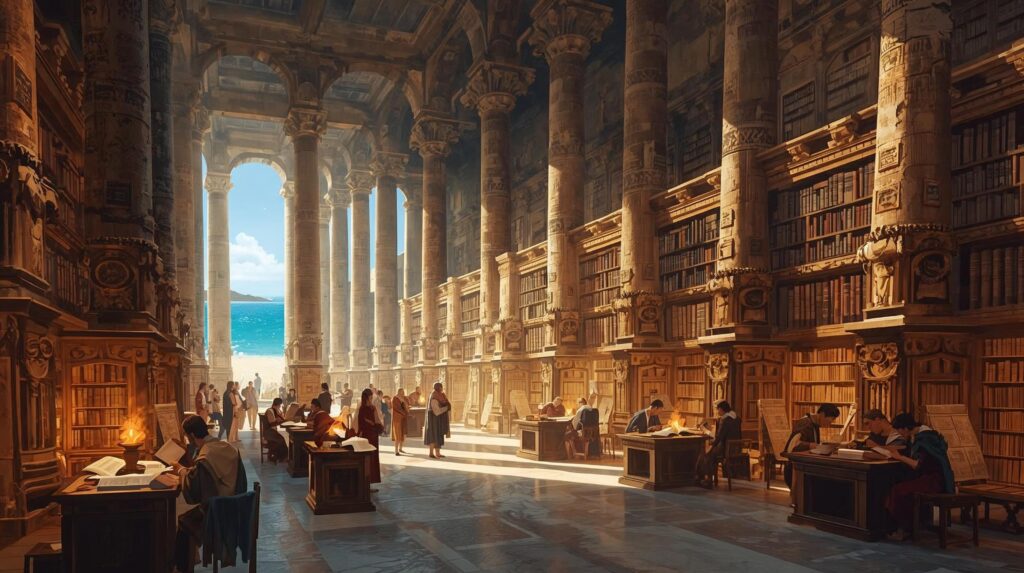
🏛️ A Library Built for the World
The Library of Alexandria was founded in the 3rd century BCE during the rule of the Ptolemaic dynasty, the Greek rulers who governed Egypt after the death of Alexander the Great.
The city of Alexandria itself had been founded by Alexander in 331 BCE, quickly becoming one of the most important cultural centers of the ancient world.
The rulers of Egypt wanted the city to become a global hub of learning.
Their vision was ambitious: to gather every important text from across the known world and store it in one place.
Ships arriving in Alexandria’s busy harbor were sometimes searched for books, which were copied by scribes before the originals were added to the library’s collection.
Over time, the library reportedly accumulated hundreds of thousands of scrolls.
📜 A Treasure of Ancient Knowledge
The scrolls housed in the library came from many civilizations.
Greek philosophers, Egyptian historians, Persian scholars, and writers from across the Mediterranean contributed to the growing collection.
Among the subjects studied were:
– Astronomy and the movement of stars
– Mathematics and geometry
– Medicine and anatomy
– Philosophy and ethics
– Poetry and literature
– Geography and navigation
Some scholars believe the library may have contained up to 400,000 scrolls, though exact numbers remain uncertain.
For the ancient world, it was an intellectual treasure beyond comparison.
🧠 A Center for Scholars
The Library of Alexandria was closely connected to an institution called the Mouseion, which functioned somewhat like an ancient university.
Scholars from across the Mediterranean traveled to Alexandria to live, study, and teach.
They were often supported by the royal court, allowing them to focus entirely on research and scholarship.
Some of the greatest thinkers of antiquity worked there.
For example:
– Euclid, whose work shaped modern geometry
– Eratosthenes, who calculated the circumference of the Earth with remarkable accuracy
– Archimedes, one of the greatest mathematicians in history
The library became a meeting place for ideas that shaped science and philosophy for centuries.
🔥 The Mystery of Its Destruction
One of the most debated questions in history is how the Library of Alexandria was destroyed.
Contrary to popular belief, there was probably no single catastrophic event that wiped it out overnight.
Instead, historians believe the library declined gradually through several incidents over centuries.
One possible cause occurred in 48 BCE, when Julius Caesar’s troops accidentally set fires in the harbor area during a conflict in Alexandria. Some ancient writers claim these fires damaged parts of the library.
Later political turmoil, wars, and changing rulers may have further weakened the institution.
By the late Roman period, the great library had likely disappeared.
📚 Knowledge That May Have Been Lost
Because most of the scrolls were destroyed or scattered, historians can only guess what knowledge might have been lost.
Ancient works in science, mathematics, literature, and history may have vanished forever.
Some lost texts might have included:
– Early scientific discoveries
– Historical records of ancient civilizations
– Works by philosophers whose writings no longer survive
– Mathematical theories centuries ahead of their time
It is impossible to know exactly what disappeared.
That mystery is part of what makes the story so compelling.
🌍 A Symbol of Humanity’s Quest for Knowledge
Even though the original library is gone, its legacy lives on.
The Library of Alexandria has become a powerful symbol of humanity’s desire to gather, preserve, and share knowledge.
Modern libraries, universities, and digital archives all continue that mission.
In fact, a modern cultural institution called the Bibliotheca Alexandrina was opened in Alexandria in 2002, honoring the spirit of the ancient library.
While it cannot restore what was lost, it celebrates the same pursuit of learning.
💡 The Fragility of Knowledge
The story of the Library of Alexandria reminds us that knowledge is not permanent unless it is preserved and shared.
Books can burn. Scrolls can decay. Entire collections can disappear through conflict or neglect.
Throughout history, civilizations have repeatedly faced the challenge of protecting knowledge for future generations.
Today, digital technology allows us to store vast amounts of information — but preservation remains just as important as ever.
Continue Exploring on Trivialwiki
If you enjoyed learning about one of history’s greatest centers of knowledge, don’t miss our previous post:
👉 The Tour de France and the World’s Toughest Cycling Race
Discover the incredible endurance and history behind the world’s most famous cycling competition.
📬 Stay Connected with Trivialwiki
👉 Facebook: https://facebook.com/Trivialwiki
👉 Instagram: https://instagram.com/trivialwiki
👉 YouTube: https://youtube.com/@trivialwiki
👉 Pinterest: https://pinterest.com/Trivialwiki
Learn. Explore. Discover.
The Library of Alexandria may have contained hundreds of thousands of ancient scrolls — what discovery do you think historians would most hope to recover from that lost collection? Share your thoughts in the comments! 📚
1 thought on “The Library of Alexandria and the Greatest Lost Knowledge in History”