
If you’ve ever tried to sign up for a website, post a comment, or log into an account, you’ve probably encountered a small test asking you to prove something unusual.
Not your name.
Not your password.
But that you are human.
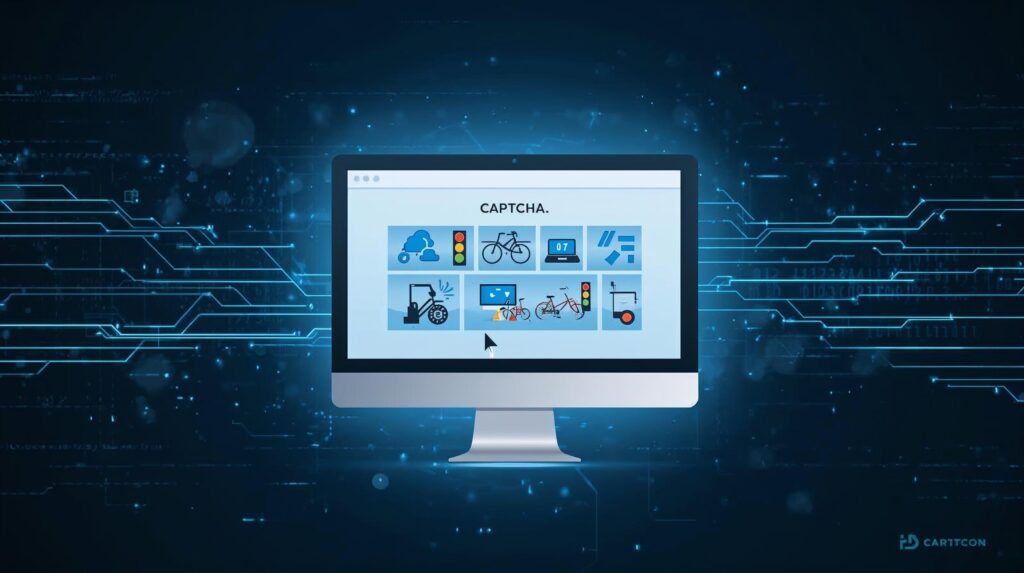
These little puzzles — clicking traffic lights, typing distorted letters, or selecting certain images — are known as CAPTCHAs. They appear all over the internet and serve a simple but crucial purpose: preventing automated programs from abusing online systems.
Behind these quick tests lies a fascinating story about cybersecurity, artificial intelligence, and the constant battle between humans and machines.
🤖 Why the Internet Needs Human Tests
The internet is full of automated programs called bots.
Some bots are helpful — search engine crawlers, for example, scan websites to index pages for search results. But many bots are harmful.
Malicious bots can:
– Create thousands of fake accounts
– Send spam messages
– Attempt password attacks
– Overload websites with traffic
– Manipulate online polls or forms
Because bots can operate much faster than humans, they can cause enormous disruption if left unchecked.
CAPTCHAs help websites determine whether a visitor is a real person or an automated program.
🔤 What CAPTCHA Actually Means
The word CAPTCHA is actually an acronym.
It stands for:
Completely Automated Public Turing test to tell Computers and Humans Apart.
The name refers to the famous Turing Test, proposed by computer scientist Alan Turing, which evaluates whether a machine can imitate human behavior convincingly.
CAPTCHAs work in the opposite direction — instead of testing whether a computer can act human, they test whether a user is human rather than a computer.
🧠 The First CAPTCHA Tests
The earliest CAPTCHAs appeared in the early 2000s.
They usually showed distorted letters and numbers that users had to type correctly into a box. Humans could read the characters despite the distortions, but computer programs struggled to interpret them.
This simple challenge proved surprisingly effective at blocking automated spam programs.
However, as artificial intelligence improved, bots gradually became better at recognizing text in images.
The CAPTCHA had to evolve.
🖼️ The Rise of Image-Based CAPTCHAs
Modern CAPTCHAs often use images instead of text.
You might be asked to:
– Select all pictures containing traffic lights
– Click squares that contain bicycles
– Identify crosswalks or buses
These tasks rely on visual recognition abilities that humans perform naturally but that computers historically struggled to replicate.
Though artificial intelligence has improved significantly in image recognition, these puzzles still slow down automated bots.
🌐 CAPTCHAs That Help Train AI
Some CAPTCHAs serve an additional purpose beyond security.
For example, reCAPTCHA, developed by researchers at Carnegie Mellon University and later acquired by Google, originally helped digitize books.
When users typed words from scanned images, they were unknowingly helping computers convert old printed texts into digital form.
Millions of people solving CAPTCHAs collectively helped digitize vast libraries of historical books.
Later versions of reCAPTCHA began using image recognition tasks to improve artificial intelligence systems used in self-driving cars and other technologies.
In other words, solving CAPTCHAs sometimes helps train the very AI systems that may eventually defeat them.
⚡ The Invisible CAPTCHA
Modern systems are becoming even more subtle.
Instead of showing puzzles, some CAPTCHAs analyze user behavior.
For example, they may examine:
– Mouse movement patterns
– Typing speed
– Browsing behavior
– Interaction timing
Humans tend to move a mouse or scroll in irregular ways, while bots behave with mechanical precision.
By analyzing these signals, websites can often detect bots without requiring users to solve any puzzle at all.
This approach is sometimes called invisible CAPTCHA.
⚔️ The Ongoing Battle Between Bots and Security
CAPTCHAs represent part of an ongoing technological arms race.
As security systems improve, bot developers attempt to build smarter programs that can bypass them.
Artificial intelligence, machine learning, and automation constantly push the boundaries of what computers can do.
This means CAPTCHA systems must continue evolving to stay effective.
It’s a continuous game of adaptation between defenders and attackers.
💡 A Small Test With a Big Role
Although they may feel like minor inconveniences, CAPTCHAs play a vital role in keeping the internet functional.
Without them, many online systems would be overwhelmed by automated spam, fake accounts, and malicious traffic.
That quick click on a checkbox — “I’m not a robot” — helps protect countless websites and online services.
Sometimes the smallest security measures make the biggest difference.
Continue Exploring on Trivialwiki
If you enjoyed learning about the hidden systems protecting the internet, don’t miss our previous post:
👉 The Gold Standard and the System That Once Controlled Global Money
Discover how global currencies were once tied directly to gold reserves.
📬 Stay Connected with Trivialwiki
👉 Facebook: https://facebook.com/Trivialwiki
👉 Instagram: https://instagram.com/trivialwiki
👉 YouTube: https://youtube.com/@trivialwiki
👉 Pinterest: https://pinterest.com/Trivialwiki
Learn. Explore. Discover.
CAPTCHAs help websites distinguish humans from bots — do you think computers will eventually become smart enough to pass every CAPTCHA test? Share your thoughts in the comments! 🤖
1 thought on “CAPTCHAs and the Test That Separates Humans From Bots”