
There is something almost magical about watching a cat fall. One moment, it may be sitting on a windowsill, climbing onto a table, or balancing on the back of a sofa. The next, it slips—and somehow manages to twist its body in midair, rotate its paws toward the ground, and land upright.
This remarkable ability has fascinated humans for centuries. It looks like the cat is ignoring gravity or performing an impossible acrobatic trick. But the secret is not magic. It is a combination of flexible anatomy, a highly developed nervous system, careful body control, and some fascinating physics.
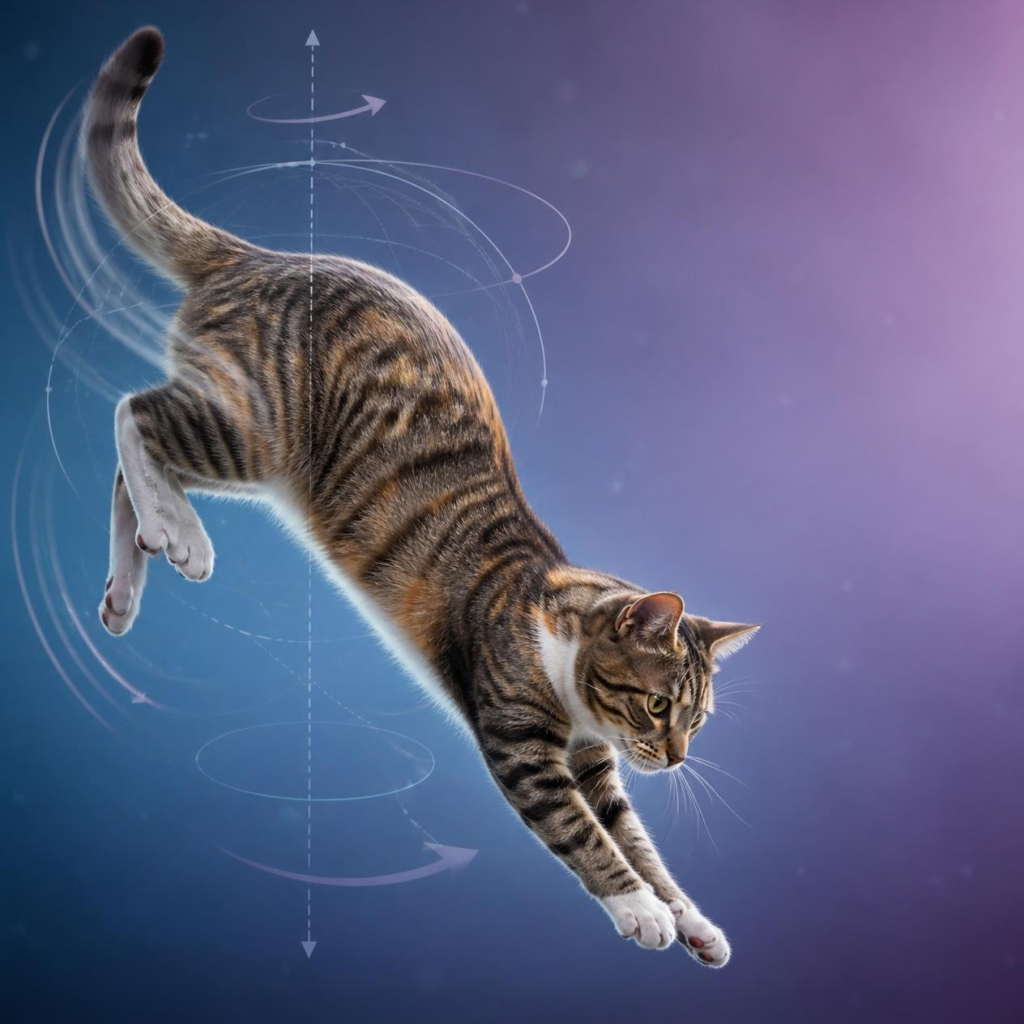
Cats do not simply “turn themselves over” as one solid object. Instead, they rearrange different parts of their bodies in midair, using rotation, momentum, and flexibility to change their orientation. This instinctive movement is known as the feline righting reflex.
So how does it work? Why can cats often land on their feet even when they begin falling upside down? And does this mean cats can survive any fall?
The answers reveal one of nature’s most elegant examples of biology working together with physics.
What Is the Feline Righting Reflex?
The feline righting reflex is an automatic ability that helps a cat rotate its body during a fall so that its feet face downward before it reaches the ground.
Unlike a learned trick, this reflex does not require a cat to think through every movement. The cat’s eyes, inner ear, brain, spine, and muscles work together rapidly to detect its position and coordinate the necessary movements.
A falling cat must answer one urgent question: Which way is down?
The cat receives information from several systems:
- Its eyes help it understand the position of the ground and nearby objects.
- Its inner ear detects changes in balance and body orientation.
- Its muscles and joints provide information about the position of its limbs.
- Its nervous system rapidly coordinates the twisting movement.
Once the cat detects that it is falling in an awkward position, its body begins a sequence of movements that can rotate its front and rear halves into the correct orientation.
The entire process can happen remarkably quickly.
Cats Do Not Rotate Like a Stiff Board
Imagine throwing a wooden plank into the air. If the plank begins upside down, it cannot suddenly turn itself upright unless an external force acts on it. A rigid object behaves as one connected piece.
A cat, however, is not rigid.
Its spine is extremely flexible, its limbs can move independently, and its body can bend and twist in several directions. This allows the cat to behave less like a solid plank and more like a collection of connected sections that can change position relative to one another.
This is the key to the righting reflex.
A cat can rotate its front half in one direction while rotating its rear half in another direction. By changing the shape of its body, it can alter how different parts move without needing to push against the air or grab onto anything.
This may sound surprising because of a basic rule of physics: angular momentum is conserved when no external torque acts on a system.
But conservation of angular momentum does not mean that every part of a flexible object must rotate in the same way. The cat can redistribute motion between different sections of its body.
That is precisely what makes its midair maneuver possible.
The Physics of Angular Momentum
To understand the cat’s movement, it helps to understand angular momentum.
Angular momentum is the rotational equivalent of ordinary momentum. It describes how much rotational motion an object has and depends on two main factors:
- How much mass the object has and how that mass is distributed.
- How quickly the object is rotating.
A simplified expression is:
Here:
- is angular momentum.
- is the moment of inertia, which describes how mass is distributed around the axis of rotation.
- is angular velocity, or how quickly the object rotates.
A cat falling through the air usually has very little initial rotation. If no significant external torque acts on it, the cat’s total angular momentum remains close to zero.
So how can it rotate at all?
The answer is that the cat changes its shape and rotates different parts of its body in opposite directions.
How a Cat Turns Itself Upright
The righting reflex is often explained as a four-stage movement, although the actual process is fluid and can vary depending on the cat’s position.
1. The Cat Detects Its Orientation
First, the cat determines that it is falling with its back, side, or head facing the wrong direction.
Its visual system and vestibular system—the balance system inside the inner ear—help provide information about its orientation.
The cat’s head usually begins to turn first. This is important because the head gives the rest of the body a reference point. Once the head is positioned correctly, the cat can organize the rest of its movements around it.
2. The Front Half Rotates
The cat bends its spine and brings its front legs closer to its body.
Pulling the front legs inward reduces the moment of inertia of the front half. In simple terms, the mass becomes concentrated closer to the axis around which that section is rotating.
When the moment of inertia decreases, that section can rotate more quickly while preserving its angular momentum.
This is similar to what happens when a figure skater pulls their arms inward and spins faster.
The cat uses this principle to rotate its front half toward the upright position.
3. The Rear Half Rotates in the Opposite Direction
The rear half of the cat then changes shape and rotates in the opposite direction.
Because the front and rear sections can move independently, the cat can adjust its orientation while keeping the total angular momentum of the body close to zero.
This is a crucial detail: the cat is not rotating its entire body as one rigid object. It is using its flexible spine and separate body sections to produce a net change in orientation.
The movement resembles a gymnast twisting in the air, except that a cat performs it instinctively and without needing a springboard or other equipment.
4. The Cat Extends Its Legs for Landing
Once the cat has rotated into the correct orientation, it spreads out its legs and prepares for impact.
Extending the legs increases the body’s moment of inertia and helps slow the rotation. The cat also spreads its body to improve stability and distribute the landing force.
Its paws, joints, muscles, and flexible spine help absorb some of the impact. The cat may bend its legs on contact, allowing the body to decelerate over a slightly longer time rather than stopping abruptly.
That small increase in stopping time can reduce the peak force experienced by the body.
Why Pulling the Legs In Helps
The cat’s ability to change its moment of inertia is one of the most important parts of the righting reflex.
Think about a person sitting on a rotating office chair. If they extend their arms outward, their mass is distributed farther from the rotation axis, increasing their moment of inertia. They rotate more slowly.
If they pull their arms inward, their moment of inertia decreases, and they can rotate faster.
Cats use a similar principle.
During the righting reflex, a cat may pull its front legs close to its body while extending or repositioning its rear legs. This allows the front and rear sections to rotate at different speeds.
The cat is effectively changing the distribution of its mass to control rotation.
It is not breaking the laws of physics. It is using them with extraordinary efficiency.
The Cat’s Flexible Spine Is a Major Advantage
A cat’s spine is highly flexible compared with the spine of a human.
This flexibility allows the cat to bend its body into a curved shape and move the front and rear halves independently. The cat can also rotate its shoulders and hips in ways that help it control its orientation.
The spine acts like a mechanical link between two movable sections.
If the cat were completely rigid, it would not have the same ability to perform the maneuver. The flexibility of its body gives it more ways to redistribute motion and change its orientation.
This is one reason cats are such effective climbers and jumpers. Their bodies are designed for rapid changes in position, balance, and direction.
Do Cats Need to Push Against the Air?
A common misconception is that cats must push against the air to turn themselves upright.
They do not need a strong external push.
A cat can change its orientation through internal movements because its body is flexible and its different sections can rotate relative to one another. The cat’s total angular momentum can remain close to zero even while its overall orientation changes.
This is sometimes compared to an astronaut turning in space without holding onto anything. By moving different parts of the body in carefully coordinated ways, the astronaut can change orientation without needing to push against a wall.
The cat performs a related maneuver, although its body mechanics are different.
Air resistance may influence the movement slightly, but it is not the main explanation for the righting reflex.
Why the Head Usually Turns First
The head is particularly important because the cat’s eyes and inner ear provide information about orientation.
When a cat begins to fall, it attempts to position its head so that the face points upward and the eyes are directed toward the environment.
The rest of the body then follows through a coordinated twisting movement.
This head-first organization makes sense from a biological perspective. The brain needs a stable reference point to determine where the rest of the body should go.
The head also contains the vestibular system, which detects rotation and changes in balance. This system helps the cat understand whether it is upside down, sideways, or upright.
The reflex is therefore not just a muscular trick. It is a fast feedback process involving sensory information and precise motor control.
How Young Cats Develop the Reflex
Kittens do not necessarily possess a fully developed righting reflex immediately after birth.
Their nervous systems, muscles, balance organs, and coordination develop as they grow. The ability becomes more reliable during the early weeks of life.
This is why very young kittens may not be able to perform the same maneuver as an adult cat.
The reflex is instinctive, but instinctive does not mean fully operational from the first moment of life. Many animal abilities depend on the maturation of the body and nervous system.
As kittens grow, they gain better control over their head, spine, limbs, and balance. Their experience moving through the environment may also improve their coordination.
Can Cats Survive Any Fall?
Although cats are exceptionally good at righting themselves, the phrase “cats always land on their feet” should not be taken literally.
Cats can land badly. They can become disoriented, collide with objects, land on uneven surfaces, or fail to complete the maneuver in time.
Even when a cat lands on its feet, the impact can still cause serious injury.
Possible injuries include:
- Broken bones.
- Damage to the jaw or teeth.
- Chest injuries.
- Internal bleeding.
- Spinal injuries.
- Damage to the paws and legs.
- Lung injuries.
The height of a fall, the surface below, the cat’s age, its physical condition, and the position in which it begins falling can all affect the outcome.
A cat falling from a low height may not have enough time to rotate fully. A cat falling from a greater height may have more time to orient itself, but the impact can be much more severe.
There is no height from which a cat is guaranteed to survive.
Why Very Short Falls Can Be Dangerous
It may seem strange, but a short fall can sometimes be more dangerous than a longer one.
A cat needs a certain amount of time to detect its orientation, rotate its body, and extend its legs. If the distance is too short, the cat may hit the ground before the righting reflex is complete.
This is especially relevant when a cat falls from a bed, table, counter, or someone’s arms.
The cat may not have enough time to organize its body before impact. A fall from a greater height may provide more time for the reflex to occur, but that does not mean the landing is safe.
The safest conclusion is simple: a cat’s righting reflex improves its chances of landing upright, but it does not make falls harmless.
Why Cats Spread Their Legs During a Fall
When a cat extends its legs and spreads its body, it increases its surface area and changes its aerodynamic behavior.
This can increase air resistance and may help the cat reach a lower terminal speed than a more compact body would.
Terminal velocity is the approximate maximum speed an object reaches while falling through air when the force of gravity is balanced by air resistance.
A cat’s spread-out posture can make it behave somewhat like a parachutist adjusting their body position.
However, the effect should not be exaggerated. A cat is not a parachute, and spreading its legs cannot eliminate the dangers of a high-speed impact.
The posture may help reduce falling speed, but the cat still has to deal with the force generated when it reaches the ground.
The “High-Rise Syndrome” Question
Veterinarians have long observed cases of cats falling from windows, balconies, and buildings. These incidents are sometimes discussed under the term “high-rise syndrome.”
Some cats survive surprisingly high falls, while others suffer severe injuries from much shorter distances.
Several factors may influence the outcome:
- Whether the cat has time to complete the righting reflex.
- Whether it lands on its feet or another part of the body.
- The surface it lands on.
- The cat’s physical condition.
- Whether the body has time to reach a stable falling posture.
- The height and speed of the fall.
There is no simple rule that a cat becomes safer after a certain height. A fall remains dangerous, and even a seemingly minor accident may require veterinary attention.
Windows and balconies should therefore be secured with strong screens or protective barriers, especially in homes with cats.
Why Cats Are So Good at Landing
The righting reflex is only one part of a cat’s landing ability.
Cats also have several physical features that help them move and land effectively:
Flexible Joints
Their joints allow a wide range of movement and help them adjust their legs during landing.
Strong Muscles
Cats have powerful muscles that support jumping, climbing, and rapid changes in direction.
Padded Paws
The pads on their feet provide some cushioning and help them grip surfaces.
Flexible Spine
The spine helps distribute movement and absorb some impact.
Quick Reaction Time
Cats can respond rapidly to changes in their position and surroundings.
Body Awareness
Their nervous system is highly skilled at tracking the position of their limbs and body.
Together, these features make cats remarkably agile. The righting reflex is not an isolated trick but part of a larger system of balance, coordination, and survival.
What the Righting Reflex Teaches Us About Physics
The feline righting reflex is a beautiful example of how physics can emerge through biological design.
The cat does not need to understand angular momentum, torque, or moment of inertia. Evolution has shaped its body and nervous system so that the correct movements happen automatically.
Several important physics principles appear in this single maneuver:
Conservation of angular momentum: The cat can change its orientation through coordinated internal movements without needing a large external torque.
Moment of inertia: By moving its limbs closer to or farther from its body, the cat controls how quickly different sections rotate.
Rotational motion: The front and rear halves of the body can rotate in different directions.
Air resistance: Spreading the body can influence falling speed and stability.
Impulse and force: Bending the legs and using the body’s flexibility can help manage the forces generated during landing.
This is why the cat’s fall is so fascinating. It is not merely an animal performing an impressive movement. It is a living demonstration of mechanics.
Could Robots Copy the Cat?
Scientists and engineers have studied animal movement to design robots that can balance, jump, twist, and land more effectively.
A robot inspired by a cat might need:
- A flexible central body.
- Independent control of front and rear sections.
- Sensors to detect orientation.
- Fast motors or actuators.
- A control system capable of adjusting movement in midair.
- Shock-absorbing legs.
Robotic systems inspired by animals are often called bio-inspired or biomimetic systems.
The cat’s righting reflex is especially interesting because it shows how a complex maneuver can be achieved through a combination of body design and rapid control.
A robot that could reliably orient itself during a fall might be more resistant to damage, better at navigating difficult terrain, or more capable of landing after a jump.
The Limits of the “Always on Their Feet” Myth
The famous saying is based on a real ability, but it is still an exaggeration.
Cats do not always land on their feet. They may not have enough time to rotate, they may be injured or elderly, or they may fall in a position that makes the maneuver difficult.
Even when a cat lands upright, it can still be hurt.
The righting reflex is best understood as a powerful survival advantage—not a guarantee of safety.
It gives cats an impressive ability to control their bodies in midair, but gravity still wins in the end.
Conclusion: A Tiny Acrobat Governed by Physics
A cat falling upside down may look like it is performing a supernatural trick. In reality, it is using a sophisticated combination of biology and physics.
Its eyes and inner ear help detect orientation. Its flexible spine allows the body to bend. Its front and rear sections rotate in coordinated ways. Its limbs change the distribution of mass, allowing it to control rotational speed. Finally, its legs and body prepare for impact.
The feline righting reflex is a reminder that nature often solves difficult mechanical problems through elegant design rather than conscious calculation.
Cats do not need to know the laws of physics. Their bodies have evolved to use them.
And that may be the most fascinating part of all: beneath the graceful movement of an ordinary household cat is a remarkably advanced system of balance, rotation, sensing, and control.
Continue Your Journey
If you enjoyed discovering how cats use physics to control their bodies, continue your journey with our article:
Why Do Mirrors Reflect? The Surprising Science Behind the Glass That Shows Us the World
From a falling cat’s changing body position to the way light bounces off a mirror, the world around us is full of ordinary experiences hiding extraordinary science.
Follow Trivialwiki
Discover more fascinating explanations, surprising facts, and curious stories:
- Facebook: https://facebook.com/Trivialwiki
- Instagram: https://instagram.com/trivialwiki
- YouTube: https://youtube.com/@trivialwiki
- Pinterest: https://pinterest.com/Trivialwiki
What other animal ability looks almost magical but is actually explained by science? Share your favorite example with us!