
The moment an airplane touches down on the runway, passengers often feel that the difficult part of the journey is over. The wheels meet the ground, the engines change their sound, and the aircraft slows down before turning towards the airport terminal. Soon, the seat belt sign switches off, passengers collect their belongings, and the cabin gradually empties.
But while passengers head towards baggage claim or immigration, something remarkable begins outside the aircraft.
Within minutes, teams of ground workers approach the airplane. Vehicles arrive, baggage compartments open, fuel equipment is connected, and the cabin begins to transform. Somewhere else in the airport, another group of passengers may already be waiting to board the very same aircraft.
How can an airplane that has just completed a journey be prepared to fly again so quickly?
The answer lies in a carefully coordinated operation known as an aircraft turnaround—one of the busiest and least visible parts of commercial aviation.
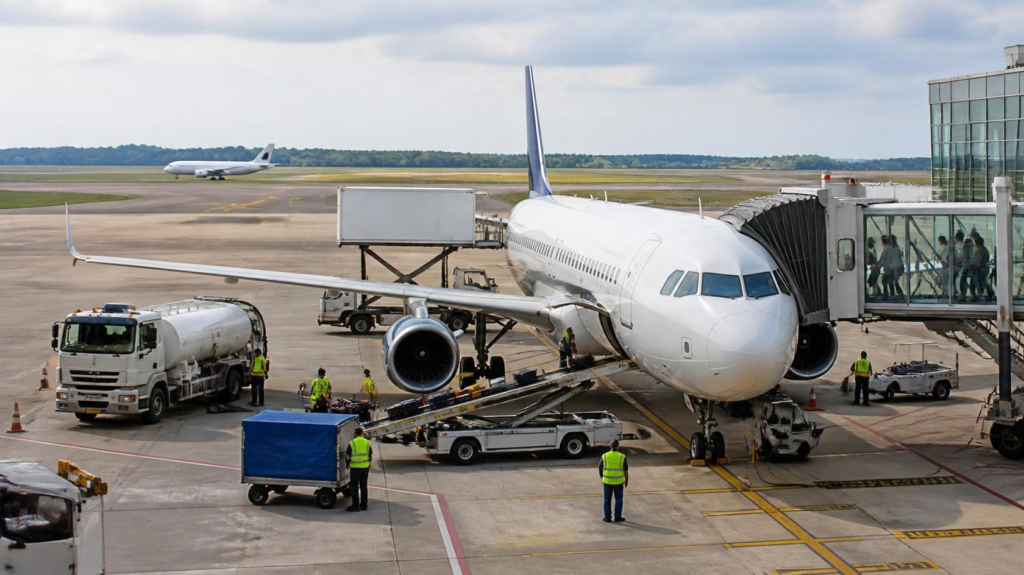
✈️ The Clock Starts Before the Aircraft Parks
An aircraft turnaround is the process of preparing an airplane for its next departure after it arrives at an airport. It involves far more than allowing passengers to get off and new passengers to get on.
Airlines plan many turnaround activities before the aircraft even lands. Ground-handling teams receive arrival information, equipment is positioned, and staff prepare for baggage unloading, cleaning, catering, and other services.
As the aircraft approaches its parking stand, ground personnel make sure the area is ready. Depending on the airport and stand arrangement, the aircraft may be guided by a marshaller or use an automated docking guidance system to stop in the correct position.
Once the aircraft has parked, the parking brake is set and the engines are shut down according to the applicable procedures. Wheel chocks may be placed to prevent unintended movement, and the aircraft is secured before the necessary ground equipment is brought into position.
Only then can the many tasks around the airplane proceed safely.
What looks like a simple parking manoeuvre to a passenger is actually the beginning of a tightly coordinated operation involving the airline, airport, ground-handling companies, and other service providers.
🧳 Where Does All the Baggage Go?
One of the first major jobs is unloading the baggage and cargo carried on the arriving flight.
Ground workers open the aircraft’s cargo compartments and remove suitcases, bags, and other items. Depending on the aircraft and loading system, baggage may be moved using belt loaders, baggage containers, or specialised handling equipment.
The bags are transferred to carts or conveyor systems and taken towards the terminal, where they enter the baggage-delivery process. Transfer baggage destined for connecting flights may follow a different route so that it can reach another aircraft in time.
Meanwhile, the empty cargo compartments are prepared for the next flight. Workers check the compartments and loading areas as required, while the next flight’s baggage is organised for loading.
This process requires accuracy as well as speed. Baggage must go to the correct destination, cargo must be handled properly, and the aircraft must be loaded according to approved instructions.
The amount of baggage can also influence turnaround time. A lightly loaded aircraft may be processed quickly, while a full flight with substantial checked baggage can require more time and equipment.
⛽ Refuelling: Giving the Aircraft Its Next Supply of Energy
An aircraft that has just flown several hours may need a substantial quantity of fuel before its next journey.
Refuelling is therefore one of the most important activities during a turnaround. At many airports, fuel is supplied through underground hydrant systems connected to specialised dispensers. At other stands, fuel trucks may deliver it directly.
The required quantity depends on the next route, expected conditions, the aircraft’s requirements, and the flight crew’s operational planning. Fuel calculations must account for the planned flight and applicable reserves rather than simply filling the tanks to capacity.
Refuelling also involves strict safety procedures. Personnel follow established rules concerning equipment, bonding and grounding where applicable, fire precautions, communication, and the management of other activities around the aircraft.
Passengers sometimes notice a fuel vehicle beside an airplane and assume that refuelling is a routine job that takes only a few minutes. In reality, it is part of a larger operation in which timing and safety must work together.
🧹 A Flying Hotel Needs to Be Reset
Imagine the cabin immediately after a full flight. Passengers have eaten meals, opened snacks, used the lavatories, read magazines, and moved around the cabin. Some may have left rubbish behind, while blankets, pillows, and other items need attention.
Before the next group boards, the cabin must be prepared for another journey.
Cleaning teams enter the aircraft to remove waste, tidy the seating areas, clean appropriate surfaces, and service the cabin according to the airline’s procedures. Lavatories may need servicing, and fresh supplies may be loaded.
Catering teams remove used equipment and replenish food, beverages, and other onboard supplies as required. Potable water and lavatory servicing may also be carried out.
These jobs can happen alongside baggage handling and other ground activities, provided the work is coordinated safely.
The turnaround is not necessarily a complete deep clean after every flight. The work depends on the aircraft, the airline’s procedures, the length of the stop, and the condition of the cabin.
The goal is to make the aircraft ready for the next group of passengers without compromising cleanliness or safety.
🔧 Who Checks Whether the Aircraft Is Ready to Fly?
Cleaning and refuelling are visible activities, but another crucial job happens through inspections and maintenance.
Aircraft operate under detailed maintenance programmes, and crews carry out the checks required for their particular flight and aircraft. Depending on the operation, technical staff may inspect reported defects, examine components, or perform scheduled maintenance tasks.
The flight crew also carries out its required pre-flight duties. These may include reviewing aircraft documentation, checking operational information, assessing the aircraft’s condition, and preparing the cockpit for the next flight.
If a pilot reports a technical problem after landing, the aircraft may require further investigation before it can depart. A minor issue might be resolved quickly, while a more complicated defect could delay the flight or require the aircraft to be taken out of service.
This is why a quick turnaround is never simply a race against the clock. The aircraft must meet the applicable safety and operational requirements before it can fly again.
🥪 How Do Meals, Water, and Other Supplies Get Replaced?
The next flight may carry a different number of passengers, travel a different route, or offer a different onboard service.
Catering teams therefore work from the requirements for the upcoming flight. They may load meals, beverages, snacks, disposable items, and other supplies while removing used catering equipment from the previous journey.
Water and other service requirements are handled according to the aircraft and airline’s procedures.
For some flights, catering is a relatively straightforward operation. For others, especially longer journeys or flights with extensive meal services, it can involve substantial quantities of food and equipment.
Each delivery must be coordinated with the other work happening around the airplane. A catering vehicle cannot simply occupy a position needed by another essential service, and all equipment must be used in accordance with airport safety rules.
The cabin may look almost unchanged from the outside, but a surprising amount of work can take place before the next passengers arrive.
👨✈️ A New Flight Means a New Plan
An airplane does not automatically repeat its previous journey. The next flight has its own destination, schedule, weather considerations, passenger list, baggage, fuel requirements, and operational plan.
The crew must prepare for those specific conditions. Depending on the operation, the airline may also arrange a crew change, review the flight plan, complete passenger and baggage information, and coordinate with air traffic control and airport operations.
Loading is particularly important because the aircraft’s weight and balance must remain within approved limits. The position and distribution of passengers, baggage, and cargo affect the aircraft’s loading calculations.
Ground staff and load-control personnel use the required information to establish the loading instructions and final figures. The responsible crew members complete their checks before departure.
Even if an aircraft has just flown the same route earlier in the day, its next flight still requires the appropriate preparation and verification.
⏱️ How Can an Airplane Be Ready in Just 30 Minutes?
Some aircraft turnarounds are remarkably short. At certain airports, airlines can prepare narrow-body passenger aircraft for another flight in around half an hour, although this is not a universal target or guarantee.
The key is that many activities happen simultaneously rather than one after another.
While passengers disembark, baggage may be unloaded. Cleaning teams can begin their work as soon as the relevant areas are available. Catering, refuelling, technical checks, and preparations for the next flight are coordinated around the aircraft.
This parallel approach saves time, but it requires clear communication and careful management of the working area.
Aircraft type, passenger numbers, airport layout, weather, maintenance requirements, and airline procedures all influence how long the process takes. Larger aircraft and long-haul operations may require considerably longer stops.
A delay in one activity can affect several others. If maintenance takes longer than expected, for example, boarding or departure may need to be adjusted. The teams must respond without skipping essential checks.
🚜 The Final Steps Before Takeoff
As the turnaround approaches completion, the aircraft is checked to ensure that the required work has been finished. Baggage and cargo are loaded and secured, the cabin is prepared, and the passengers board.
The crew completes the necessary departure procedures, and the doors are closed when the aircraft is ready for that stage of the operation.
Ground equipment is removed, the area around the aircraft is checked, and a pushback tug may connect to the nose landing gear. The tug moves the aircraft away from its stand when the relevant clearances and procedures permit.
The aircraft then starts or continues its taxi preparations according to the approved procedures. The pilots communicate with air traffic control, follow taxi instructions, and wait for the required takeoff clearance.
Only when the necessary conditions are met can the airplane line up and depart.
The aircraft that looked almost motionless at the terminal a short time earlier is now beginning another journey.
🌍 The Hidden Teamwork Behind Every Flight
Air travel often appears effortless from a passenger’s seat. We board, fasten our seat belts, fly to our destination, and leave the airport. Yet every flight depends on a large network of people working behind the scenes.
Baggage handlers, cleaners, engineers, fuel operators, caterers, dispatch teams, pilots, cabin crew, and airport personnel all contribute to getting the aircraft ready. Their work must be coordinated because each task can affect the timing and safety of the others.
The next time you see an airplane parked at a terminal, remember that it is not simply waiting for its next passengers. It may be undergoing a carefully planned transformation, with dozens of people and vehicles helping prepare it for another trip.
A successful turnaround is a remarkable combination of logistics, engineering, communication, and teamwork.
The aircraft may spend only a short time on the ground, but the work happening around it helps keep the entire world of aviation moving.
Continue Exploring on Trivialwiki
Discover another fascinating story about the systems that connect our world:
The Invisible System Guiding the World
Explore how GPS, satellites, and precise timing help guide aircraft, ships, vehicles, and the devices we use every day.
📬 Stay Connected with Trivialwiki
Follow Trivialwiki for more fascinating stories about aviation, science, history, technology, and the world around us.
- Facebook: https://facebook.com/Trivialwiki
- Instagram: https://instagram.com/trivialwiki
- YouTube: https://youtube.com/@trivialwiki
- Pinterest: https://pinterest.com/Trivialwiki
Trivialwiki — Learn. Explore. Discover.
Have you ever watched the ground crew working around an airplane from your airport window? Which part of the turnaround process surprised you the most? Share your thoughts in the comments!
References
1. Schiphol Airport — Ready for take-off in ten steps… https://news.schiphol.com/how-the-turnaround-process-works/
2. UK Health and Safety Executive — Aircraft turnaround https://www.hse.gov.uk/airtransport/topics/turnaround.htm
3. International Air Transport Association — Top Ways to Safely Improve the Efficiency of Aircraft Turnaround with Standardized Procedures https://www-ade.iata.org/en/publications/newsletters/iata-knowledge-hub/improve-efficiency-aircraft-turnaround/
4. European Union Aviation Safety Agency — Easy Access Rules for Ground Handling https://www.easa.europa.eu/en/document-library/easy-access-rules/online-publications/easy-access-rules-ground-handling
1 thought on “What Happens Between an Airplane Landing and Taking Off Again?”