
The Surprising Science Behind the Glass That Shows Us the World
Every morning, millions of people look into a mirror without giving it much thought.
We use mirrors to check our hair, adjust our clothes, shave, apply makeup, and sometimes practice what we are going to say before an important conversation. Mirrors are so familiar that they almost disappear into the background of daily life.
But a simple question reveals something extraordinary:
Why does a mirror reflect light instead of allowing us to see through it?
After all, a mirror is usually made from glass, and glass is transparent. If light can pass through a window, why does it bounce back from a mirror and create an image of our face?
The answer lies in the interaction between light and matter—and in a clever combination of ordinary glass and a thin, highly reflective coating.
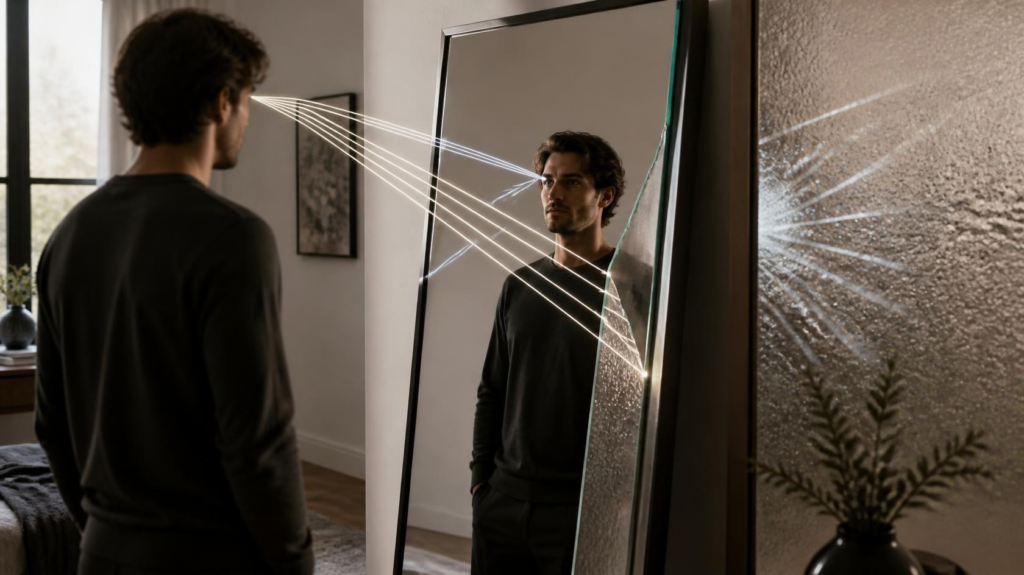
A mirror is not magical glass. It is more like a carefully constructed light trap that redirects rays toward our eyes in an organized way.
Light Is Always Moving Around Us
To understand mirrors, we first need to understand light.
Light travels in waves and carries energy from one place to another. It moves from the Sun to Earth, from a lamp across a room, and from a phone screen into our eyes.
When light reaches an object, several things can happen:
- It may be absorbed.
- It may pass through the material.
- It may scatter in different directions.
- It may be reflected.
The result depends on the material and its surface.
A black shirt absorbs much of the visible light that reaches it. A clear window allows much of the light to pass through. A rough wall scatters light in many directions.
A mirror, however, reflects light in a particularly organized way.
That organization is what allows us to see a recognizable image.
What Is Reflection?
Reflection happens when light strikes a surface and returns into the surrounding space.
You may have noticed that light can bounce off many different objects. Sunlight reflects from buildings, roads, water, paper, leaves, and even the walls of a room.
But not all reflection looks the same.
There are two main types:
- Specular reflection
- Diffuse reflection
Specular reflection occurs when light reflects from a relatively smooth surface in an organized direction. Mirrors and calm water are good examples.
Diffuse reflection occurs when light hits a rough surface and scatters in many directions. Paper, fabric, painted walls, and unfinished wood behave this way.
Both types involve reflection, but only a smooth surface preserves the directional arrangement of incoming light well enough to form a clear image.
The Rule: Light Bounces at the Same Angle
The basic law of reflection is surprisingly simple:
The angle at which light arrives is equal to the angle at which it leaves.
Scientists describe this using an imaginary line called the normal, which is drawn perpendicular to the surface at the point where the light strikes.
The incoming light makes an angle with the normal. The reflected light leaves at the same angle on the opposite side.
This is why a mirror can show you an object that is not directly in front of your eyes.
Light from your face travels toward the mirror. The mirror redirects that light into your eyes. Your brain interprets the incoming rays as though they came from behind the mirror.
The mirror does not actually contain another world or another person. It is redirecting light in a way that creates the appearance of an image.
Why Does a Smooth Surface Matter?
Imagine throwing hundreds of small balls at two surfaces.
If the first surface is smooth and flat, the balls may bounce in predictable directions. If the second surface is covered with bumps and grooves, the balls scatter in many different directions.
Light behaves in a similar way.
A polished mirror has a very smooth surface at the scale relevant to visible light. The reflected rays remain organized, so the image stays clear.
A rough wall also reflects light, but tiny irregularities send the rays in different directions. The light becomes scattered, and no sharp image forms.
This is why you can see your face in a polished metal surface but not in a rough piece of stone.
The difference is not that one object reflects and the other does not. The difference is that one produces organized reflection, while the other produces mostly scattered reflection.
A Mirror Is Usually Glass with Metal Behind It
Most household mirrors have a structure that is more interesting than it first appears.
A typical modern mirror often contains:
- A thin sheet of glass at the front
- A reflective metal coating behind the glass
- Protective layers over the back of the coating
The glass provides a smooth, durable surface and protects the reflective layer from scratches, moisture, and physical damage.
The metal layer does most of the reflecting.
Common reflective materials include silver and aluminum. Silver is highly reflective for visible light, while aluminum is widely used because it is practical, durable when properly protected, and effective across a broad range of wavelengths.
When you look into a household mirror, you are usually looking through the glass at light reflected from the thin metal coating behind it.
The glass is not the main reason the mirror is reflective. It is the protective front layer that allows the reflective coating to remain smooth and usable.
Why Does the Metal Reflect So Much Light?
The behavior of metals comes from their electrons.
Atoms contain electrons, and in metals, some electrons are not tightly bound to individual atoms. They can move through the material more freely than electrons in many other substances.
When light strikes a metal, its electric field interacts with these mobile electrons. The electrons respond to the incoming electromagnetic wave, producing their own electromagnetic response.
This interaction causes much of the light to be sent back from the surface rather than passing deeply into the material.
That is why metals often look shiny.
The reflective coating in a mirror is engineered to take advantage of this property. Instead of allowing light to enter a thick, rough, or irregular metal object, manufacturers create a thin, smooth reflective layer that can redirect light in a controlled manner.
The result is a surface that reflects enough light to form a bright image.
Why Is the Reflective Coating Behind the Glass?
You might wonder why the metal is not placed on the front, where the light reaches it directly.
There are mirrors with front-surface reflective coatings, especially in scientific instruments, telescopes, optical devices, and specialized equipment. But ordinary household mirrors usually place the reflective layer behind the glass.
This arrangement offers several advantages.
The glass protects the metal from scratches, fingerprints, moisture, and everyday contact. It also provides a hard, easy-to-clean surface.
If the metal coating were exposed directly, it could be damaged more easily. Even a tiny scratch or patch of corrosion could interfere with the reflected image.
The glass also helps keep the reflective layer smooth and stable.
So the design is a practical compromise: the glass is transparent enough for light to reach the reflective layer, while the metal sends the light back through the glass toward the observer.
Why Can We See Through a Window but Not Through a Mirror?
A clear window and a mirror may both contain glass, but their surfaces behave differently because of what is behind or on them.
A window is designed to transmit light. It allows a large portion of visible light to pass through, although some light is still reflected from its surfaces.
A mirror contains a reflective coating that sends much of the incoming light back toward the source side.
In a normal room, light from your face reaches the mirror and returns to your eyes. Very little visible light passes through the metal coating behind it.
That is why the mirror appears reflective rather than transparent.
The glass itself is not suddenly becoming opaque. The reflective layer changes the behavior of the complete object.
Why Do We See an Image Behind the Mirror?
One of the strangest things about mirrors is that the image appears to exist behind the glass.
If you stand in front of a mirror, your reflection seems to be located at a distance behind the surface. But there is no actual person standing there.
This is called a virtual image.
The light rays entering your eyes are real, but they do not actually come from behind the mirror. Your brain naturally assumes that light travels in straight lines. When it traces the reflected rays backward, they appear to originate from a point behind the mirror.
That apparent location is where the virtual image seems to be.
The image is called virtual because the light does not actually converge at that point. You cannot place a screen behind the mirror and capture the image there in the same way you can capture a projected image from a real light source.
The mirror creates the appearance of depth through the geometry of reflected light.
Why Is the Image the Same Size as You?
A flat mirror produces an image that is generally the same size as the object in front of it.
If you stand two meters in front of a flat mirror, your image appears to be two meters behind the mirror. The total apparent distance between you and your reflection is therefore about four meters.
This is a consequence of the law of reflection and the flat shape of the mirror.
The mirror behaves as though the image is located symmetrically behind its surface. Your left side remains on the left side of the image, and your right side remains on the right.
This leads to another common mystery.
Do Mirrors Really Reverse Left and Right?
People often say that mirrors reverse left and right, but that is not quite accurate.
A mirror does not actually swap your left and right sides. It reverses the direction perpendicular to its surface—the direction from front to back.
Imagine pointing your finger toward the mirror. Your reflected finger appears to point toward you from behind the glass. The front-to-back direction has been reversed.
Your left hand remains opposite your left hand. Your right hand remains opposite your right hand.
Why, then, does the image seem reversed?
One reason is that we imagine turning a person around to face us. If a person turned around, their left and right sides would appear exchanged from our viewpoint. But a mirror does not rotate you. It creates a front-to-back reversed image.
The confusion comes from how we mentally compare the reflection with another person facing us.
Why Does Writing Look Backward in a Mirror?
Words appear reversed in a mirror because the letters are arranged across the front-to-back direction.
A printed word has a specific orientation. When light from the printed surface reflects from a mirror, the image appears as though the page has been flipped through the mirror plane.
The letters are not being physically rearranged inside the paper. The mirror is producing a reflected image with reversed depth orientation.
This is why emergency vehicles sometimes use specially reversed lettering on the front of the vehicle. Drivers see the word correctly in their rear-view mirrors, allowing them to recognize the emergency vehicle more quickly.
Why Are Some Mirrors Curved?
Not all mirrors are flat.
Some mirrors are curved inward, like the inside of a spoon. These are called concave mirrors.
Others curve outward, like the back of a spoon. These are called convex mirrors.
Curved mirrors change the paths of reflected light in different ways.
A concave mirror can bring reflected rays together. Depending on the object’s distance, it may produce a magnified image, a reduced image, or even a real image that can be projected onto a screen.
This is why concave mirrors are used in some makeup mirrors, shaving mirrors, headlights, and optical instruments.
A convex mirror spreads reflected rays outward. It generally produces a smaller image but provides a wider field of view.
That is why convex mirrors are useful in vehicle side mirrors, parking areas, shops, and road intersections.
The small warning often printed on vehicle mirrors—“Objects in mirror are closer than they appear”—is related to the reduced image and wider viewing angle produced by convex mirrors.
Why Do Some Mirrors Make Us Look Taller or Wider?
A perfectly flat mirror produces an image without changing your overall proportions.
But a curved or uneven mirror can distort the image.
If the mirror curves outward in one direction, it may make objects appear smaller. If it curves inward, it may magnify certain areas.
Even a mirror that looks flat may have slight distortions caused by the glass, the frame, the wall behind it, or the way it was manufactured.
That is why you might look slightly different in a shop mirror, an elevator mirror, a gym mirror, or a funhouse mirror.
The reflection is not necessarily showing a different version of your body. It may simply be showing how the mirror’s shape redirects light.
Why Does a Mirror Reflect Some Colors Better Than Others?
White light contains many visible wavelengths, which we interpret as different colors.
A mirror reflects much of this visible light, but not always equally. The reflective material, coating thickness, glass, and surface condition can influence which wavelengths are reflected more efficiently.
A high-quality mirror may reflect visible colors relatively evenly, producing a natural-looking image.
Other mirrors may have a slight tint. Some may reflect more light in certain parts of the spectrum than others.
Specialized mirrors can be designed to reflect particular wavelengths while allowing others to pass through. These are used in cameras, scientific instruments, lasers, telescopes, and optical systems.
So a mirror is not necessarily a perfect reflector of every kind of light. Its behavior depends on the material and the wavelength.
Can Mirrors Reflect Invisible Light?
Yes.
Reflection is not limited to visible light.
Infrared radiation, ultraviolet radiation, microwaves, radio waves, and other forms of electromagnetic radiation can also be reflected under suitable conditions.
The exact behavior depends on the wavelength and the material.
For example, metal surfaces can reflect radio waves and microwaves. This is important in radar systems, antennas, satellite communication, and other technologies.
Some specialized mirrors are designed for infrared or ultraviolet light rather than ordinary visible light.
This means that the basic principle behind a bathroom mirror is connected to much larger technologies used in astronomy, medicine, communication, and physics.
Why Do Mirrors Get Foggy?
A mirror becomes foggy when water vapor in the air condenses into tiny droplets on its surface.
After a hot shower, warm moist air reaches the cooler mirror. Water vapor turns into small liquid droplets, creating a thin layer of moisture.
These droplets scatter light in many directions. Instead of reflecting light in a clean, organized way, the wet surface produces a blurry appearance.
The mirror has not stopped being reflective. The layer of water changes the surface that light interacts with.
Anti-fog mirrors and heated bathroom mirrors work by keeping the surface warm enough to reduce condensation.
A simple trick such as wiping the mirror also works because it removes the droplets that scatter the light.
Why Does a Dirty Mirror Look Dull?
Dust, fingerprints, grease, and scratches interfere with the smooth surface of a mirror.
A fingerprint contains oils and other substances that create an uneven layer over the glass. Dust particles scatter light. Scratches can distort the direction of reflected rays.
As a result, less light reaches your eyes in the organized way needed for a sharp image.
Cleaning a mirror does not make the metal suddenly more reflective. It restores a smoother optical surface so that light can reflect more cleanly.
This is another reminder that reflection depends not only on the material but also on the condition of the surface.
Mirrors and the Speed of Light
Light travels extremely fast—about 300,000 kilometers per second in a vacuum.
Because of this, the light traveling from your face to a bathroom mirror and back to your eyes takes an incredibly short amount of time.
You are not seeing your reflection exactly at the same instant the light leaves your face. You are seeing light that has traveled to the mirror, reflected, and returned.
For an ordinary household mirror, the delay is far too small for us to notice.
But the principle becomes important when mirrors are placed very far apart. Scientists use reflected light from the Moon, spacecraft, planets, and distant objects to measure distances and study motion.
A mirror is therefore not just a household object. It is part of the same system of light travel used to investigate the universe.
Mirrors Help Scientists Study Space
Mirrors play a major role in telescopes and other scientific instruments.
Astronomical telescopes often use carefully shaped mirrors to collect and focus light from distant stars, galaxies, nebulae, and planets.
A large mirror can gather more light than a small one, allowing scientists to observe faint objects that would otherwise be difficult to detect.
Reflecting telescopes can also avoid some of the problems associated with large glass lenses. A mirror can be supported from behind, and its reflective surface can be shaped to focus light accurately.
The same basic principle that lets you see your face can help astronomers study objects billions of light-years away.
That is a remarkable connection between a bathroom mirror and the edge of the observable universe.
Are Mirrors Perfect?
No mirror reflects every bit of light.
Some light may be absorbed by the coating, some may be scattered by tiny imperfections, and some may reflect from the glass itself.
Even highly engineered mirrors have limits. Their reflectivity depends on wavelength, angle of incidence, surface quality, coating material, and manufacturing precision.
A household mirror may reflect most visible light effectively, but it is not perfect.
Specialized scientific mirrors can be designed to achieve extremely high reflectivity for selected wavelengths. However, achieving excellent performance across a wide range of wavelengths can be more difficult.
In practical terms, every mirror is a compromise between reflectivity, durability, cost, surface quality, and intended use.
The Mirror Is Not Showing You the Present Exactly
There is one more subtle idea hidden in an ordinary reflection.
A mirror shows you how you looked a tiny fraction of a second ago.
Light needs time to travel from your face to the mirror and back to your eyes. The distance in a normal room is small, so the delay is unimaginably brief.
But the principle is universal.
When we look at the Sun, we see it as it was roughly eight minutes earlier because sunlight takes about eight minutes to reach Earth. When astronomers observe distant galaxies, they see them as they existed millions or billions of years ago.
A mirror in your home gives you an extremely recent image of yourself. A telescope gives scientists ancient images of the universe.
Both are revealing the past through traveling light.
Final Thought
A mirror seems simple because we use one every day.
But behind that familiar reflection is a fascinating combination of physics, materials science, geometry, and human perception.
Light leaves your face, travels toward a smooth surface, interacts with a reflective coating, and returns to your eyes. Your brain interprets those rays as an image located behind the mirror.
The glass protects the reflective layer. The metal responds to light through its electrons. The smooth surface keeps the reflection organized. The shape of the mirror determines whether the image looks normal, magnified, reduced, or distorted.
So the next time you look into a mirror, remember:
You are not looking through the glass at another version of yourself. You are seeing light make a carefully organized journey—and your brain turning that journey into an image.
Continue Your Journey
If you enjoyed discovering the science behind everyday objects, continue your journey with:
Why Is Bhutan Famous for Gross National Happiness? How One Country Introduced an Alternative Way to Think About National Progress
From the physics of reflected light to the way an entire country measures progress, Trivialwiki explores the surprising ideas hidden inside ordinary life.
Stay Curious with Trivialwiki
Follow Trivialwiki for more fascinating facts, scientific mysteries, and stories that make everyday things extraordinary:
- Facebook: https://facebook.com/Trivialwiki
- Instagram: https://instagram.com/trivialwiki
- YouTube: https://youtube.com/@trivialwiki
- Pinterest: https://pinterest.com/Trivialwiki
What everyday object should we explain next—the science behind it may be far more surprising than you expect.