
Today, black pepper sits quietly on dining tables around the world.
It is so common that many people barely think about it. A quick twist of a pepper grinder adds flavor to a meal, and then life moves on.
Yet there was a time when black pepper was one of the most valuable commodities on Earth.
Kings desired it. Merchants crossed oceans to obtain it. Fortunes were built upon it. Empires competed for control of its trade. Explorers risked their lives searching for faster routes to the lands where it grew.
Incredibly, this tiny black spice helped shape world history.
The story of black pepper is not just a story about food. It is a story about trade, exploration, wealth, and humanity’s desire to obtain something rare and valuable.
Few everyday ingredients have had such an extraordinary impact on civilization.
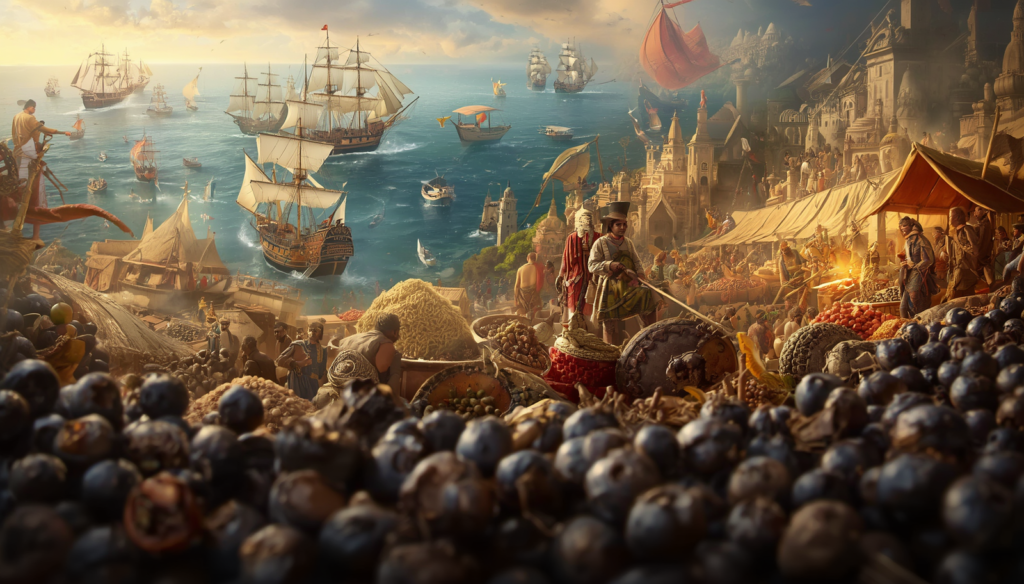
🌿 A Plant Hidden in Tropical Forests
Black pepper comes from a flowering vine known as Piper nigrum.
The plant thrives in warm, humid climates and grows naturally along the southwestern coast of India, particularly in the region now known as Kerala.
For thousands of years, local farmers cultivated pepper vines in this fertile landscape.
The peppercorns themselves begin as small green fruits. Once harvested and dried, they shrivel into the familiar black spheres found in kitchens worldwide.
Although pepper seems ordinary today, ancient traders quickly recognized its value.
Its flavor was unlike anything available elsewhere.
And because it grew in only a few regions, supply was limited.
🚢 The Ancient Spice Trade
Long before the age of European exploration, pepper was already traveling across continents.
Merchants transported it from India to the Middle East, North Africa, and Europe through a network of trade routes that connected civilizations.
The spice journey was long and complicated.
Pepper might pass through several traders before reaching its final destination.
Each intermediary added costs, making the spice increasingly expensive.
By the time pepper reached Europe, it had become a luxury product.
Wealthy households prized it.
For many people, owning pepper was a sign of status and prosperity.
💰 Worth Its Weight in Gold
The value of pepper during parts of history is difficult to overstate.
In medieval Europe, black pepper was sometimes used as a form of payment.
Rent, taxes, and debts could occasionally be settled using peppercorns.
Merchants stored it like treasure.
Nobles displayed it as evidence of wealth.
The spice became so valuable that people referred to affluent merchants as “pepperers.”
Although the expression has largely disappeared, it reflects how closely pepper became associated with economic success.
For centuries, black pepper was among the most sought-after products in the world.
🌍 Why Europe Wanted Pepper So Badly
Modern readers often wonder why pepper became so valuable.
After all, it is simply a seasoning.
The answer lies partly in its rarity and partly in its usefulness.
Pepper added flavor to foods at a time when culinary options were more limited than they are today.
It also traveled relatively well compared to many other agricultural products.
Most importantly, Europeans could not grow it themselves.
The spice had to be imported from distant lands.
Anything difficult to obtain tends to become valuable.
Pepper’s scarcity transformed it into a luxury commodity.
🗺️ The Search for a Sea Route
By the fifteenth century, European demand for spices had become enormous.
However, existing trade routes involved numerous middlemen.
Each intermediary increased costs.
European kingdoms wanted direct access to spice-producing regions.
This desire helped launch one of history’s greatest eras of exploration.
Sailors and navigators searched for new maritime routes that would bypass traditional overland networks.
The goal was simple.
Reach the spice sources directly.
Among the most coveted prizes was black pepper.
⛵ How Pepper Helped Trigger the Age of Exploration
When Portuguese explorers began sailing farther south along the coast of Africa, they were not simply seeking adventure.
They were seeking trade.
More specifically, they were seeking spices.
In 1498, the Portuguese explorer Vasco da Gama successfully reached India by sea.
His arrival established a direct maritime connection between Europe and the spice-producing regions of Asia.
The impact was enormous.
Trade became faster and more profitable.
European powers suddenly had a direct route to some of the world’s most valuable goods.
A tiny spice had helped motivate one of history’s most significant voyages.
⚔️ Empires Built on Spice
As maritime trade expanded, competition intensified.
Portugal, the Netherlands, Britain, and other European powers sought control over spice-producing regions and trade routes.
Ports became strategic assets.
Colonies were established.
Navies protected commercial interests.
Much of this activity was driven by the desire to secure profitable access to spices, including pepper.
Although many factors shaped colonial expansion, the spice trade played a surprisingly important role.
Entire commercial empires emerged around products that now sit unnoticed in kitchen cupboards.
🌶️ The King of Spices
Pepper eventually earned the nickname “The King of Spices.”
The title reflected both its popularity and its economic importance.
While other spices such as cinnamon, cloves, nutmeg, and saffron were also highly prized, black pepper achieved a unique combination of widespread demand and global influence.
It became a staple ingredient across cultures and cuisines.
Unlike some luxury spices that remained rare, pepper eventually reached broader segments of society.
Its popularity endured long after its extraordinary prices disappeared.
📦 From Luxury to Everyday Ingredient
Over time, improvements in agriculture, transportation, and trade dramatically increased pepper availability.
What had once been a luxury affordable only to the wealthy gradually became accessible to ordinary households.
The development of global shipping networks further accelerated this process.
Today, pepper is one of the world’s most widely traded spices.
Millions of people use it daily without considering the remarkable history behind it.
Its journey from rare treasure to common seasoning reflects the broader story of globalization itself.
🌏 A Tiny Spice with a Massive Legacy
Few products have influenced world history as profoundly as black pepper.
It encouraged long-distance trade.
It connected civilizations.
It motivated exploration.
It contributed to the growth of maritime commerce.
And it played a role in shaping the global economy.
All because people loved the flavor of a small dried fruit growing on vines in tropical forests.
The next time you reach for a pepper shaker, remember that you are holding a product that once inspired merchants, explorers, and empires.
For centuries, this tiny spice helped change the world.
🌶️ Continue Your Journey
If you enjoyed discovering how everyday items have shaped history, don’t miss our previous post:
👉 The Silk Road: The Ancient Network That Connected Civilizations
Learn how ancient trade routes connected East and West, spreading goods, ideas, religions, and technologies across continents long before the modern era.
📬 Stay Connected with Trivialwiki
👉 Facebook: https://facebook.com/Trivialwiki
👉 Instagram: https://instagram.com/trivialwiki
👉 YouTube: https://youtube.com/@trivialwiki
👉 Pinterest: https://pinterest.com/Trivialwiki
Learn. Explore. Discover.
Black pepper is now one of the world’s most common seasonings, but it once motivated explorers to cross oceans and helped shape global trade. Were you surprised that such a small spice could have such a large impact on history? Share your thoughts in the comments! 🌍🌶️
1 thought on “The Spice That Changed the World”