
For centuries, sailors traveling between the Atlantic and Pacific Oceans faced a difficult problem.
The two oceans were separated by the entire length of the American continents. To move ships between them, vessels had to travel thousands of extra kilometers around the southern tip of South America — a dangerous route known as Cape Horn.
The journey was long, stormy, and risky.
Then, in the early 20th century, humanity created an engineering shortcut that would transform global trade forever: the Panama Canal.
Today, this narrow waterway cutting across Central America remains one of the most important shipping routes in the world.
🌎 A Geographic Problem Waiting for a Solution
The Isthmus of Panama is one of the narrowest land bridges connecting North and South America. At its thinnest point, the distance between the Atlantic and Pacific Oceans is only about 80 kilometers (50 miles).
For centuries, explorers imagined cutting a canal through this narrow strip of land.
The idea seemed simple on a map — but the reality was far more challenging. The region was covered with dense jungle, steep hills, and tropical diseases that devastated early construction efforts.
Turning this vision into reality would require decades of determination and innovation.
🇫🇷 The First Attempt That Failed
The first serious attempt to build the canal began in the 1880s, led by the French engineer Ferdinand de Lesseps, who had successfully built the Suez Canal in Egypt.
But Panama proved far more difficult.
Unlike the flat desert terrain of Suez, Panama’s landscape included mountains, heavy rainfall, and rivers that frequently flooded. Workers also faced deadly outbreaks of malaria and yellow fever, which killed thousands of laborers.
After nearly a decade of effort and enormous financial losses, the French project collapsed.
The canal remained unfinished.
🇺🇸 The Project That Changed History
In the early 1900s, the United States took over the project.
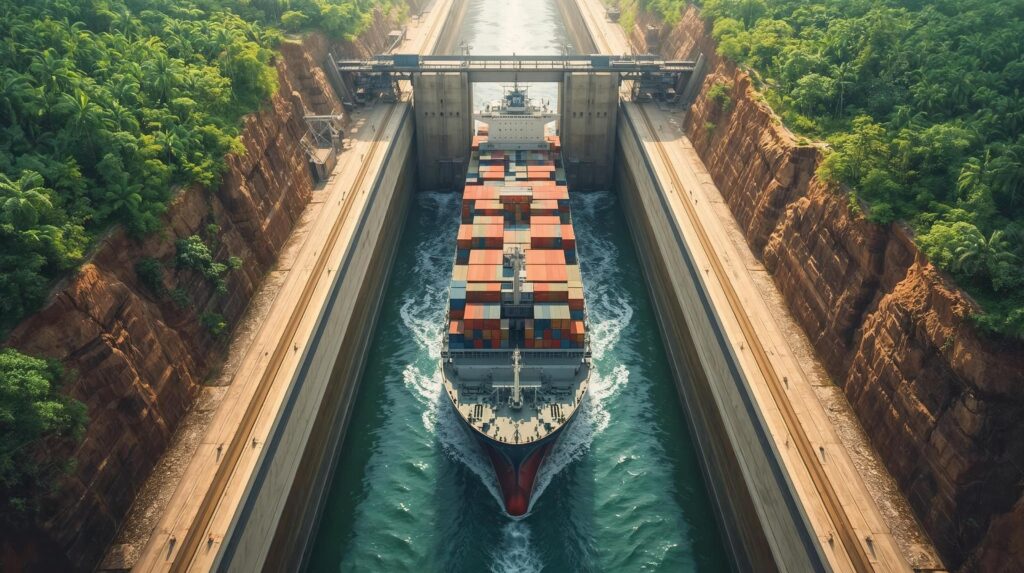
American engineers redesigned the canal and adopted a different approach. Instead of cutting a straight sea-level channel, they created a system of locks — giant water elevators that raise ships up to an artificial lake before lowering them again on the other side.
Construction began in 1904, and the project quickly became one of the largest engineering efforts in history.
Workers blasted through mountains, redirected rivers, and built massive concrete lock chambers.
After ten years of work, the canal officially opened in 1914.
🚢 How the Canal Actually Works
The Panama Canal does not simply connect the two oceans at sea level.
Instead, ships pass through a series of locks that raise them about 26 meters (85 feet) above sea level to cross Gatun Lake, a large artificial lake created during construction.
The process works like a staircase made of water:
- Ships enter the first lock chamber
- Water fills the chamber, lifting the ship upward
- The ship moves into the next chamber
- The process repeats until it reaches the lake level
After crossing the lake, the locks gradually lower the ship back down to sea level on the opposite side.
Each transit through the canal typically takes 8 to 10 hours.
🌍 A Shortcut That Saves Weeks
The Panama Canal dramatically reduced travel distances between major ports.
For example:
– A ship traveling from New York to San Francisco would save more than 13,000 kilometers compared with sailing around South America.
– Voyages that once took weeks could now be completed far more quickly.
This shortcut transformed international shipping and helped accelerate global trade.
The canal became one of the most strategically important waterways on Earth.
🛳️ Expanding for the Modern World
Over time, global shipping vessels grew larger than the original canal locks could handle.
To accommodate modern cargo ships, a major expansion project was completed in 2016, adding a new set of larger locks known as the Panama Canal Expansion.
These new locks allow much larger ships — called Neo-Panamax vessels — to pass through the canal.
This expansion reinforced the canal’s role as a critical artery of global commerce.
🧠 Engineering Against Nature
Building the Panama Canal required solving enormous challenges.
Engineers had to manage:
– Tropical rainfall
– Landslides in unstable soil
– Massive excavation through rock
– The control of the powerful Chagres River
At one point, the project required moving more earth than any previous engineering project in history.
The canal stands as one of the greatest examples of human determination overcoming geographic obstacles.
🌎 A Global Trade Lifeline
Today, the Panama Canal handles thousands of ships every year, transporting goods such as:
– Oil and natural gas
– Vehicles
– Grain and food products
– Consumer goods and electronics
About 5% of the world’s maritime trade passes through the canal.
For many shipping routes, it remains the fastest and most efficient connection between two oceans.
💡 A Shortcut That Changed the World
What once seemed like an impossible dream — carving a passage through a tropical continent — became one of the most influential engineering achievements in history.
The Panama Canal reshaped global trade, reduced travel times, and connected economies across oceans.
It is a reminder that sometimes the most powerful innovations are not new technologies, but new pathways.
A narrow channel of water changed how the world moves.
Continue Exploring on Trivialwiki
If you enjoyed learning how engineering projects can transform global trade, don’t miss our previous post:
👉 Velcro and the Plant That Inspired a Global Invention
Discover how a tiny plant burr led to one of the most widely used fastening technologies in the world.
📬 Stay Connected with Trivialwiki
👉 Facebook: https://facebook.com/Trivialwiki
👉 Instagram: https://instagram.com/trivialwiki
👉 YouTube: https://youtube.com/@trivialwiki
👉 Pinterest: https://pinterest.com/Trivialwiki
Learn. Explore. Discover.
The Panama Canal transformed global shipping by creating a shortcut between two oceans — what other engineering projects do you think changed the world in unexpected ways? Share your thoughts in the comments! 🌎🚢
Green trees sway karfaoqer.com