
At first glance, Singapore does not seem like the kind of country that would become one of the world’s major economic success stories.
It is a small island nation with limited natural resources, a land area smaller than many large cities, and a population far smaller than most global powers.
Yet today, Singapore is known for:
– one of the world’s busiest ports
– a highly advanced economy
– exceptional urban planning
– modern infrastructure
– one of the highest standards of living in Asia
Its transformation from a modest trading port into a global financial and technological hub is one of the most remarkable development stories in modern history.
🌏 A Small Nation in a Strategic Location
Singapore sits at the southern tip of the Malay Peninsula in Southeast Asia.
Although small in size, its location is incredibly important.
The island lies near the Strait of Malacca, one of the busiest shipping routes in the world. For centuries, ships traveling between:
– Europe
– the Middle East
– India
– China
– Southeast Asia
passed through this region.
Because of this strategic position, Singapore became an important trading center long before it became an independent country.
🚢 From Trading Port to Colonial Hub
In 1819, British official Sir Stamford Raffles established Singapore as a trading post for the British East India Company.
The island quickly grew into a major port because of its excellent location and free-trade policies.
Merchants from many regions arrived, including:
– Chinese traders
– Indian merchants
– Arab businesses
– European companies
Over time, Singapore developed into one of the busiest ports in Asia.
Its multicultural population also began taking shape during this period.
🇸🇬 Independence and Uncertainty
Singapore’s path to independence was not simple.
After World War II and the end of British colonial rule, Singapore briefly joined Malaysia in 1963.
However, political and economic tensions led to Singapore becoming an independent nation in 1965.
At the time, many people were uncertain whether the small country could survive on its own.
Singapore faced major challenges:
– limited land
– no significant natural resources
– unemployment
– housing shortages
– regional instability
Its future was far from guaranteed.
🏗️ Building a Modern Nation
Under the leadership of Lee Kuan Yew and his government, Singapore began an ambitious transformation.
The country focused heavily on:
– education
– infrastructure
– industrial development
– trade
– anti-corruption policies
Large public housing programs helped provide homes for much of the population.
The government also invested in:
– ports
– airports
– transportation systems
– business-friendly policies
These efforts attracted international companies and investors.
Over time, Singapore evolved into a major center for finance, shipping, manufacturing, and technology.
✈️ One of the World’s Most Connected Cities
Despite its small size, Singapore became one of the most globally connected places on Earth.
Its airport, Changi Airport, is frequently ranked among the best in the world.
Its port is one of the busiest shipping hubs globally, handling enormous volumes of international cargo.
Singapore also developed into an important financial center where multinational companies operate regional headquarters.
Its economy became deeply connected to global trade.
🌳 A “City in Nature”
Singapore is also famous for its urban planning and greenery.
Although highly modern and densely populated, the city-state invests heavily in parks, gardens, and environmental design.
The government actively promotes tree planting and green spaces throughout the city.
Today Singapore is often described as a “City in Nature.”
Famous attractions include:
– Gardens by the Bay
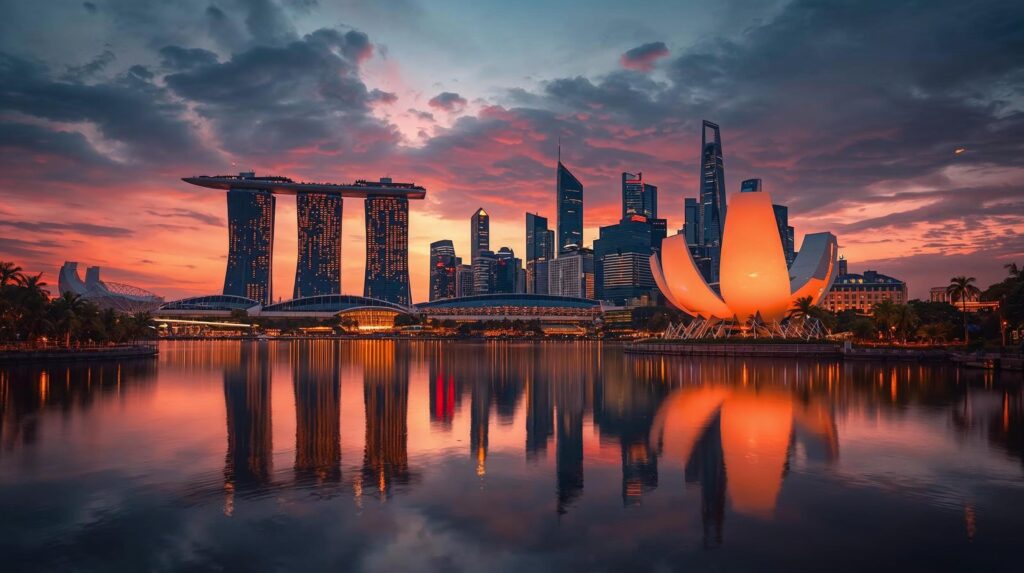
– Marina Bay Sands
– the Supertree Grove
– extensive urban parks
The country combines dense urban development with carefully planned environmental spaces.
🌍 A Multicultural Society
Singapore’s population reflects centuries of migration and trade.
The country officially recognizes multiple ethnic communities, including:
– Chinese
– Malay
– Indian
– Eurasian groups
This diversity influences:
– food
– languages
– festivals
– architecture
– cultural traditions
Singapore has four official languages:
– English
– Mandarin Chinese
– Malay
– Tamil
English serves as the main working language, helping connect Singapore internationally.
📚 Education and Innovation
One of Singapore’s major priorities has been education.
The country invested heavily in building strong schools and universities, emphasizing science, mathematics, engineering, and technology.
Today Singapore is known for:
– advanced research
– technological innovation
– highly skilled workforce development
This focus helped the country move from manufacturing into finance, biotechnology, digital technology, and advanced services.
💡 A Remarkable Transformation
Singapore’s rise demonstrates how geography alone does not determine a nation’s future.
Despite limited natural resources and small size, the country used:
– strategic planning
– global trade
– education
– infrastructure
– long-term policy decisions
to become one of the world’s most successful economies.
Its story is often studied as an example of rapid national development.
🌆 A Small Country with a Global Presence
Today Singapore stands as one of the world’s most influential small nations.
Its skyline, ports, airports, and financial districts reflect decades of transformation driven by careful planning and global connectivity.
What began as a small island trading port evolved into a modern global hub linking East and West.
A reminder that sometimes the smallest countries can leave the biggest impact on the world.
Continue Exploring on Trivialwiki
If you enjoyed learning about remarkable transformations in the modern world, don’t miss our previous post:
👉 Moore’s Law and the Prediction That Powered Modern Computing
Discover how a simple observation about computer chips helped shape the digital age.
📬 Stay Connected with Trivialwiki
📬 Stay Connected with Trivialwiki
👉 Facebook: https://facebook.com/Trivialwiki
👉 Instagram: https://instagram.com/trivialwiki
👉 YouTube: https://youtube.com/@trivialwiki
👉 Pinterest: https://pinterest.com/Trivialwiki
Learn. Explore. Discover.
Singapore transformed from a small island into a global powerhouse — which country’s development story fascinates you the most? Share your thoughts in the comments! 🌏
Автосервис Тойота в Москве предлагает широкий спектр услуг. В этом автосервисе вы найдете опытных техников, которые знают все о Тойота.
Если вам нужен качественный и надежный автосервис Toyota, мы предлагаем широкий спектр услуг для вашего автомобиля.
Работа с автомобилями этой марки требует особого подхода. Мастера сервиса постоянно повышают свою квалификацию для качественного обслуживания.
Техническое оснащение сервиса соответствует самым высоким стандартам. Это позволяет проводить диагностику и ремонт на высшем уровне.
Обращаясь в автосервис Тойота, вы можете рассчитывать на высокое качество услуг. Мы ценим каждого клиента и стремимся к его удовлетворенности.