
Imagine sitting in front of a computer in the 1960s. There is no familiar desktop filled with icons, no colorful windows, no wireless mouse 🖱️, and no simple way to point at something on the screen. If you wanted to tell the computer what to do, you usually had to type commands using a keyboard.
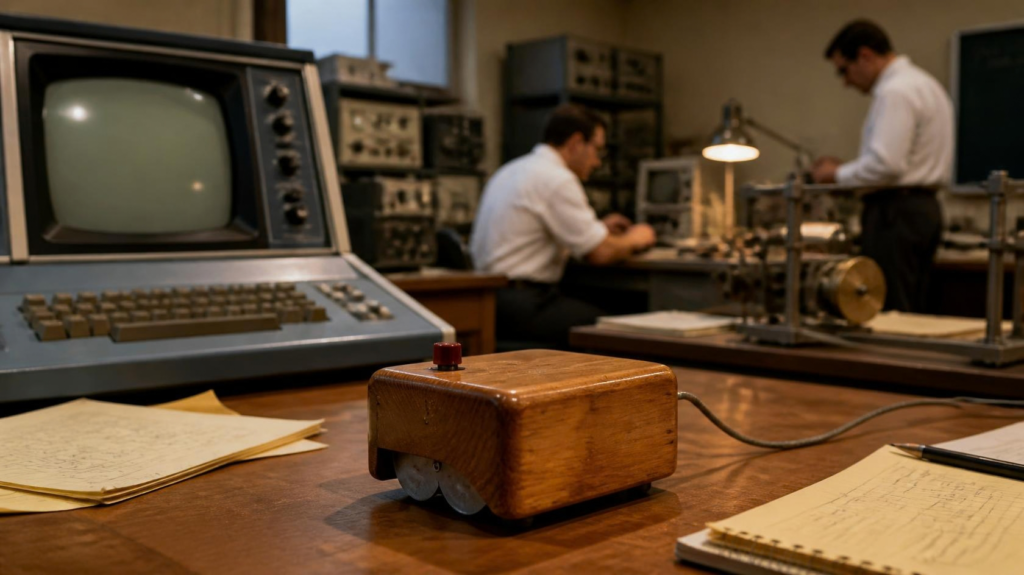
Then came a strange little invention: a small wooden box with wheels underneath, a single button on top, and a cable trailing behind it like a tail.
That humble wooden box would eventually become one of the most familiar objects in modern computing—the computer mouse.
Today, almost every desktop computer user understands how a mouse works. We move it across a surface, the pointer moves on the screen, and we click buttons to open files, select text, browse websites, or play games. But the original version looked surprisingly primitive compared with the sleek optical and wireless mice we use today.
The first computer mouse was built in 1964 by engineer Bill English, based on an idea developed by computer pioneer Douglas Engelbart at the Stanford Research Institute, now known as SRI International. It was carved from wood, had two wheels underneath, and contained just one button.
It was not designed to look beautiful. It was not created for gaming, office work, or browsing the internet. It was built to answer a much bigger question:
How could humans interact with computers more naturally and efficiently?
A World Before the Mouse
To understand why the mouse was such an important invention, we need to travel back to a time when computers worked very differently.
Modern computers are designed around graphical interfaces. We see icons, menus, folders, buttons, images, and windows. We can move a pointer, click on an object, drag it somewhere else, and immediately see the result.
Early computers were not like that.
Many computers in the 1950s and early 1960s were operated through keyboards, punched cards, switches, or command-based systems. Users often had to type instructions or prepare information in advance. Computers were powerful machines, but interacting with them was not especially natural.
Douglas Engelbart believed this could be improved.
Engelbart was a researcher who wanted computers to help people solve complicated problems, organize information, and work together more effectively. His vision was much broader than simply making computers faster. He wanted to make computers easier for humans to use.
In the early 1960s, he began exploring better ways for people to control information displayed on a computer screen. A keyboard was useful for entering text, but it was not always ideal for pointing at a particular location on a display.
If someone wanted to select a word, highlight a paragraph, move an object, or choose a location on a screen, there had to be a better method.
That was where the idea of a pointing device began to take shape.
The Idea Came Before the Invention
The first concept behind the mouse appeared in Engelbart’s thinking around 1961. While considering computer graphics and human-computer interaction, he imagined a device that could track movement across a surface and translate that movement into coordinates on a screen.
The idea was surprisingly simple.
If a device could detect movement from left to right and forward to backward, a computer could use those two directions to control the position of a cursor.
In modern terms, these are the X and Y coordinates.
The concept was inspired partly by a mechanical instrument called a planimeter, which was used by engineers and mapmakers to measure areas on drawings, maps, and blueprints. Engelbart realized that a similar principle could be used in reverse: instead of using movement to measure a drawing, movement could be used to control a cursor on a display.
He imagined a small device with wheels that would roll across a desk. One wheel would detect horizontal movement, while another would detect vertical movement. The computer could combine those signals and move a pointer on the screen.
At first, this was only an idea recorded in a notebook. But it eventually became a working machine.
The Wooden Box That Started It All
In 1964, Engelbart’s team at SRI began building and testing different pointing devices. The team wanted to discover which method would allow people to select information on a screen most quickly and accurately.
Several designs were considered. Some devices were based on existing technologies, while others were experimental inventions created inside the laboratory.
One of the devices was built by Bill English, the chief engineer working with Engelbart.
English created a small handheld device using a wooden shell. Inside it were two wheels mounted at right angles to each other. These wheels touched the surface beneath the device and detected movement.
The wooden casing was not manufactured in a modern electronics factory. It was made in the SRI machine shop, using materials and tools that were available at the time.
The result looked more like a small wooden block than a modern computer accessory.
It had:
- A wooden outer shell.
- Two metal tracking wheels.
- A single button on top.
- A cable connected to the computer.
- A mechanism for translating movement into screen coordinates.
There was no optical sensor, no scroll wheel, no Bluetooth connection, and no smooth plastic casing.
Yet the basic purpose was already there: move the device, and the pointer moved.
The first prototype is often described as a wooden mouse because it genuinely looked like one of the simplest possible versions of the device.
Why Was It Called a Mouse?
The name “mouse” was not originally a carefully planned brand name.
The early device had a cable extending from its rear. When the small wooden box was moved around the desk, the cable looked like a tail. The shape of the device, combined with the trailing wire, reminded people of a small mouse.
The nickname simply stuck.
There are different recollections about exactly who first used the name, and even the researchers involved could not always remember the precise moment it became popular. But the explanation is easy to understand: the device was small, moved around a surface, and had a tail-like cable.
The official patent did not call it a mouse.
Instead, the invention was described using the much more technical name:
“X-Y Position Indicator for a Display System.”
That title explains what the device actually did. It detected movement along two axes and used that information to control a position on a computer display.
“X-Y Position Indicator” may have been accurate, but “mouse” was much easier to remember.
The Mouse Was Not the Only Option
Engelbart’s team did not automatically assume that the mouse was the best pointing device. They tested it against several alternatives.
At the time, other pointing technologies included:
- Light pens.
- Joysticks.
- Trackballs.
- Pivoting devices.
- Knee-operated controls.
- Other experimental input mechanisms.
A light pen, for example, allowed a user to point directly at a screen. It was an important technology and had been used in earlier computer systems. A joystick could also control movement, while a trackball allowed users to rotate a ball with their hand.
The mouse had to prove that it was more useful than these alternatives.
The team conducted experiments to compare the devices in terms of speed, accuracy, and ease of use. The results were impressive: the mouse performed extremely well and was found to be faster and less error-prone in many of the tested tasks.
That was a major turning point.
The mouse was not selected merely because it looked interesting. It was selected because it worked.
The experiments helped establish the mouse as an important part of Engelbart’s developing computer system.
The First Mouse Had Only One Button
Modern mice can have several buttons, a scroll wheel, side controls, adjustable sensitivity, and even programmable lighting. The first mouse was much simpler.
It had only one button.
The button was positioned on top of the wooden casing and was used to select items or perform an action. Later designs experimented with more buttons, and Engelbart’s team eventually used versions with multiple buttons.
The researchers considered different numbers of buttons, including designs with several switches. However, the available space and technology placed practical limits on how many buttons could fit into the device.
The first prototype was therefore extremely basic. It did not need to perform all the functions of a modern mouse. Its main job was to demonstrate that hand movement could be translated into movement on a computer screen.
That simple achievement was enough to change the future of computing.
How Did the Wooden Mouse Work?
The first mouse did not use the optical sensor found in most modern mice. Instead, it relied on mechanical wheels.
Inside the wooden casing were two wheels mounted perpendicular to each other.
One wheel detected movement along the horizontal axis. The other detected movement along the vertical axis. As the user moved the mouse across a surface, the wheels rotated.
The rotation was converted into electrical signals that the computer interpreted as movement.
For example, if the user moved the mouse to the right, the horizontal wheel detected that movement. If the user moved it forward, the vertical wheel detected movement in that direction. The computer then updated the cursor’s position on the screen.
This was an elegant solution to a difficult problem.
The device did not need to understand what the user was pointing at. It only needed to communicate movement. The computer’s software could then decide what happened when the pointer reached a particular location or when the user pressed the button.
The basic principle remains familiar today, even though the technology has changed dramatically.
The Mouse Was Demonstrated to the World in 1968
The mouse remained a research prototype for several years. It was not immediately sold in computer shops, and most people had never seen anything like it.
That changed on December 9, 1968.
Douglas Engelbart and his team presented a remarkable demonstration at the Fall Joint Computer Conference in San Francisco. The event later became famous as “The Mother of All Demos.”
The presentation showed a collection of ideas that were far ahead of their time.
Among the technologies demonstrated were:
- A computer mouse.
- Graphical display elements.
- Hypertext links.
- Collaborative document editing.
- Video conferencing concepts.
- Shared-screen interaction.
- Text editing and document management.
- Early ideas resembling modern computer interfaces.
The mouse was only one part of the presentation, but it attracted attention because it offered a new way to interact with a computer.
Instead of typing every instruction, users could point at information and select it. This made computing feel more direct and visual.
The demonstration did not immediately transform the consumer computer market. However, it showed researchers and technology companies what interactive computing could become.
The wooden mouse had officially entered computing history.
The Patent Came Later
Although the first prototype was built in 1964, the patent process took longer.
SRI filed a patent application in 1967. The patent was granted in 1970 under the technical title “X-Y Position Indicator for a Display System.”
The patent described a device that used wheels to detect movement and translate it into positional information for a display.
The invention was credited to Douglas Engelbart, while Bill English played a key role in constructing the first physical prototype.
This distinction is important. Many inventions are created through teamwork. One person may develop the original concept, another may build the hardware, and others may test, refine, or improve it.
The computer mouse was one of those collaborative inventions.
Xerox PARC Did Not Invent the Mouse
The mouse is sometimes mistakenly credited to Xerox PARC, the famous research center that helped develop many important computer technologies.
Xerox PARC did play a major role in the history of graphical computing. Its researchers helped develop systems that made the mouse much more practical and influential, including the Xerox Alto computer.
However, the mouse itself was invented before Xerox PARC existed.
The first wooden prototype was built at SRI in 1964. Xerox PARC was established later, in 1970.
The confusion exists because Xerox PARC helped bring together many ideas that became central to modern computing. Its work on graphical interfaces, windows, icons, networking, and pointing devices strongly influenced later computers.
But the original wooden mouse belongs to Douglas Engelbart, Bill English, and the SRI research team.
From Wooden Wheels to Optical Sensors
The mouse changed considerably after its first prototype.
One important improvement came in the early 1970s, when Bill English developed a design that used a rolling ball instead of two perpendicular wheels.
This became known as the ball mouse.
The ball touched the desk surface and rotated as the mouse moved. Inside the device, rollers detected the ball’s movement and converted it into signals representing direction and speed.
The ball mouse was more flexible than the original wheel-based design because it could detect movement in different directions without requiring the user to move the device in a particular way.
For many years, ball mice became common in homes, offices, and schools.
Eventually, mechanical ball mice were replaced by optical mice. Optical mice use light and a sensor to track changes in the surface beneath them. This removed the need for a moving ball and reduced problems caused by dust, dirt, and mechanical wear.
Later developments introduced laser sensors, wireless connections, adjustable sensitivity, gaming features, and programmable controls.
Despite these improvements, the basic goal remained the same as it was in 1964:
Turn the movement of a human hand into movement on a computer screen.
A Simple Invention With a Huge Impact
The first mouse was not technically complex by modern standards. It was made from wood, used mechanical wheels, and had only one button.
But inventions do not always need to be complicated to be important.
The mouse solved a major problem in human-computer interaction. It gave people a way to point, select, and interact with information without having to type every command.
That helped make computers more approachable.
As graphical user interfaces became popular, the mouse became increasingly useful. Users could open folders, move files, select text, draw pictures, edit documents, and navigate software through simple hand movements.
The mouse also helped shape the design of modern software. Buttons needed to be clickable. Menus needed to respond to pointer movement. Icons needed to be arranged in ways that made sense. Applications began to assume that users could point at objects and interact with them directly.
In that sense, the mouse did more than control a pointer. It helped influence the way people think about using computers.
The Inventor Did Not Become Rich From the Mouse
One of the more surprising details in the mouse’s history is that Douglas Engelbart did not become wealthy from the invention.
The patent was held by SRI, Engelbart’s employer. The mouse later became an important part of personal computing, but the patent expired before the technology became widely dominant in the consumer market.
As a result, Engelbart did not receive the enormous financial rewards that people might associate with such a widely used invention.
His greatest contribution was not simply the mouse itself. He helped imagine an entirely new relationship between humans and computers—one based on interaction, information sharing, collaboration, and the idea that computers could expand human intelligence.
The mouse was one piece of that much larger vision.
The Wooden Mouse Still Exists
The original mouse was not merely a historical description. Physical examples and replicas have been preserved in museums and technology collections.
The device is a reminder of how different early computer hardware looked compared with modern electronics.
A current wireless mouse may look polished, ergonomic, and highly engineered. The first mouse looked like something that could have been made in a small workshop.
That contrast is what makes it so fascinating.
The invention did not begin with a sleek product design. It began with a practical experiment and a rough wooden prototype.
The researchers were not trying to create a fashionable accessory. They were trying to discover a better way for people to work with computers.
From a Wooden Box to Everyday Life
Today, the computer mouse is so familiar that many people rarely think about it.
We use it to select text, open documents, edit photographs, design buildings, browse the internet, create software, and play games. Some people use vertical mice, trackballs, ergonomic mice, gaming mice, or wireless models. Others have replaced the mouse with a touchpad, touchscreen, stylus, or voice control.
Yet the original idea remains visible in almost every desktop environment.
A small device moves across a surface. A pointer moves on a screen. A button allows the user to make a selection.
That entire interaction can be traced back to a wooden box built in a research laboratory in 1964.
The first computer mouse was not made from advanced plastics or precision optical components. It was made from wood.
And somehow, that simple invention helped make the digital world feel much more human.
A Small Invention That Changed Computing
The first computer mouse is a wonderful example of how groundbreaking inventions can begin with simple materials and a clear idea.
Douglas Engelbart imagined a better way to interact with computers. Bill English turned that idea into a working wooden device. Their team tested it against other technologies and discovered that it could make screen selection faster and easier.
Over time, the mouse evolved from wooden wheels to mechanical balls, optical sensors, laser tracking, wireless connections, and advanced gaming controls.
But beneath all those improvements is the same original concept:
A computer should respond naturally to the movements of the person using it.
The next time you move your mouse across your desk, remember that you are using a descendant of a small wooden box with two wheels and one button.
Continue Your Journey
If you enjoyed discovering how the computer mouse began, continue your journey with our previous article:
The Strange Reason Airplane Food Tastes Different
Share the Curiosity 🌍
If this story surprised you, share it with someone who uses a computer every day but may not know that the first mouse was made of wood.
- Facebook: https://facebook.com/Trivialwiki
- Instagram: https://instagram.com/trivialwiki
- YouTube: https://youtube.com/@trivialwiki
- Pinterest: https://pinterest.com/Trivialwiki
What Do You Think?
If the first computer mouse had been shown to you in 1964, would you have recognized it as the beginning of a technology that would become essential to modern computing?