
Take a moment to look around your desk.
Chances are you’ll find a ballpoint pen nearby.
It may be clipped to a notebook, resting beside a computer, or tucked into a drawer waiting to be used. It is such a common object that most people rarely think about it.
Yet the ballpoint pen is one of the most successful inventions of the modern age.
Billions are produced every year. They are used in schools, offices, hospitals, banks, and homes across the globe. They have traveled to remote villages, crossed oceans, and even accompanied astronauts into space.
What’s remarkable is that the ballpoint pen was created to solve a surprisingly frustrating problem.
Before its invention, writing could be messy, inconvenient, and often unreliable.
The story of the ballpoint pen is a tale of persistence, innovation, and a simple idea that transformed how the world writes.
✒️ Life Before the Ballpoint Pen
For much of history, writing was a laborious process.
Ancient civilizations used reed pens, quills, and brushes. Later, fountain pens became popular because they could store ink internally, eliminating the need to repeatedly dip a pen into an ink bottle.
Although fountain pens represented a major improvement, they were far from perfect.
The liquid ink flowed easily, which was both an advantage and a disadvantage.
Pens often leaked.
Ink smudged on paper.
Writers had to wait for pages to dry.
Traveling with a fountain pen could be risky because changes in air pressure sometimes caused ink spills.
For journalists, businesspeople, and students, these inconveniences were a constant source of frustration.
The world needed a better solution.
📰 A Journalist Notices a Problem
The breakthrough came from an unlikely source.
A Hungarian journalist named László Bíró spent much of his career working with newspapers.
While observing the printing process, he noticed something interesting.
The ink used in newspapers dried much faster than the ink used in fountain pens.
This fast-drying ink reduced smudging and produced cleaner results.
There was just one problem.
The thicker newspaper ink could not flow through a traditional fountain pen.
Most inventors might have accepted the limitation.
Bíró decided to solve it.
⚙️ The Brilliant Idea of a Tiny Ball
Bíró’s solution was surprisingly simple.
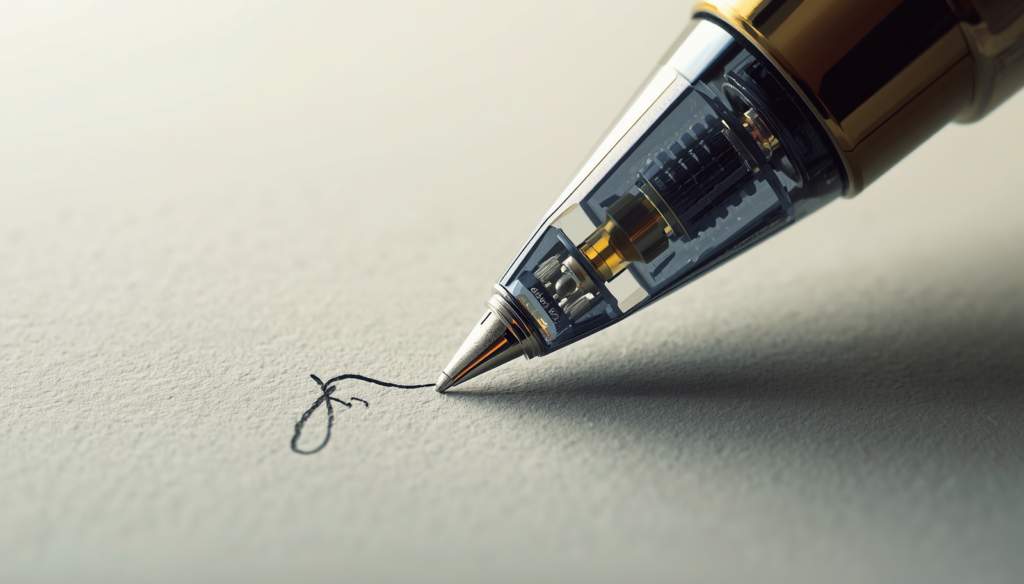
Instead of allowing ink to flow directly from a nib, he placed a tiny rotating ball at the tip of the pen.
As the pen moved across paper, the ball rolled.
The movement picked up ink from an internal reservoir and transferred it smoothly onto the writing surface.
At the same time, the ball acted as a seal, preventing excess ink from leaking out.
The concept solved several problems at once.
The ink dried more quickly.
Smudging was reduced.
Leaks became less common.
The pen became easier to carry and use.
Sometimes the most revolutionary inventions are also the simplest.
🏭 From Prototype to Product
Creating the idea was only the beginning.
Manufacturing a reliable ballpoint pen proved difficult.
The tiny metal ball had to be incredibly precise.
If it was too loose, ink leaked.
If it was too tight, the pen would not write properly.
Developing a consistent production process required years of refinement.
Eventually, Bíró and his collaborators succeeded.
In 1938, he patented his design.
The invention would soon begin changing the world.
✈️ Why Pilots Loved Ballpoint Pens
One of the first groups to embrace ballpoint pens was aviators.
During flight, fountain pens often leaked because of changes in air pressure.
This created obvious problems in aircraft cockpits.
Ballpoint pens were much more reliable.
Their sealed design made them better suited for high-altitude conditions.
As a result, pilots quickly adopted them.
This early success helped demonstrate the practical advantages of the new technology.
What began as a solution for journalists was proving useful in entirely different fields.
🌍 A Writing Revolution
After World War II, ballpoint pens began spreading rapidly.
Consumers appreciated their convenience.
Businesses appreciated their reliability.
Manufacturers appreciated their scalability.
Unlike fountain pens, ballpoint pens required little maintenance.
There was no need to refill ink bottles frequently or clean delicate components.
The pen worked immediately and consistently.
As production increased, prices fell.
What had once been a premium product gradually became affordable for almost everyone.
The ballpoint pen was on its way to becoming a global standard.
📚 Transforming Education and Work
Few inventions have had such a widespread impact on everyday life.
Students could take notes more easily.
Office workers could complete paperwork efficiently.
Professionals could carry dependable writing instruments wherever they went.
The simplicity of the ballpoint pen helped make writing more accessible.
Its influence extended beyond convenience.
Reliable writing tools supported education, communication, and record-keeping on an unprecedented scale.
The modern world runs on information, and the humble ballpoint pen played an important role in spreading it.
🚀 Pens Beyond Earth
The story of the ballpoint pen even extends into space.
Writing in space presents unique challenges because gravity behaves differently in orbit.
Some specialized writing instruments were developed specifically for astronauts.
However, ballpoint pens also found their place in various space missions because of their practicality and reliability.
The fact that a technology designed to solve everyday writing problems could eventually travel beyond Earth says a great deal about its effectiveness.
Few inventors imagine their creations reaching outer space.
💰 The Most Successful Writing Tool Ever Created
Today, billions of ballpoint pens are manufactured annually.
They are available in countless styles, colors, and designs.
Some cost only a few cents.
Others are luxury items crafted from precious materials.
Yet beneath these differences, the fundamental principle remains unchanged.
A tiny rolling ball transfers ink to paper.
The same elegant idea developed decades ago continues to serve humanity.
It is difficult to think of another writing instrument that has achieved such universal adoption.
💡 The Tiny Ball That Changed the World
The ballpoint pen’s success demonstrates an important truth about innovation.
Great inventions do not always involve massive machines or complex technologies.
Sometimes they solve simple problems exceptionally well.
László Bíró wanted a pen that would not smudge and leak.
His solution transformed writing for billions of people.
The next time you sign a document, jot down a note, or scribble a reminder, take a closer look at the pen in your hand.
Inside its tip is a tiny rotating ball.
Small enough to go unnoticed.
Important enough to change the world.
🖊️ Keep Exploring
If you enjoyed discovering the hidden engineering behind everyday objects, don’t miss our previous post:
Learn how tiny ridges and grooves on a key act like physical passwords, helping locks recognize the correct key and keep unwanted visitors out.
📬 Stay Connected with Trivialwiki
👉 Facebook: https://facebook.com/Trivialwiki
👉 Instagram: https://instagram.com/trivialwiki
👉 YouTube: https://youtube.com/@trivialwiki
👉 Pinterest: https://pinterest.com/Trivialwiki
Learn. Explore. Discover.
The ballpoint pen was invented to solve the messy problems of fountain pens, yet it went on to become one of the most widely used tools in human history. What is the oldest pen you still own, and does it still work? Share your story in the comments! 🖊️🌍