
Walk through the baking aisle of any supermarket and compare the prices.
Sugar is relatively cheap.
Cocoa powder is affordable.
Many spices cost only a few dollars.
Then you notice vanilla.
A small bottle of pure vanilla extract often costs surprisingly more than many other flavorings. In some years, natural vanilla has even become more expensive by weight than silver.
This raises an obvious question:
How can a flavor used in ice cream, cakes, cookies, and desserts be so expensive?
The answer lies in a remarkable story involving tropical orchids, disappearing bees, painstaking hand pollination, unpredictable weather, and one of the most labor-intensive agricultural products on Earth.
Behind every drop of natural vanilla is a process that requires extraordinary patience and human effort.
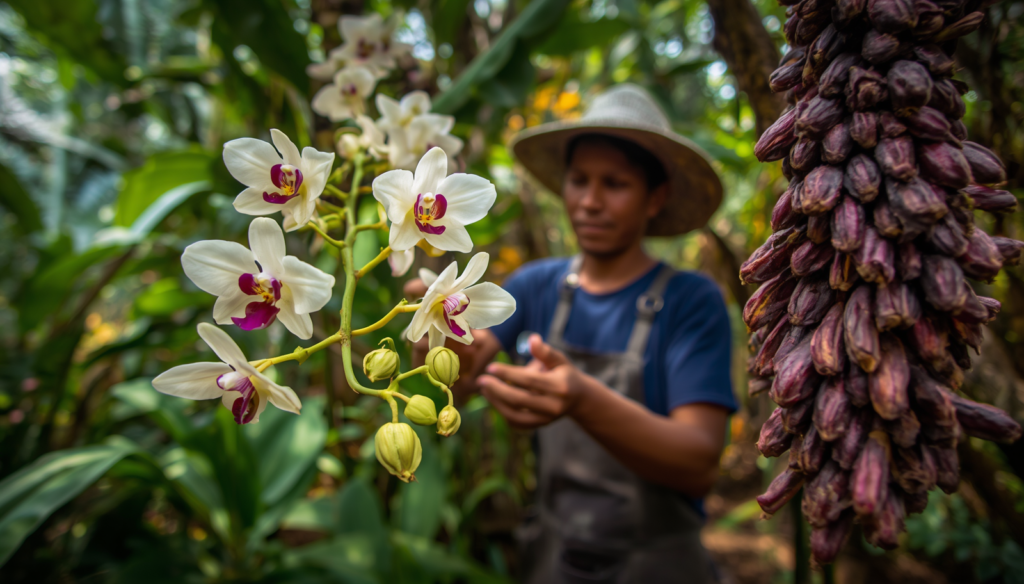
🌸 Vanilla Comes from an Orchid
Many people assume vanilla comes from a tree, a shrub, or perhaps a spice plant.
In reality, vanilla comes from an orchid.
The most widely cultivated species, Vanilla planifolia, produces long green pods often called vanilla beans.
This fact alone makes vanilla unusual.
The orchid family contains thousands of species, but only a few produce edible vanilla.
Growing orchids is already challenging. Producing vanilla orchids is even more demanding because the plants require warm temperatures, high humidity, and careful cultivation.
Yet the real challenge begins when the flowers bloom.
🐝 The Mystery of the Missing Pollinators
When vanilla orchids were first cultivated outside their native habitat, farmers encountered a major problem.
The flowers bloomed beautifully but rarely produced pods.
The reason was surprisingly simple.
In its native environment in parts of Mexico, vanilla evolved alongside specific pollinators, including certain species of bees.
These insects could naturally pollinate the flowers.
When vanilla plants were introduced to other regions, those pollinators were absent.
Without pollination, there would be no vanilla beans.
For years, this limited large-scale vanilla production.
Then a remarkable breakthrough changed everything.
👦 The Discovery That Revolutionized Vanilla
In 1841, a 12-year-old enslaved boy named Edmond Albius living on the island of Réunion discovered an efficient method for hand-pollinating vanilla flowers.
Using a small stick and careful technique, he transferred pollen between parts of the flower manually.
The process worked.
His discovery transformed vanilla cultivation around the world.
Even more astonishing is that farmers still use essentially the same technique today.
More than 180 years later, much of the world’s vanilla production depends on a method developed by a teenager.
✋ Every Flower Must Be Pollinated by Hand
This is where vanilla becomes expensive.
Unlike many crops that can be pollinated naturally or mechanically, vanilla flowers usually require human intervention.
Each flower blooms for only a very short period, often just a single day.
If pollination does not occur during that window, the flower withers and produces no vanilla pod.
Farmers must inspect plants carefully and pollinate individual flowers by hand.
Imagine walking through fields containing thousands of delicate orchid blossoms and repeating this process flower by flower.
The amount of labor required is enormous.
Every successful vanilla bean begins with a human hand.
⏳ Patience Is Essential
Even after pollination, vanilla farmers must wait.
The pods take many months to mature on the vine.
Unlike some crops that can be harvested quickly, vanilla requires patience throughout its growing cycle.
Farmers carefully monitor the developing beans, waiting until the timing is just right.
Harvesting too early can reduce quality.
Harvesting too late can create other problems.
The timing must be precise.
And even then, the work is only beginning.
🌞 The Long Curing Process
Freshly harvested vanilla beans do not smell like vanilla.
This surprises many people.
The familiar aroma develops only after an extensive curing process.
Farmers blanch, sweat, dry, and condition the beans over several months.
During this period, complex chemical reactions occur inside the pods.
The characteristic vanilla flavor gradually emerges.
The process is slow and labor-intensive.
A vanilla bean may spend months curing before it is ready for sale.
When people buy natural vanilla extract, they are purchasing the result of years of cultivation and processing.
🌪️ Weather Can Change Everything
Much of the world’s vanilla comes from regions such as Madagascar.
This concentration creates another challenge.
Extreme weather can have a major impact on global supply.
Cyclones, droughts, and other environmental events may damage crops or reduce yields.
When supply decreases and demand remains high, prices rise.
The vanilla market has experienced dramatic price fluctuations over the years because production depends heavily on conditions that farmers cannot fully control.
A single storm season can influence vanilla prices worldwide.
🍦 Why Not Just Use Artificial Vanilla?
Given the cost of natural vanilla, many manufacturers use alternatives.
Artificial vanilla often relies on a compound called vanillin, which provides much of vanilla’s characteristic flavor.
This approach is far cheaper than cultivating natural vanilla.
However, natural vanilla contains hundreds of flavor compounds beyond vanillin.
These additional compounds contribute depth, complexity, and subtle aromas that many chefs and bakers prefer.
The difference is similar to comparing a symphony orchestra with a single instrument.
Both may play the same melody, but one offers far greater richness.
For this reason, premium products often continue using natural vanilla despite its higher cost.
🌍 A Global Obsession
Today, vanilla is one of the world’s most popular flavors.
It appears in:
ice cream,
cakes,
cookies,
chocolates,
coffee drinks,
perfumes,
and countless other products.
Ironically, because vanilla is so common, people often think of it as ordinary.
In everyday language, “vanilla” is sometimes even used to describe something plain.
Yet there is nothing plain about the journey behind natural vanilla.
Its production requires extraordinary effort from farm to bottle.
💡 One of the World’s Most Remarkable Crops
The next time you enjoy vanilla ice cream or smell vanilla in a dessert, consider what happened before that flavor reached your plate.
An orchid flower bloomed for a single day.
A farmer carefully pollinated it by hand.
Months passed as the pod matured.
Additional months were spent curing and developing the aroma.
Then the finished product traveled across the world.
Few flavors require so much patience and craftsmanship.
Vanilla may seem simple, but its story is one of nature, innovation, and human dedication.
That is why one of the world’s favorite flavors is also one of its most expensive.
🍨 Continue Your Journey
If you enjoyed learning how everyday ingredients have shaped history and commerce, don’t miss our previous post:
👉 The Spice That Changed the World
Discover how black pepper motivated exploration, influenced global trade, and helped shape the course of world history.
📬 Stay Connected with Trivialwiki
👉 Facebook: https://facebook.com/Trivialwiki
👉 Instagram: https://instagram.com/trivialwiki
👉 YouTube: https://youtube.com/@trivialwiki
👉 Pinterest: https://pinterest.com/Trivialwiki
Learn. Explore. Discover.
Natural vanilla is one of the most labor-intensive agricultural products in the world, requiring hand pollination and months of careful processing. Were you surprised to learn how much work goes into producing vanilla? Share your thoughts in the comments! 🍦🌸
1 thought on “Why Is Vanilla So Expensive?”