
Imagine traveling from China to Europe without airplanes, trains, or even modern roads.
The journey would take months, perhaps years. You would cross deserts, climb mountain ranges, navigate unfamiliar cultures, and face dangers ranging from harsh weather to bandits. Few people would attempt such a voyage from beginning to end.
Yet for centuries, goods, ideas, technologies, religions, and cultures moved across exactly such routes.
This vast network became known as the Silk Road, one of the most influential trade systems in human history.
Despite its name, the Silk Road was not a single road.
It was a complex web of interconnected trade routes stretching thousands of kilometers across Asia, the Middle East, and Europe. Along these routes, merchants exchanged far more than products. They helped shape civilizations, spread innovations, and connected distant societies long before the modern era of globalization.
The Silk Road became the ancient world’s version of the internet—a network through which knowledge, culture, and commerce flowed across continents.
🏛️ How the Silk Road Began
The origins of the Silk Road can be traced back more than 2,000 years.
During the reign of the Han Dynasty in China, emperors sought stronger connections with regions to the west. Trade opportunities, diplomatic relationships, and strategic alliances encouraged exploration beyond China’s traditional borders.
Gradually, merchants began traveling farther from home.
At the same time, traders from Central Asia, Persia, India, and the Mediterranean were expanding their own commercial networks.
Over time, these routes linked together.
What emerged was not a single highway but a collection of pathways connecting some of the world’s most important civilizations.
The network eventually stretched from eastern China to the Mediterranean Sea.
🧵 Why Silk Became So Valuable
The Silk Road owes its name to one particular product: silk.
Ancient Chinese silk was highly prized throughout the world.
Lightweight, luxurious, and remarkably strong, silk fascinated foreign merchants and rulers. For centuries, China closely guarded the secrets of silk production, making the fabric rare and valuable outside its borders.
In parts of Europe and the Middle East, silk became a symbol of wealth and status.
Kings, nobles, and wealthy merchants eagerly purchased it.
The demand was so strong that silk often functioned almost like a form of currency.
However, silk was only one of many products transported along the routes.
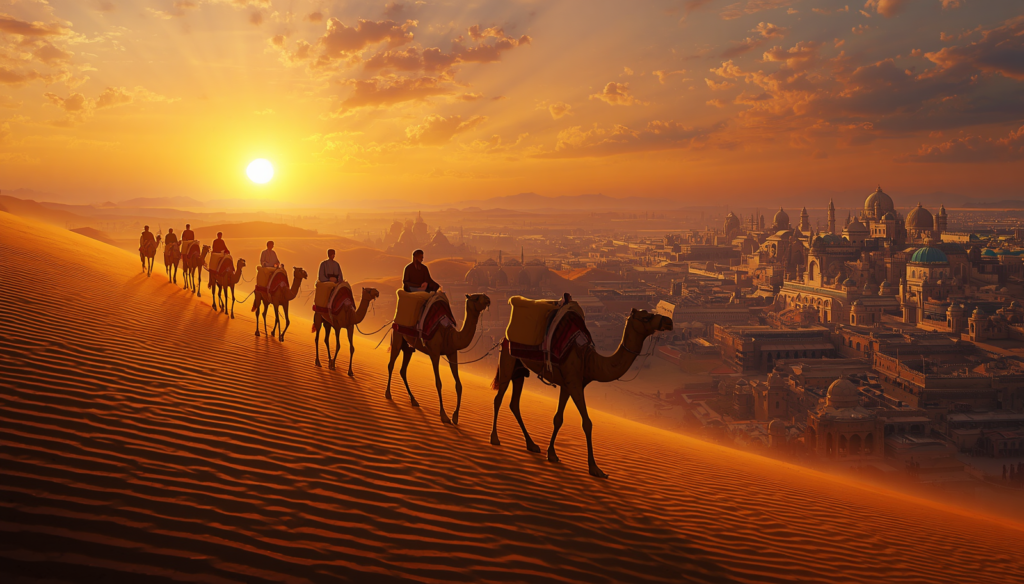
🐫 The Caravans of the Desert
Much of the Silk Road crossed harsh and unforgiving terrain.
Traders frequently traveled through deserts such as the Gobi Desert and the Taklamakan Desert, where temperatures could be extreme and water scarce.
To survive these conditions, merchants relied heavily on caravans.
Long lines of camels carried goods across vast distances.
Camels were perfectly suited for the task. Their ability to travel long distances without water made them invaluable in desert environments.
A single caravan might include dozens or even hundreds of animals.
The sight of these caravans slowly crossing the landscape became one of the defining images of Silk Road commerce.
🌍 More Than Just Trade
Although goods were important, the Silk Road’s greatest impact may have been cultural rather than economic.
People traveling along the routes carried ideas wherever they went.
Religions spread across regions that had never previously encountered them.
Scientific knowledge moved between civilizations.
Artistic styles influenced distant cultures.
Technologies that originated in one part of the world appeared thousands of kilometers away.
In many ways, the Silk Road became a channel through which civilizations learned from one another.
It helped create connections between societies that otherwise might have remained isolated.
📜 The Spread of Revolutionary Ideas
Some of history’s most important innovations traveled along Silk Road routes.
Paper, which originated in China, eventually reached the Middle East and Europe.
The spread of paper transformed communication, education, and record-keeping.
Printing techniques, mathematical knowledge, and scientific discoveries also moved between cultures.
The exchange worked in multiple directions.
Ideas from India, Persia, the Islamic world, and Europe likewise traveled eastward.
The result was a continuous flow of knowledge that accelerated human progress.
Many innovations we take for granted today owe part of their spread to these ancient trade networks.
🕌 The Journey of Religions
The Silk Road played a major role in the spread of religious beliefs.
Buddhism traveled from India into Central Asia and China.
Islam expanded across vast regions connected by trade.
Christianity reached distant communities through merchants and missionaries.
As traders moved between cities and kingdoms, they carried not only goods but also stories, philosophies, and spiritual traditions.
The Silk Road became one of history’s most powerful engines of cultural exchange.
Many regions were permanently transformed by ideas that arrived along these routes.
🏙️ The Rise of Great Trading Cities
Trade created prosperity.
Cities located along major Silk Road routes often flourished.
Places such as Samarkand, Bukhara, and Kashgar became important commercial centers where merchants from different cultures met and exchanged goods.
These cities developed vibrant markets filled with products from distant lands.
Languages, customs, and traditions blended together.
Visitors could encounter traders from dozens of regions in a single marketplace.
The Silk Road helped create some of the most cosmopolitan cities of the ancient world.
⚔️ Trade’s Unwanted Passenger
Not everything carried along the Silk Road was beneficial.
Trade routes also allowed diseases to travel.
Historians believe that some major epidemics spread more rapidly because of increased connections between distant populations.
The most famous example may be the Black Death, which devastated parts of Europe, Asia, and the Middle East during the 14th century.
The same networks that transported silk and spices also transported pathogens.
This reminder highlights an important truth about connectivity: it can spread both opportunities and risks.
🚢 The Decline of the Silk Road
For centuries, the Silk Road remained a vital part of global trade.
Eventually, however, its importance began to decline.
Several factors contributed to this change.
Maritime trade routes became increasingly efficient.
Advances in shipbuilding allowed merchants to transport larger quantities of goods by sea.
Ocean voyages often proved safer, faster, and more economical than crossing deserts and mountain ranges.
Gradually, international trade shifted toward maritime networks.
The Silk Road never disappeared entirely, but its central role diminished.
💡 The Original Globalization Network
Today, the world is connected through airplanes, container ships, fiber-optic cables, and digital communication systems.
Information and goods move faster than ever before.
Yet the basic idea is not new.
More than two thousand years ago, the Silk Road connected distant civilizations through a network of trade and communication.
It demonstrated that human societies thrive when they exchange ideas, knowledge, and products.
Long before modern globalization, the Silk Road showed that the world was already becoming interconnected.
🌏 The Road That Changed the World
The Silk Road was far more than a trade route.
It was a bridge between civilizations.
It connected East and West, facilitated the exchange of knowledge, and helped shape the development of cultures across continents.
Silk, spices, paper, religions, technologies, and ideas all traveled its pathways.
Its influence can still be seen today in the languages we speak, the foods we eat, the technologies we use, and the cultural traditions we inherit.
For centuries, merchants crossing deserts and mountains helped bring the world closer together.
And in doing so, they created one of the most important networks in human history.
🐫 Keep Exploring
If you enjoyed learning about the systems that connected people across vast distances, don’t miss our previous post:
👉 Lightning: Nature’s Most Spectacular Electrical Show
Discover how one of nature’s most powerful phenomena shaped scientific understanding and continues to amaze people around the world.
📬 Stay Connected with Trivialwiki
👉 Facebook: https://facebook.com/Trivialwiki
👉 Instagram: https://instagram.com/trivialwiki
👉 YouTube: https://youtube.com/@trivialwiki
👉 Pinterest: https://pinterest.com/Trivialwiki
Learn. Explore. Discover.
The Silk Road connected civilizations across thousands of kilometers and helped spread goods, ideas, religions, and technologies throughout the ancient world. If you could travel one historic route from the past, would you choose the Silk Road? Why or why not? Share your thoughts in the comments! 🐫🌏
1 thought on “The Silk Road: The Ancient Network That Connected Civilizations”