
Few natural phenomena inspire as much awe as lightning.
One moment, dark clouds gather overhead. The next, a brilliant flash tears across the sky, illuminating the landscape with a burst of energy so powerful that it can be seen from kilometers away. A few seconds later comes the thunder—a deep rumble that reminds us of nature’s immense power.
For thousands of years, lightning frightened and fascinated humanity.
Ancient civilizations often believed it was the weapon of gods. Some cultures viewed it as a sign of divine anger, while others saw it as a symbol of strength and protection. Even today, despite our scientific understanding, watching a lightning storm can feel almost magical.
Yet lightning is not magic.
It is one of nature’s most dramatic demonstrations of electricity, a process involving enormous amounts of energy, complex atmospheric conditions, and some of the most powerful electrical forces found on Earth.
The story of lightning reveals how a common weather event became one of science’s most fascinating subjects.
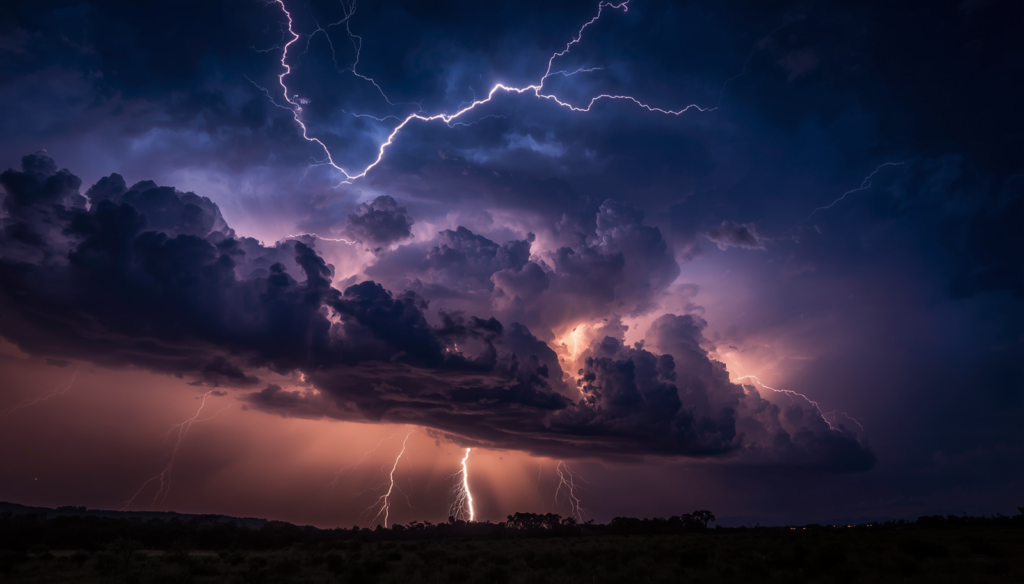
☁️ How Storm Clouds Become Electrically Charged
Lightning begins inside storm clouds.
These clouds are far more active than they appear from the ground. Within them, powerful updrafts and downdrafts constantly move water droplets, ice crystals, and hail particles through different layers of the atmosphere.
As these particles collide, tiny electrical charges are exchanged.
Over time, the cloud becomes electrically separated.
The upper portion of the cloud typically develops a positive charge, while the lower portion becomes negatively charged.
This separation creates an enormous electrical imbalance.
Nature dislikes imbalance.
As the difference in charge grows larger, the atmosphere begins searching for a way to restore equilibrium.
That search eventually produces lightning.
⚡ The Moment a Lightning Bolt Forms
Air normally acts as an excellent electrical insulator.
Electricity cannot easily travel through it.
However, when the electrical difference between charged regions becomes large enough, the insulating properties of air begin to break down.
A channel of ionized air forms.
Once this conductive pathway exists, electricity can suddenly surge through it.
The result is a lightning bolt.
The process happens incredibly quickly.
A lightning strike may last only a fraction of a second, yet during that brief moment, enormous amounts of energy are released.
The flash we see is the visible evidence of electricity racing through the atmosphere.
🌍 Not All Lightning Strikes the Ground
Many people imagine lightning as a bolt traveling from a cloud to the ground.
While this certainly happens, it represents only part of the story.
Lightning can occur:
- between different clouds
- within the same cloud
- between a cloud and the ground
- between clouds and the upper atmosphere
In fact, most lightning never reaches the ground at all.
Many flashes remain entirely within storm systems.
These hidden electrical exchanges occur constantly around the world, often unnoticed by people below.
🔥 Hotter Than the Surface of the Sun
One of the most astonishing facts about lightning involves temperature.
The channel through which lightning travels can reach temperatures approaching 30,000°C (54,000°F).
That is several times hotter than the surface of the Sun.
This intense heat causes the surrounding air to expand explosively.
The rapid expansion creates a shock wave that travels through the atmosphere.
We hear this shock wave as thunder.
In other words, thunder is not a separate phenomenon.
It is the sound created by lightning superheating the air.
⏱️ Why Thunder Arrives Later
Have you ever noticed that lightning appears before thunder?
This delay often causes confusion.
The explanation lies in the different speeds of light and sound.
Light travels extraordinarily fast.
The flash reaches your eyes almost instantly.
Sound moves much more slowly through the atmosphere.
As a result, thunder arrives several seconds later.
The longer the delay between the flash and the thunder, the farther away the lightning strike occurred.
This simple observation has helped people estimate the distance of storms for generations.
🌎 A Planet Constantly Sparkling
Lightning is not a rare event.
At any given moment, thousands of thunderstorms are active around the world.
Scientists estimate that Earth experiences millions of lightning strikes every day.
Viewed from space, our planet appears to sparkle continuously.
Storm systems across continents and oceans generate an almost constant display of electrical activity.
Most of it occurs far from major population centers, which is why people often underestimate just how common lightning truly is.
Earth is far more electrically active than it appears.
🦒 The Surprising Connection to Tall Objects
Lightning tends to strike tall objects more frequently.
Trees, towers, buildings, and mountains often become preferred targets because they reduce the distance electricity must travel to reach the ground.
This is why skyscrapers frequently experience lightning strikes.
The famous Empire State Building is struck dozens of times each year.
Fortunately, modern structures are often equipped with lightning protection systems.
These systems safely channel electrical energy into the ground, preventing significant damage.
The principle behind them traces back to one of history’s most famous scientific experiments.
🪁 Benjamin Franklin and the Kite
When people think about lightning and science, one name often comes to mind: Benjamin Franklin.
According to popular accounts, Franklin flew a kite during a thunderstorm in 1752 to investigate whether lightning and electricity were related.
Although the story is often simplified and sometimes exaggerated, Franklin’s work helped establish an important scientific understanding.
He demonstrated that lightning was indeed an electrical phenomenon.
His research eventually led to the development of the lightning rod, one of the most successful safety inventions in history.
🚀 Lightning Beyond Earth
Lightning is not unique to our planet.
Scientists have observed lightning on several other worlds within our Solar System.
Massive storms on planets such as Jupiter and Saturn produce powerful electrical activity.
These discoveries suggest that lightning may be a common feature of planetary atmospheres.
Wherever conditions allow electrical charges to build and separate, nature seems capable of creating spectacular displays of energy.
In a sense, lightning is a universal phenomenon.
💡 The Flash That Changed Science
For ancient civilizations, lightning was a mystery.
For modern science, it became a gateway to understanding electricity.
The study of lightning helped scientists uncover principles that eventually contributed to technologies powering homes, industries, communications systems, and modern life itself.
What begins as a flash in the sky connects directly to some of humanity’s greatest scientific achievements.
Few natural events have inspired so much curiosity while teaching us so much about the world around us.
⚡ A Reminder of Nature’s Power
Despite centuries of scientific progress, lightning remains one of nature’s most dramatic spectacles.
Its flashes illuminate storms, its thunder shakes the air, and its energy reminds us that Earth’s atmosphere is far more dynamic than it appears.
Every bolt represents a struggle to restore balance.
An invisible buildup of electrical charge suddenly released in a brilliant display visible across the sky.
The next time a storm rolls in and lightning flashes overhead, remember that you are witnessing one of the most powerful and fascinating natural processes on Earth.
For a moment, the atmosphere becomes a giant electrical circuit—and the sky lights up with its energy.
🌩️ Continue Your Journey
If you enjoyed exploring the hidden science behind everyday phenomena, don’t miss our previous post:
👉 The World’s First Bank: How Modern Banking Began
Discover how medieval merchants, money changers, and early financial institutions helped create the foundations of the modern global economy.
📬 Stay Connected with Trivialwiki
👉 Facebook: https://facebook.com/Trivialwiki
👉 Instagram: https://instagram.com/trivialwiki
👉 YouTube: https://youtube.com/@trivialwiki
👉 Pinterest: https://pinterest.com/Trivialwiki
Learn. Explore. Discover.
Lightning may last only a fraction of a second, but it releases extraordinary amounts of energy and reveals the hidden electrical forces at work in Earth’s atmosphere. Have you ever witnessed an unforgettable lightning storm? Share your experience in the comments! ⚡🌩️
1 thought on “Lightning: Nature’s Most Spectacular Electrical Show”