
Imagine carrying your entire life savings in a bag of gold coins.
That was the reality for much of human history.
Merchants traveling between cities often transported large amounts of money across dangerous roads. Theft was a constant concern. Even storing wealth at home carried significant risks. If a fire, flood, or robbery occurred, years of savings could disappear overnight.
As trade expanded and economies became more sophisticated, people needed a safer way to manage money.
The solution would eventually transform the world.
It began with institutions that could safely store wealth, transfer funds between distant locations, and provide loans to businesses and individuals. Over time, these institutions evolved into what we now call banks.
Today, banks are so deeply integrated into daily life that most people rarely think about their origins.
Yet the story of the world’s first banks is one of trust, innovation, commerce, and human ingenuity. It is a story that helped lay the foundations for the modern global economy.
🏺 Banking Before Banks
Long before formal banks existed, people still needed financial services.
Ancient civilizations developed various methods for storing wealth and facilitating trade.
In ancient Mesopotamia, temples often served as secure locations where valuable goods could be stored. Because these institutions were respected and protected, people trusted them with their assets.
Records suggest that temple administrators sometimes facilitated loans and financial transactions.
Similar practices appeared in other ancient societies, including Egypt, Greece, and Rome.
While these systems were not banks in the modern sense, they demonstrated an important idea: people were willing to trust institutions to safeguard their wealth.
That idea would eventually change the world.
⚖️ The Problem of Growing Trade
As commerce expanded during the Middle Ages, financial challenges became more complex.
Merchants were increasingly conducting business across large distances.
A trader in Venice might purchase goods from Constantinople and sell them in France. Carrying large quantities of coins across such journeys was dangerous and inconvenient.
Different regions often used different currencies, creating additional complications.
Commerce needed a more efficient system.
The growth of trade created demand for specialists who could handle money, exchange currencies, and facilitate transactions.
These specialists would become the ancestors of modern bankers.
🪑 The Origin of the Word “Bank”
One of the most interesting parts of banking history is the origin of the word itself.
The term “bank” comes from the Italian word banca, meaning “bench.”
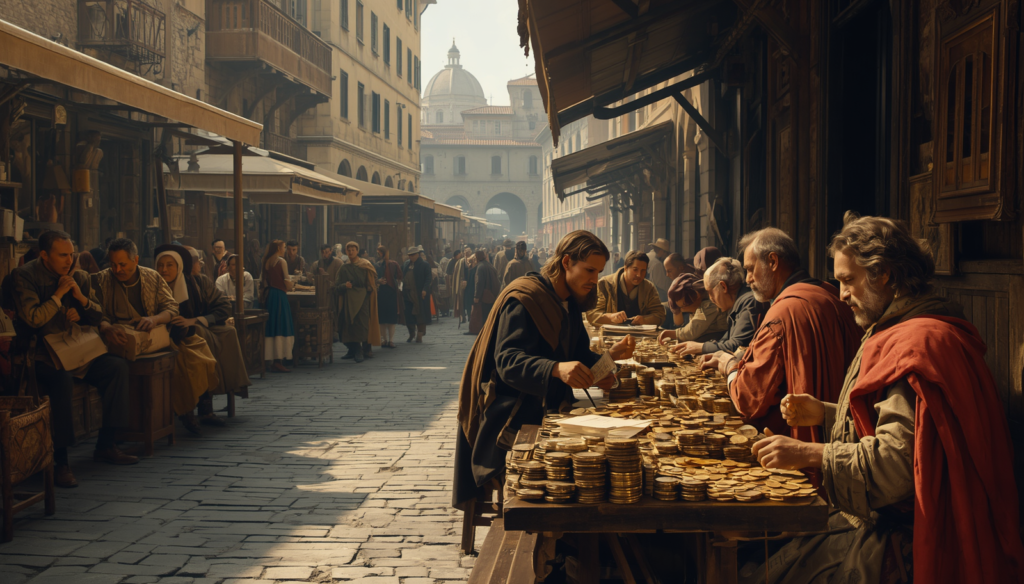
In medieval Italian cities, money changers often conducted business while seated at wooden benches in public marketplaces.
People visited these benches to exchange currencies, settle debts, and conduct financial transactions.
Over time, the bench became associated with the profession itself.
Eventually, the word evolved into the modern term “bank.”
Even today, the language preserves a connection to those early financial traders working in bustling marketplaces centuries ago.
🇮🇹 The Rise of Italian Banking
Many historians trace the roots of modern banking to the powerful city-states of medieval and Renaissance Italy.
Cities such as Venice, Florence, and Genoa became major centers of international trade.
Merchants required financial services on a scale that had never existed before.
Banking families emerged to meet this demand.
They developed systems for:
- accepting deposits
- transferring funds
- exchanging currencies
- financing commercial ventures
These innovations made trade faster, safer, and more efficient.
As a result, Italian banking institutions became some of the most influential financial organizations in Europe.
🏛️ The World’s Oldest Bank
When discussing the world’s first bank, one institution often receives special attention:
Banca Monte dei Paschi di Siena, founded in 1472 in the Italian city of Siena.
Today, it is widely recognized as the oldest continuously operating bank in the world.
Founded more than five centuries ago, it originally focused on providing loans and financial services to local communities.
Remarkably, the institution survived wars, political upheavals, economic crises, and technological revolutions.
Its continued existence provides a direct link to the early history of modern banking.
Very few organizations of any kind can claim such longevity.
✉️ The Innovation of Letters of Credit
One of the most important banking innovations involved something called a letter of credit.
Imagine being a merchant traveling hundreds of kilometers.
Instead of carrying a chest filled with coins, you could deposit money with a banking institution and receive a document proving your funds existed.
Upon reaching another city, you could present the document and access your money.
This dramatically reduced the risks associated with long-distance trade.
The concept may sound familiar because it resembles many modern financial services.
The idea of accessing money without physically carrying it was revolutionary.
🌍 Banking Helps Build a Global Economy
As banking systems improved, trade expanded.
Merchants gained easier access to capital.
Businesses could borrow money to fund growth.
Investments became more practical.
Governments could finance large projects.
In many ways, banking became the infrastructure supporting economic development.
The impact extended far beyond individual transactions.
Banking helped create the conditions that allowed cities, industries, and international commerce to flourish.
Without reliable financial institutions, modern economies would be difficult to imagine.
💳 From Gold Coins to Digital Payments
The world of banking has changed dramatically since the days of medieval money changers.
Today, many financial transactions occur electronically.
People transfer funds through smartphones, pay for purchases with cards, and manage accounts online.
The physical movement of money has largely been replaced by digital information.
Yet the underlying purpose remains remarkably similar.
Banks continue helping people:
- store wealth
- transfer money
- access credit
- support economic activity
The technology has changed, but the fundamental role has endured.
🤝 Why Trust Is the Real Product
Perhaps the most important lesson in banking history is that banks do not primarily deal in money.
They deal in trust.
Customers trust banks to protect deposits.
Businesses trust financial institutions to process transactions.
Borrowers trust lenders to provide access to capital.
Entire economies depend on confidence in financial systems.
Without trust, banking cannot function effectively.
This principle has remained unchanged from the earliest Italian marketplaces to today’s digital financial networks.
💡 The Institution That Changed Commerce Forever
Many inventions transformed transportation, communication, and technology.
Banking transformed something equally important: the movement of money.
By providing secure storage, facilitating trade, and supporting investment, banks helped create the foundations of the modern economy.
What began with merchants, money changers, and wooden benches eventually evolved into a global financial system connecting billions of people.
The next time you use online banking, withdraw cash from an ATM, or make a digital payment, remember that you are participating in a tradition that stretches back centuries.
A tradition that began with a simple idea:
People needed a safer and smarter way to manage money.
💰 You Might Also Enjoy
If you enjoyed learning how financial institutions shaped the modern world, don’t miss our previous post:
👉 Why Does Tennis Use Love, 15, 30, and 40?
Discover the surprising history behind one of sport’s most unusual scoring systems and why tennis still uses terms that originated centuries ago.
📬 Stay Connected with Trivialwiki
👉 Facebook: https://facebook.com/Trivialwiki
👉 Instagram: https://instagram.com/trivialwiki
👉 YouTube: https://youtube.com/@trivialwiki
👉 Pinterest: https://pinterest.com/Trivialwiki
Learn. Explore. Discover.
Banks have existed in some form for thousands of years, but modern banking emerged from the needs of merchants and growing trade networks. Could you imagine managing your finances without banks, cards, or digital payments? Share your thoughts in the comments! 💳🏛️
1 thought on “The World’s First Bank: How Modern Banking Began”