
Imagine waking up in an unfamiliar city and needing directions to your hotel.
You open your phone, type the destination into a navigation app, and within seconds a blue line appears, guiding you turn by turn through streets you’ve never seen before.
Or perhaps you’ve ordered food online and are watching a tiny icon move across a map as your delivery approaches your home.
Maybe you’ve tracked a flight crossing an ocean or watched a rideshare vehicle arrive in real time.
These experiences feel completely ordinary today.
Yet all of them depend on one of the most remarkable technological systems ever created: GPS, the Global Positioning System.
It operates quietly above our heads, twenty-four hours a day, every day of the year. Billions of people rely on it without ever seeing it. Most never stop to wonder how their phone can instantly determine its location anywhere on Earth.
The answer involves satellites traveling through space, atomic clocks accurate to billionths of a second, and one of humanity’s most impressive engineering achievements.
🛰️ The Challenge of Knowing Where You Are
For most of human history, determining location was difficult.
Ancient travelers relied on landmarks, stars, maps, and local knowledge. Sailors crossing oceans often faced enormous uncertainty. A ship could know roughly how far north or south it was, yet determining its east-west position accurately remained a major challenge for centuries.
Mistakes could be costly.
Ships became lost, journeys took longer than expected, and explorers often ventured into the unknown with only rough estimates of their position.
Even as technology improved, accurate navigation remained complicated. Pilots, sailors, and surveyors depended on specialized instruments and calculations that required considerable skill.
The dream of knowing your exact location instantly would have seemed impossible.
🚀 A Space-Age Solution
The story of GPS began during the Cold War.
In 1957, the Soviet Union launched Sputnik 1, the world’s first artificial satellite. Scientists monitoring its radio signals noticed something interesting. As the satellite moved through space, the frequency of its signal appeared to change slightly because of its motion relative to observers on Earth.
This phenomenon, known as the Doppler Effect, inspired a new idea.
If people could determine a satellite’s position by studying its signals, perhaps the reverse was also possible. A receiver on Earth might determine its own location by analyzing signals from satellites.
Over the following decades, engineers developed this concept into a global navigation system.
The result was GPS.
🌍 How GPS Actually Works
At first glance, GPS seems almost magical.
A phone can determine its position within seconds, even in a city it has never visited before.
The reality is a masterpiece of mathematics and timing.
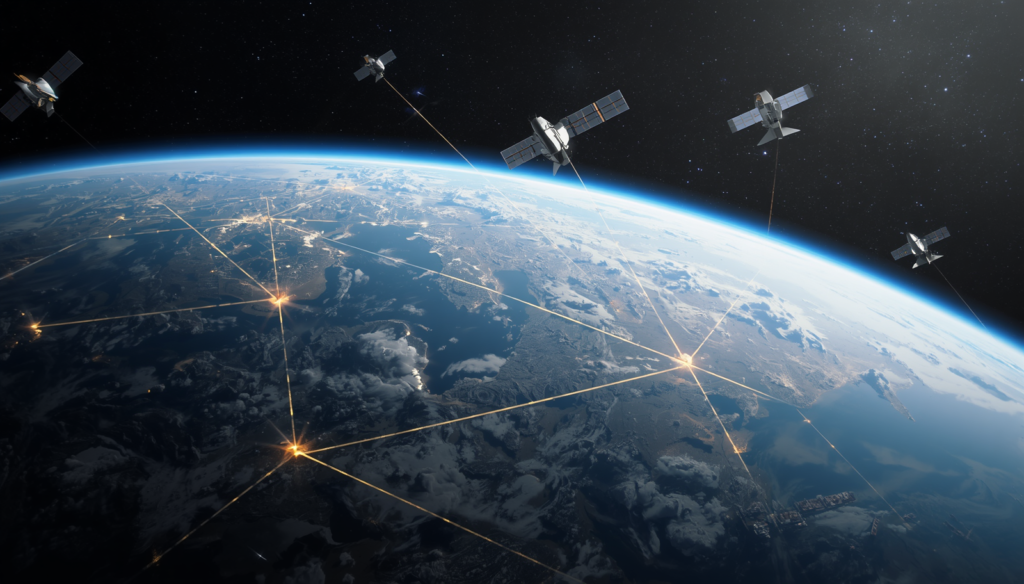
Dozens of GPS satellites orbit Earth at an altitude of roughly 20,000 kilometers. Each satellite continuously broadcasts information about its location and the exact time the signal was transmitted.
Your phone receives these signals.
Because radio signals travel at the speed of light, even tiny timing differences matter. By measuring how long the signals took to arrive, the device calculates its distance from each satellite.
One satellite narrows your location to a huge area.
Two satellites narrow it further.
Three satellites provide a much better estimate.
Four or more satellites allow the device to determine its precise position on Earth’s surface.
All of this happens in a fraction of a second.
⏱️ Why GPS Depends on Atomic Clocks
The most astonishing part of GPS may be its obsession with time.
Light travels nearly 300,000 kilometers every second.
A timing error of just one millionth of a second could introduce location errors of hundreds of meters.
To avoid this problem, GPS satellites carry highly accurate atomic clocks.
These clocks are so precise that they lose only tiny fractions of a second over extremely long periods.
Without them, GPS would quickly become unreliable.
In a very real sense, your ability to find a nearby coffee shop depends on some of the most accurate clocks ever built.
📱 More Than Just Navigation
Many people associate GPS with maps and driving directions.
In reality, its influence extends far beyond navigation.
Modern aviation relies heavily on satellite-based positioning. Aircraft use GPS to improve route accuracy and enhance safety.
Farmers use GPS-guided equipment to plant crops with remarkable precision.
Shipping companies track vehicles and cargo around the world.
Emergency responders use location data to reach people more quickly.
Financial networks depend on GPS timing signals to synchronize transactions.
Even mobile phone networks use GPS-derived timing information.
The system quietly supports countless aspects of modern life.
🌐 GPS Has Competition
Although many people use the term GPS as a generic label, GPS is actually one specific satellite navigation system operated by the United States.
Other countries have developed their own systems.
Russia operates GLONASS.
Europe developed Galileo.
China created BeiDou.
Modern smartphones often use signals from several of these systems simultaneously.
This improves accuracy and reliability.
As a result, today’s location services are often even more powerful than the original designers of GPS imagined.
🚗 The Technology That Changed Daily Life
Few technologies have altered everyday behavior as dramatically as GPS.
A generation ago, travelers carried paper maps.
Drivers stopped to ask strangers for directions.
Tourists carefully planned routes before leaving their hotels.
Today, many people simply enter a destination and begin walking.
The technology has changed how we travel, shop, exercise, work, and explore.
Entire industries—including ridesharing, food delivery, and location-based services—depend on it.
What was once an advanced military project has become part of daily life for billions of people.
🌌 A System We Rarely Notice
One of the most remarkable aspects of GPS is how invisible it has become.
Unlike airplanes, bridges, or skyscrapers, it has no obvious physical presence in our daily environment.
The satellites orbit far above Earth, silently transmitting signals that most people never think about.
Yet the system’s impact is enormous.
Every day, it helps people navigate unfamiliar roads, coordinate transportation networks, synchronize communications, and connect with the world around them.
Few technologies have become so essential while remaining so unnoticed.
💡 The Invisible Guide Above Us
The next time your phone instantly tells you where you are, take a moment to appreciate what is happening.
Signals are traveling from satellites moving through space at thousands of kilometers per hour.
Atomic clocks are measuring time with extraordinary precision.
Complex mathematical calculations are occurring almost instantly.
And all of it is happening so seamlessly that it feels effortless.
GPS is more than a navigation tool.
It is one of humanity’s greatest examples of invisible infrastructure—a system operating quietly above our heads, helping billions of people find their way every single day.
🌍 Continue Your Journey
If you enjoyed learning about the hidden systems that quietly power modern life, don’t miss our previous post:
👉 Why Do We Blow Out Birthday Candles and Make a Wish?
Discover how one of the world’s most beloved birthday traditions may trace its origins to ancient beliefs, moon worship, and centuries-old folklore.
📬 Stay Connected with Trivialwiki
👉 Facebook: https://facebook.com/Trivialwiki
👉 Instagram: https://instagram.com/trivialwiki
👉 YouTube: https://youtube.com/@trivialwiki
👉 Pinterest: https://pinterest.com/Trivialwiki
Learn. Explore. Discover.
GPS helps billions of people navigate the world every day, yet most never see the satellites making it possible. Could you imagine traveling today without GPS or digital maps? Share your thoughts in the comments! 🛰️🌍
1 thought on “The Invisible System Guiding the World”