
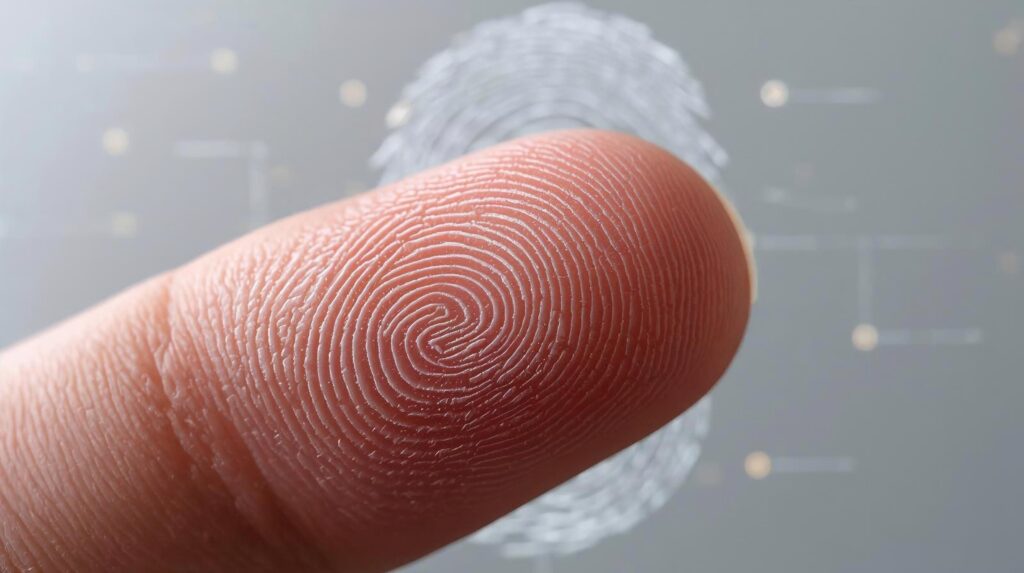
Look closely at the tips of your fingers.
You’ll see a series of tiny ridges forming swirling patterns across the skin. These patterns might seem ordinary, but they carry an extraordinary property: no two people on Earth share the same fingerprints.
Not even identical twins.
Fingerprints have fascinated scientists, investigators, and historians for more than a century. Today they are one of the most reliable ways to identify a person.
But why do these patterns exist at all? And how does the body create something so uniquely individual?
The story of fingerprints is a remarkable blend of biology, chance, and science.
🧬 How Fingerprints Form Before Birth
Fingerprints begin forming long before we are born.
During the early stages of pregnancy, the skin on a fetus’s fingers develops small ridges known as friction ridges. These ridges start appearing around the 10th week of pregnancy and are fully developed by about the 24th week.
The exact pattern depends on many tiny influences inside the womb, including:
– Genetics
– The fetus’s position
– Blood flow
– Pressure from surrounding tissues
– The movement of amniotic fluid
Because these conditions vary slightly for every developing baby, the resulting ridge patterns become unique.
Even identical twins — who share the same DNA — develop different fingerprints.
🔍 The Three Main Fingerprint Patterns
Although fingerprints are unique, they generally fall into three broad pattern types.
Loops
The most common pattern, loops curve inward and then exit on the same side of the finger.
Whorls
Whorls form circular or spiral patterns.
Arches
Arches rise in the center like a small hill before flowing to the other side.
These categories help investigators classify prints, but the tiny details within each pattern make every fingerprint distinct.
🖐️ Why Humans Have Fingerprints
Fingerprints are not just for identification.
Their primary biological purpose is to improve grip and touch sensitivity.
The ridges on our fingertips increase friction, allowing us to hold objects more securely. They also amplify vibrations when we touch surfaces, helping nerve endings detect fine textures.
This sensitivity allows humans to perform delicate tasks such as writing, typing, or handling small objects.
Without these ridges, our hands would be far less precise tools.
🕵️ Fingerprints in Criminal Investigation
Fingerprints became an important forensic tool in the late 19th century.
Before that time, identifying criminals relied heavily on photographs or written descriptions, which could easily be inaccurate.
In the 1890s, scientists demonstrated that fingerprints were both unique and permanent throughout a person’s life.
Soon police forces around the world began using fingerprint records to identify suspects.
Today fingerprint analysis remains one of the most widely used methods in criminal investigations.
📱 Fingerprints in Modern Technology
Fingerprints have also entered everyday technology.
Many smartphones, laptops, and security systems now use fingerprint scanners as a form of biometric authentication.
Instead of typing a password, users can unlock devices simply by touching a sensor.
These systems work by scanning the ridge patterns on a fingertip and comparing them with stored data.
Because fingerprint patterns are so unique, this method provides both convenience and security.
🧠 A Pattern That Lasts a Lifetime
One of the most remarkable features of fingerprints is their permanence.
The ridge patterns formed before birth remain unchanged throughout a person’s life.
Even as skin grows or ages, the patterns expand but maintain their original structure.
Only deep injuries that damage the underlying skin layers can permanently alter fingerprints.
Otherwise, the patterns remain constant from childhood to old age.
🌍 A Tool for Identification Worldwide
Today fingerprint databases are used by governments and organizations across the world.
They help identify individuals for:
– Criminal investigations
– Immigration records
– Security clearances
– Personal identification systems
In many places, fingerprints are part of national identification programs that help verify a person’s identity quickly and accurately.
What began as a biological curiosity has become a powerful global identification system.
💡 A Unique Signature Written by Nature
Fingerprints are a quiet example of nature’s ability to create complexity from simple biological processes.
A combination of genetic instructions and tiny variations during development produces patterns that no two humans share.
These ridges help us grip objects, feel textures, and — unexpectedly — identify ourselves in the modern world.
Every time you touch a surface, you leave behind a subtle signature that belongs only to you.
A tiny pattern that quietly proves your individuality.
Continue Exploring on Trivialwiki
If you enjoyed learning about the fascinating biology behind fingerprints, don’t miss our previous post:
👉 CAPTCHAs and the Test That Separates Humans From Bots
Discover how websites use clever tests to distinguish real users from automated programs.
📬 Stay Connected with Trivialwiki
👉 Facebook: https://facebook.com/Trivialwiki
👉 Instagram: https://instagram.com/trivialwiki
👉 YouTube: https://youtube.com/@trivialwiki
👉 Pinterest: https://pinterest.com/Trivialwiki
Learn. Explore. Discover.
Fingerprints make every person uniquely identifiable — what other features of the human body do you think are completely unique? Share your thoughts in the comments! 🖐️
1 thought on “Fingerprints and the Patterns That Make Every Human Unique”