
Every summer, millions of fans across the world watch a remarkable sporting spectacle unfold across the roads of France.
Hundreds of cyclists race through mountains, countryside villages, and historic cities, covering thousands of kilometers over three grueling weeks. The race tests endurance, strategy, teamwork, and mental strength like few other competitions on Earth.
This is the Tour de France, widely considered the most prestigious and demanding cycling race in the world.
But the Tour is more than just a sporting event. It is a cultural phenomenon that combines athletic endurance with geography, history, and national identity.
🚴♂️ A Race Born From a Newspaper Rivalry
The Tour de France began in 1903, and its origin was surprisingly simple.
At the time, a French sports newspaper called L’Auto wanted to increase its readership. To attract attention, the editors proposed an ambitious idea: a bicycle race that would circle the entire country of France.
The concept was bold. Cyclists would ride enormous distances across difficult terrain, often on rough roads with little support.
The first Tour featured 60 riders and six stages that stretched across the country.
Despite the difficulty, the race captured public imagination immediately. Newspapers sold rapidly, and the event quickly became an annual tradition.
🗺️ A Journey Across France
Unlike many sporting events that take place in a single stadium or city, the Tour de France is a moving race.
Each year, the route changes, but the race usually covers around 3,500 kilometers (about 2,200 miles) over 21 stages spread across three weeks.
Cyclists travel through:
– Flat countryside stages suited for sprinting
– Rolling hills that challenge strategy
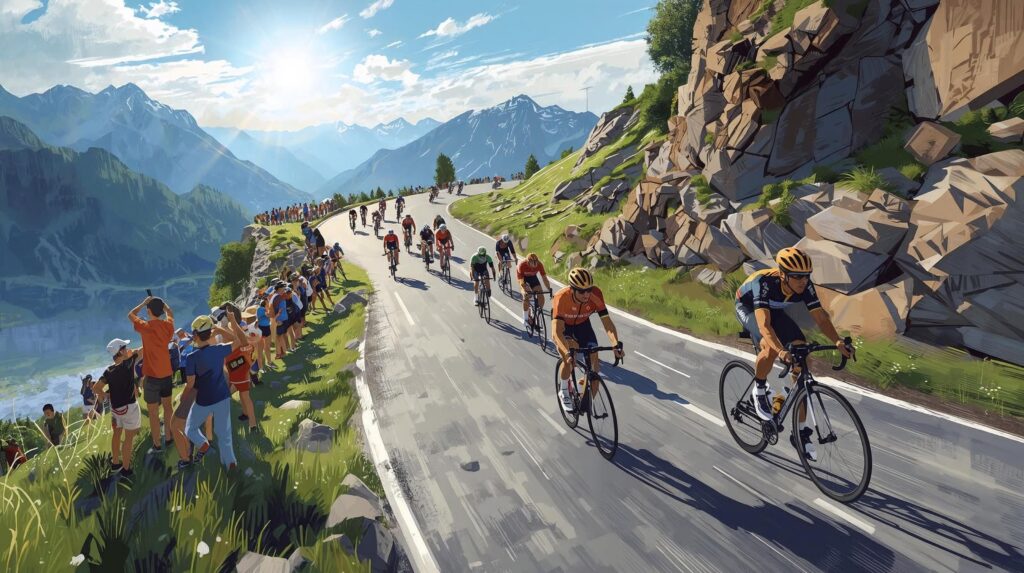
– Legendary mountain climbs in the Alps and Pyrenees
These mountain stages are often the most dramatic moments of the race.
Steep climbs, thin air, and long distances push riders to their physical limits.
🏔️ The Mountains That Decide Champions
Some of the Tour’s most famous moments occur on steep mountain roads.
Climbs like Alpe d’Huez, Mont Ventoux, and Col du Tourmalet have become legendary among cycling fans.
These ascents can stretch for more than 15 kilometers with gradients steep enough to exhaust even the strongest athletes.
Thousands of spectators line the mountain roads, cheering riders as they struggle upward.
In many cases, the winner of the Tour is decided on these brutal climbs.
🟡 The Famous Yellow Jersey
One of the most recognizable symbols of the race is the yellow jersey, known in French as the maillot jaune.
The rider with the fastest overall time across all stages wears the yellow jersey during the race.
The color was chosen because the newspaper that created the Tour, L’Auto, was printed on yellow paper.
Today, wearing the yellow jersey represents leadership in the race and is one of the greatest honors in professional cycling.
👥 A Team Sport Disguised as an Individual Race
Although only one cyclist wins the Tour de France, the race is deeply dependent on teamwork.
Each team usually consists of eight riders, and many of them sacrifice their own chances to support their team leader.
These support riders, known as domestiques, perform crucial tasks such as:
– Shielding the leader from wind
– Fetching food and water
– Setting the pace during difficult climbs
Without strong teamwork, winning the Tour is almost impossible.
🌍 A Global Sporting Event
Although the race began as a French competition, the Tour de France is now truly international.
Cyclists from dozens of countries participate each year, and the race is broadcast to hundreds of millions of viewers worldwide.
Some editions of the race even begin outside France, with opening stages held in cities across Europe.
Despite this global reach, the Tour remains deeply tied to French culture and landscapes.
🧠 Endurance Beyond Imagination
Completing the Tour de France requires extraordinary physical endurance.
Cyclists ride more than 150 kilometers per day on average, often at speeds exceeding 40 km/h.
During the race, riders burn thousands of calories daily and must maintain intense focus while navigating narrow roads, sudden weather changes, and tactical competition.
Fatigue builds over three weeks, making recovery and strategy just as important as raw strength.
It’s a true test of human stamina.
🎉 A National Festival on Wheels
Beyond the competition itself, the Tour de France has become a national celebration.
Villages decorate streets with banners and flags when the race passes through. Spectators gather along roadsides hours before riders arrive.
A colorful parade of promotional vehicles travels ahead of the cyclists, distributing souvenirs and creating a festive atmosphere.
For many communities, hosting a stage of the Tour is a moment of pride.
💡 A Race That Defines Cycling
Over more than a century, the Tour de France has grown into the most prestigious event in professional cycling.
It blends athletic excellence with breathtaking landscapes and historical tradition.
Every year, the race produces moments of drama, triumph, and exhaustion that capture the imagination of fans worldwide.
Few sporting events test the limits of endurance so completely.
The Tour de France is not just a race.
It is a journey across a nation — and a celebration of the human spirit in motion.
Continue Exploring on Trivialwiki
If you enjoyed learning about one of the world’s most demanding sporting events, don’t miss our previous post:
👉 Paper Clips and the Genius of Simple Design
Discover how a simple piece of bent wire became one of the most effective everyday tools ever invented.
📬 Stay Connected with Trivialwiki
👉 Facebook: https://facebook.com/Trivialwiki
👉 Instagram: https://instagram.com/trivialwiki
👉 YouTube: https://youtube.com/@trivialwiki
👉 Pinterest: https://pinterest.com/Trivialwiki
Learn. Explore. Discover.
The Tour de France pushes athletes to incredible limits — which sport do you think requires the greatest endurance? Share your thoughts in the comments! 🚴♂️
1 thought on “The Tour de France and the World’s Toughest Cycling Race”