
Some inventions are complex machines built with thousands of moving parts.
Others are astonishingly simple.
The paper clip belongs to the second category. It is nothing more than a small piece of bent metal wire, yet it has remained one of the most widely used office tools for more than a century.
Its design is so simple that many people barely notice it anymore. But behind this modest object lies an elegant example of engineering efficiency — a design so effective that it has changed very little since its creation.
Few everyday tools demonstrate the power of simplicity as perfectly as the paper clip.
📎 A Tool Born From a Simple Need
Before paper clips became common, people used a variety of methods to hold documents together.
Pages were sometimes sewn with thread, pinned with straight pins, or even sealed with wax. These methods worked, but they could damage paper or make documents difficult to rearrange.
As paperwork increased during the 19th century — especially with the growth of business offices and government records — a better solution became necessary.
People needed a way to secure papers without puncturing or permanently binding them.
That small problem eventually inspired the paper clip.
🧠 The Design That Works So Well
The most common paper clip design today is called the Gem clip.
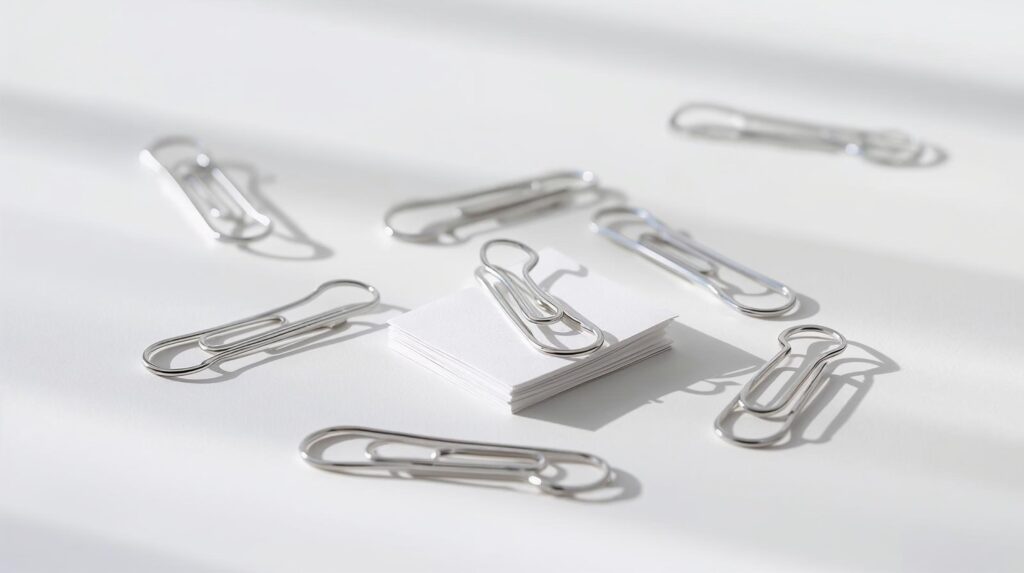
It consists of a single piece of wire bent into two loops that slide over each other. This simple structure creates tension that holds sheets of paper together.
The brilliance of the design comes from three key qualities:
– It is easy to attach and remove
– It does not damage paper
– It can be reused indefinitely
The curved loops distribute pressure evenly across the paper stack, creating enough friction to hold pages securely.
All of this from a tiny piece of wire.
🏭 The Rise of Office Tools
The late 1800s saw a rapid expansion of office work.
Businesses, banks, and governments were producing more paperwork than ever before. Filing systems, typewriters, and standardized documents became common.
The paper clip emerged during this period as a simple but essential office accessory.
Manufacturers began producing millions of clips using machines that bent steel wire into precise shapes.
Soon, the paper clip became a standard tool in offices around the world.
🇳🇴 A Surprising Symbol of Resistance
One of the most unusual chapters in the paper clip’s history occurred during World War II.
In Nazi-occupied Norway, citizens were forbidden from displaying national symbols that represented unity or resistance.
As a quiet act of defiance, many Norwegians began wearing paper clips on their clothing.
The clip symbolized solidarity — a small object representing how people could remain connected and united despite oppression.
Though the practice was eventually banned by authorities, the paper clip became a lasting symbol of resistance.
🔧 Engineering Hidden in Simplicity
At first glance, a paper clip seems almost too simple to involve engineering.
Yet its effectiveness relies on careful balance between flexibility and strength.
If the wire were too stiff, it would tear paper.
If it were too soft, it would lose its grip.
The curved loops create just the right amount of tension to hold multiple pages together while still allowing easy removal.
In engineering terms, the paper clip is a perfect example of minimal design achieving maximum function.
🌍 A Global Office Staple
Today, billions of paper clips are produced every year.
They appear in offices, schools, libraries, and homes across the world. Even in the digital age, when many documents exist only on screens, paper clips remain widely used.
Their simplicity keeps them relevant.
Unlike complex technologies that become outdated, the paper clip continues to perform its job perfectly.
🧠 The Paper Clip in Technology and Creativity
The paper clip has also found surprising uses beyond paperwork.
People have used paper clips to:
– Reset electronic devices
– Create small tools or hooks
– Build prototypes in engineering experiments
– Teach concepts of design and mechanics
Even popular software once used a cartoon paper clip as a digital assistant — a reminder of how recognizable the object has become.
Few everyday items are so universally familiar.
💡 The Beauty of Simple Solutions
Many inventions become more complicated over time.
The paper clip demonstrates the opposite principle: sometimes the simplest solution is the best one.
A single piece of wire, carefully shaped, can perform a task that once required pins, stitching, or adhesives.
That elegant simplicity explains why the paper clip has survived for generations with almost no change.
It’s a reminder that great design often hides in the smallest details.
Continue Exploring on Trivialwiki
If you enjoyed discovering the clever design behind everyday tools, don’t miss our previous post:
👉 The Panama Canal and the Shortcut That Changed Global Trade
Explore how one of the world’s greatest engineering projects transformed global shipping routes.
📬 Stay Connected with Trivialwiki
👉 Facebook: https://facebook.com/Trivialwiki
👉 Instagram: https://instagram.com/trivialwiki
👉 YouTube: https://youtube.com/@trivialwiki
👉 Pinterest: https://pinterest.com/Trivialwiki
Learn. Explore. Discover.
The humble paper clip proves that simple ideas can be incredibly powerful — what other everyday objects do you think hide brilliant design? Share your thoughts in the comments! 📎
Good info.