
It stretches 40,000 kilometres around the Pacific Ocean, swallows tectonic plates whole, and has shaped the history of entire civilisations. Welcome to the planet’s most dramatic address.
Somewhere beneath the Pacific Ocean right now, two of Earth’s great tectonic plates are pressing against each other with unimaginable force. One is being slowly dragged beneath the other — ground down into the mantle, melted, and eventually forced back up to the surface as molten rock. This process has been going on for tens of millions of years, and it shows absolutely no signs of stopping.
The result? A 40,000-kilometre arc of volcanoes, earthquakes, and geological fury that scientists call the Ring of Fire — and that the 700 million people who live along its edges call home.
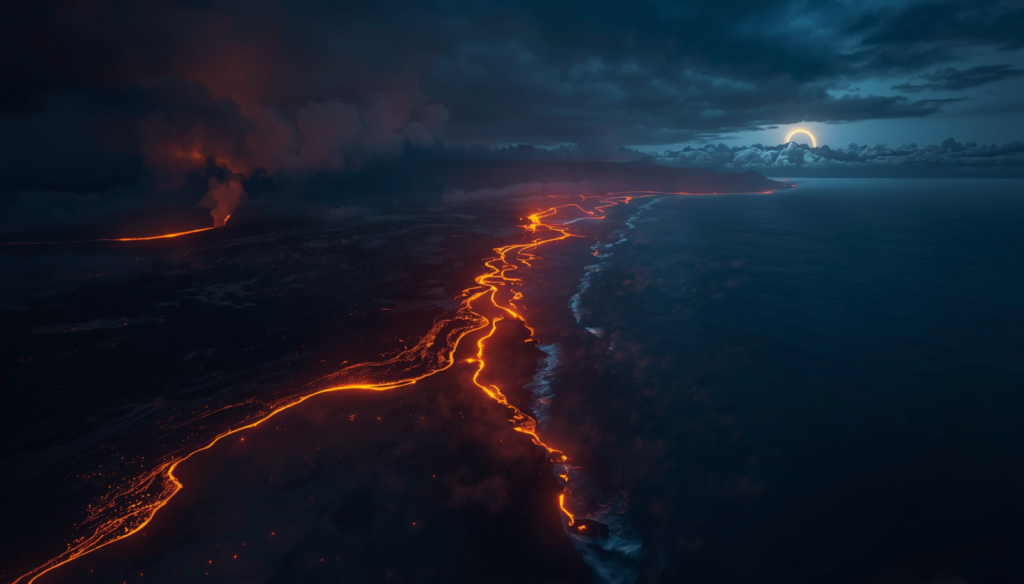
🌏 What Exactly Is the Ring of Fire?
Despite the dramatic name, the Ring of Fire is not actually a complete ring. It is shaped more like a horseshoe, curving along the edges of the Pacific Ocean from the southern tip of South America, up the western coast of the Americas, across the Aleutian Islands of Alaska, down through Japan and the Philippines, and finally through Indonesia and New Zealand.
The name was not the invention of Hollywood screenwriters — it comes quite literally from what you would see if you looked at a map of the world’s active volcanoes. They trace this horseshoe almost perfectly, because they are all driven by the same underlying cause: the movement of tectonic plates.
The Pacific Plate — the largest tectonic plate on Earth — is surrounded on almost all sides by other plates that are pressing against it, sliding past it, or diving beneath it. Where plates collide, the denser oceanic plate gets forced downward into the mantle in a process called subduction. As it descends, it heats up, releases water into the surrounding rock, and lowers the rock’s melting point. That rock becomes magma, rises through the crust, and erupts. Hence: volcano.
The Ring of Fire is not a place where the Earth misbehaves. It is where the Earth reminds us how it works.
The result of all this geological restlessness is staggering in scale. The Ring of Fire is home to approximately 75% of the world’s active volcanoes and generates around 90% of all earthquakes on Earth. It is, without question, the most geologically active zone on the planet.
| 40,000 km Total length of the Ring of Fire | 90% Of all world earthquakes occur here | 450+ Active volcanoes along its length | 700M+ People living within its reach |
🌋 A Neighbourhood of Volcanoes
More than 450 volcanoes line the Ring of Fire, from the graceful snow-capped cone of Mount Fuji in Japan to the smouldering crater of Mount St. Helens in Washington State. Some are dormant, resting between eruptions for centuries. Others are persistently, almost casually, active — like Kilauea in Hawaii, which has been erupting almost continuously since 1983.
But the Ring of Fire has also produced some of the most catastrophic volcanic events in recorded history. In August 1883, the island of Krakatoa in Indonesia essentially destroyed itself in one of the most violent eruptions ever witnessed. The explosion was so loud it was heard nearly 5,000 kilometres away in Australia. The resulting tsunamis, with waves reaching up to 30 metres, killed more than 36,000 people along the coasts of Java and Sumatra. For months afterward, ash from the eruption circled the globe, turning sunsets vivid shades of red and orange across Europe and America — and dropping global temperatures noticeably for the following year.
Then there is Mount Pinatubo in the Philippines, which erupted in June 1991 in what was the second-largest volcanic eruption of the 20th century. So much ash and sulphur dioxide was blasted into the atmosphere that average global temperatures dropped by about 0.5°C for the following two years. A single volcano on a single island temporarily altered the climate of the entire planet.
🌊 When the Ground Shakes the Ocean
If volcanoes are the Ring of Fire’s most dramatic spectacle, earthquakes are its most frequent reminder that the ground beneath our feet is anything but stable. And no event illustrates this more starkly than what happened off the coast of southern Chile on the afternoon of 22 May, 1960.
At 3:11 PM, the earth began to shake. It did not stop for ten minutes. The ground convulsed violently as roughly 1,000 kilometres of fault ruptured along the subduction zone where the Nazca Plate meets the South American Plate. When it was over, seismologists measured it at magnitude 9.5 — the most powerful earthquake ever recorded in human history. Two million people were left homeless. The tsunami it generated crossed the entire Pacific, killing 61 people in Hilo, Hawaii — 10,000 kilometres from the epicentre — and reaching Japan 22 hours later.
The 2004 Indian Ocean earthquake, also triggered by a subduction zone on the Ring of Fire’s western edge, struck with a magnitude of 9.1 and generated a tsunami that swept across 14 countries. At least 225,000 people lost their lives, making it one of the deadliest natural disasters in recorded history. The waves reached as far as the eastern coast of Africa.
These are not ancient events lost to history. The 2011 Tōhoku earthquake off the coast of Japan — magnitude 9.0 — sent waves 40 metres high crashing into the Sanriku coastline, triggered the Fukushima Daiichi nuclear disaster, and killed an estimated 19,300 people. Less than 15 years ago.
🗾 The Countries That Live on the Edge
More than 25 countries sit directly on or beside the Ring of Fire, and for many of them, living with geological instability is simply part of daily life. Japan, perhaps more than any other nation, has built its entire culture and infrastructure around this reality. Japanese schoolchildren practice earthquake drills from an early age. Buildings are engineered to sway rather than collapse. Coastal towns have tsunami warning systems and clearly marked evacuation routes. Japan experiences around 1,500 earthquakes every single year — the vast majority too small to feel, but a constant reminder of what lies beneath.
Indonesia sits atop the meeting point of several major tectonic plates and contains more active volcanoes than any other country on Earth. The Philippines, New Zealand, Chile, and the western United States face similarly elevated risk. The San Andreas Fault, which runs nearly the entire length of California, is part of the Ring of Fire system — a transform boundary where the Pacific Plate and North American Plate grind past each other horizontally, rather than one diving beneath the other.
🔭 What Science Has Learned from the Ring
For all the destruction it has caused, the Ring of Fire has also been one of the most important natural laboratories in the history of science. It was the study of its earthquake and volcanic patterns that helped confirm the theory of plate tectonics in the 1960s — one of the most significant scientific breakthroughs of the 20th century. Before that, scientists had long noticed that the continents looked like puzzle pieces that might once have fitted together, but they had no convincing mechanism to explain why. The Ring of Fire provided the evidence.
Today, the Ring’s thousands of kilometres of subduction zones — where one plate dives beneath another — give geologists an unparalleled window into the deep interior of the Earth. The rock that descends into the mantle carries water and minerals with it, triggering chemical reactions that scientists are still working to fully understand. The magma that rises back up brings samples of the deep Earth to the surface, giving researchers access to material they could never otherwise reach.
💡 Living Alongside the Fire
There is a question that often occurs to people when they learn what the Ring of Fire is and where it runs: why do so many people live there? The answer is, paradoxically, that the same forces that make these regions dangerous also make them extraordinarily fertile. Volcanic soil is among the richest agricultural soil on Earth, packed with minerals and nutrients that produce abundant harvests. The flanks of volcanoes in Indonesia, Japan, and Central America have supported dense farming communities for thousands of years. People have always weighed the long-term benefit of rich soil against the infrequent, if catastrophic, risk of eruption.
There is also the simple reality of history — cities, ports, and civilisations were established along these coastlines long before modern seismology existed. Moving is rarely an option when your entire culture, economy, and history is rooted in a place.
✨ Final Thoughts
The Ring of Fire is a reminder that the Earth is not a finished object. It is an active, churning, restless system — and the Pacific rim is where that restlessness is most visible, most audible, and most felt. Every volcanic eruption along its length, every earthquake that rolls through its coastlines, is the planet doing what it has been doing for billions of years: rearranging itself.
For the people who live along it, that can mean devastation on a scale that is hard to comprehend from the outside. But it also means living on some of the most dynamic, fertile, and geologically fascinating land on Earth. The Ring of Fire does not ask permission. It simply burns — and the world pays attention.
Continue Exploring on Trivialwiki
📖 https://trivialwiki.com/what-happens-when-a-desert-traveller-forgets-about-his-milk/
📬 Stay Connected with Trivialwiki
👉 Facebook
👉 Instagram
👉 YouTube
👉 Pinterest
Learn. Explore. Discover.
Over to you: If you could visit any volcano or earthquake zone along the Ring of Fire — purely for the experience — where would you go, and why? Share your thoughts in the comments below!
В Москве существует множество автосервисов, специализирующихся на Тойота. В этом автосервисе вы найдете опытных техников, которые знают все о Тойота.
Если вам нужен качественный и надежный автосервис Toyota в Москве, мы предлагаем широкий спектр услуг для вашего автомобиля.
Ремонт и обслуживание Тойота требуют от специалистов глубоких знаний. Все работники имеют соответствующую квалификацию и опыт.
Техническое оснащение сервиса соответствует самым высоким стандартам. Благодаря этому, мы можем гарантировать качество выполняемых работ.
Вы получите качественное и профессиональное обслуживание вашего автомобиля. Ваше доверие для нас — наивысшая награда.