
If you look at a map of the Netherlands, one fact immediately stands out.
Large parts of the country sit at or even below sea level.
For most nations, that would be a serious problem. Rising tides, storm surges, and flooding would constantly threaten homes, farms, and cities. Many regions would simply be considered unsuitable for permanent settlement.
Yet the Netherlands did something remarkable.
Instead of retreating from the water, the Dutch spent centuries learning how to control it.
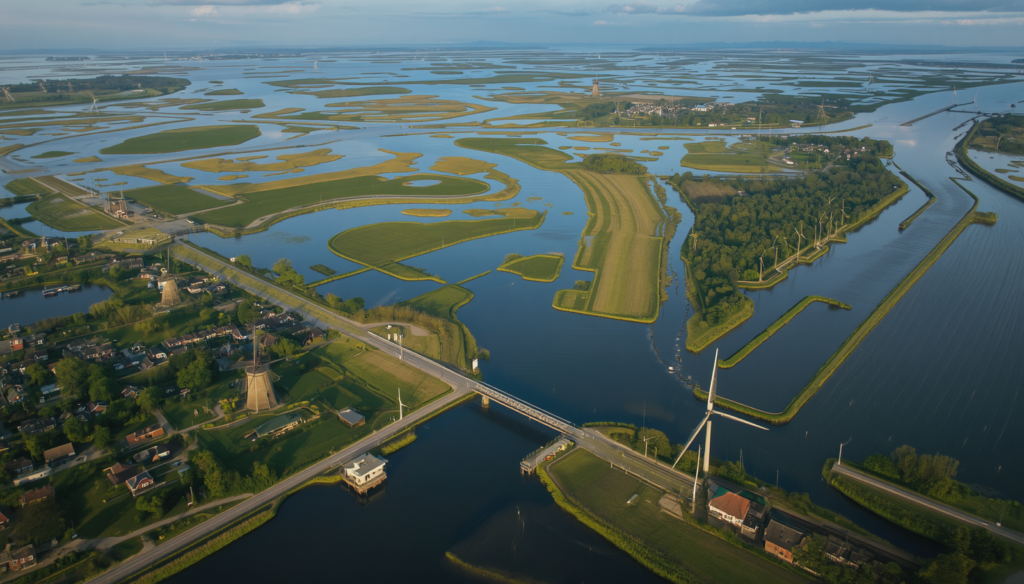
They built dikes, drained lakes, reclaimed land from the sea, and developed some of the most sophisticated water-management systems ever created. Their success was so extraordinary that today millions of people live safely on land that, in many other circumstances, would be underwater.
The story of the Netherlands is not simply the story of a country.
It is the story of one of humanity’s greatest engineering battles against nature.
🌊 Living with a Constant Threat
Water has always shaped Dutch history.
The Netherlands sits in a low-lying region where several major European rivers—including the Rhine, Meuse, and Scheldt—flow toward the North Sea.
This geography created both opportunities and dangers.
The rivers brought fertile soil and valuable trade routes. At the same time, they increased the risk of flooding. Powerful storms from the North Sea could push seawater inland, threatening communities and farmland.
For centuries, floods were a regular part of life.
Entire villages could disappear beneath the water. Crops were destroyed, homes were damaged, and lives were lost.
The Dutch eventually realized that surviving in this environment would require more than simply rebuilding after every flood.
They needed a long-term solution.
🏗️ The Rise of the Dikes
One of the earliest and most important Dutch innovations was the dike.
A dike is a raised barrier designed to keep water out of low-lying areas.
Early communities began building simple earth embankments to protect farmland and settlements. Over time, these barriers became larger, stronger, and more sophisticated.
As neighboring communities connected their dikes together, they created extensive defensive systems capable of protecting entire regions.
The result was a landscape that increasingly depended on human engineering rather than natural geography.
In many parts of the Netherlands, the line between land and water became something people actively managed.
🌾 Creating Land from Water
Protecting existing land was only the beginning.
The Dutch eventually developed techniques for creating entirely new land.
These reclaimed areas are known as polders.
The process was ambitious.
First, engineers surrounded a body of water with dikes. Then they removed the water from inside the enclosed area, exposing land that could be used for farming, housing, or development.
For centuries, this work relied heavily on one of the country’s most iconic symbols: the windmill.
Many Dutch windmills were not built primarily for grinding grain. Instead, they powered pumps that helped remove water from polders.
The image of windmills turning against the Dutch sky is therefore closely connected to the country’s struggle against flooding.
They were among the machines that literally helped create new land.
⚙️ The Country That Expanded Itself
Most nations grow through conquest, migration, or economic development.
The Netherlands did something much rarer.
It expanded its territory by reclaiming land from water.
Over the centuries, thousands of square kilometers were recovered through engineering projects.
Some areas that are now thriving cities, farms, and neighborhoods were once lakes, marshes, or parts of the sea.
This achievement required remarkable planning, coordination, and persistence across generations.
Few countries can say they physically increased their size through human ingenuity.
🌪️ The Disaster That Changed Everything
Despite centuries of experience, nature occasionally reminded the Dutch who they were dealing with.
In 1953, a devastating North Sea storm struck the Netherlands.
The resulting storm surge overwhelmed many existing flood defenses.
Large areas were inundated. Thousands of people lost their lives, and hundreds of thousands were affected.
The disaster shocked the nation.
It also inspired one of the most ambitious engineering responses in modern history.
Rather than accepting future catastrophes as inevitable, the Netherlands decided to build stronger protections than ever before.
🌉 The Delta Works
The response to the 1953 flood became known as the Delta Works.
This enormous system of dams, barriers, locks, sluices, and floodgates is widely considered one of the greatest engineering projects ever undertaken.
The goal was simple in concept but challenging in practice: reduce the country’s vulnerability to storm surges while preserving navigation and ecological systems.
The project took decades to complete.
Its structures stretch across vast sections of the Dutch coastline and continue protecting millions of people today.
Engineers around the world study the Delta Works as a model of large-scale flood management.
It stands as a monument to human determination and technical expertise.
🚴 A Modern Nation Built on Water Management
Today, water management remains a central part of Dutch life.
The Netherlands continuously monitors:
river levels,
sea conditions,
groundwater systems,
and weather patterns.
Advanced technologies help predict potential flooding risks long before they become emergencies.
Dutch engineers are now considered global leaders in water management, advising projects in countries facing similar challenges.
Ironically, the nation that spent centuries fighting water has become one of the world’s foremost experts on living with it.
🌍 A New Challenge: Climate Change
The Dutch story is far from over.
Climate change and rising sea levels present new challenges for the future.
Scientists predict that many coastal regions worldwide may face increasing flood risks during the coming decades.
For the Netherlands, this issue is particularly important because so much of the country lies close to sea level.
Rather than waiting for problems to emerge, Dutch planners continue investing in innovative solutions.
Some projects focus on strengthening existing defenses. Others explore ways to work with natural water systems rather than simply resisting them.
The country remains engaged in the same struggle it began centuries ago—only now with modern technology.
💡 A Nation Built on Determination
The Netherlands demonstrates that geography does not always determine destiny.
Faced with conditions that might have discouraged settlement altogether, generations of Dutch citizens chose a different path.
They built barriers where none existed. They drained lakes, reclaimed land, and developed engineering solutions that reshaped the landscape itself.
The result is one of the most remarkable examples of human adaptation in history.
Today, millions of people live, work, and thrive on land that owes its existence to centuries of effort and ingenuity.
The Netherlands did not simply survive alongside water.
It became a country that refused to drown.
🌍 Continue Your Journey
If you enjoyed learning about humanity’s greatest battles against nature, don’t miss our previous post:
👉 Why Olympic Gold Medals Aren’t Really Gold
Discover the surprising truth behind one of the world’s most prestigious sporting awards and learn why Olympic gold medals contain far less gold than most people imagine.
📬 Stay Connected with Trivialwiki
👉 Facebook: https://facebook.com/Trivialwiki
👉 Instagram: https://instagram.com/trivialwiki
👉 YouTube: https://youtube.com/@trivialwiki
👉 Pinterest: https://pinterest.com/Trivialwiki
Learn. Explore. Discover.
The Netherlands reclaimed land from the sea and built some of the world’s most advanced flood defenses. Could you imagine living below sea level, protected by engineering alone? Share your thoughts in the comments! 🇳🇱🌊
1 thought on “The Netherlands: The Country That Refused to Drown”