
Imagine a small lizard sitting quietly on a branch. Its skin is green, its eyes move independently, and its long tongue can shoot out faster than you might expect. Then another chameleon appears. Suddenly, the first animal may flash yellow, orange, blue, or even dark brown.
It looks like magic. It almost seems as though the chameleon is trying to disappear into its surroundings—or perhaps showing off like a living rainbow.
But the real reason chameleons change color is far more interesting.
Chameleons do not primarily change color to match every background. Instead, their colors are often a form of communication. They use changes in appearance to express mood, attract mates, warn rivals, react to danger, and sometimes control how much heat their bodies absorb.
Their skin is not simply a colored surface. It is a remarkably complex optical system, almost like a tiny biological display hidden beneath their scales.
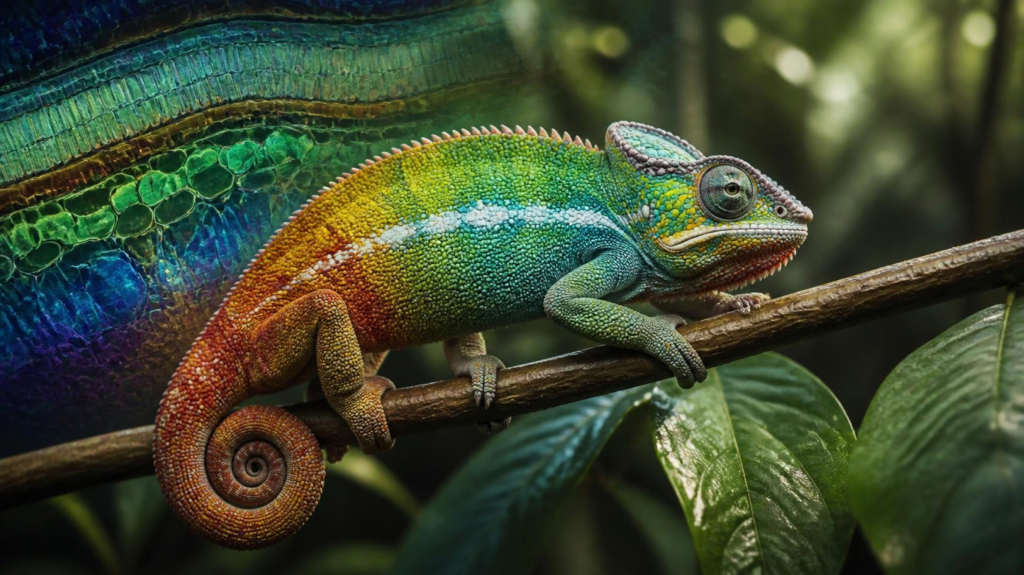
The Popular Myth: Chameleons Change Color to Hide
The most common explanation is that chameleons change color to blend into whatever is behind them. We often imagine a chameleon turning brown on a tree branch, green among leaves, or gray against a rock.
There is some truth to the idea that coloration can help camouflage them. Many chameleons naturally have colors and patterns that make them difficult to notice in vegetation. However, most chameleons cannot instantly copy the exact color or pattern of any surface.
A chameleon sitting on a green leaf does not necessarily become the same shade of green as that leaf. Its color change is usually influenced more strongly by its emotional state, social situation, temperature, and light conditions.
In other words, a chameleon is not carrying out a photographic scan of its surroundings. It is responding to what is happening around it.
That makes its color changes less like a disappearing trick and more like a combination of a mood ring, warning signal, and temperature-control system.
Color Is a Language for Chameleons
For many chameleons, color is an important part of body language.
Humans communicate through facial expressions, gestures, posture, and voice. Chameleons rely heavily on visual signals because they are often solitary animals that need to communicate from a distance.
A male chameleon encountering another male may change color to appear more threatening. Bright or contrasting colors can make the animal look larger, stronger, or more confident. The display may warn the rival:
“This territory is occupied. Stay away.”
During courtship, males may also display striking colors to attract females. A colorful display can communicate that the male is healthy, active, and ready to mate.
Females may change color as well. In some species, a female that is receptive to mating shows one color pattern, while a pregnant or unreceptive female may display a very different pattern to discourage males.
The exact signals vary from one species to another, but the general principle is the same: color helps chameleons communicate without making a sound.
What Happens When a Chameleon Gets Angry?
A chameleon’s color can change dramatically during a confrontation.
When two males meet, they may puff up their bodies, flatten themselves sideways, open their mouths, rock back and forth, and display vivid colors. These actions make the animal appear more intimidating.
Color can be especially useful because it can be seen before the animals physically fight. A bright display may allow one chameleon to assess the other and decide whether the contest is worth continuing.
In some species, an aggressive male may develop intense yellow, orange, or red areas. Other species may become darker or show contrasting patches. The particular colors depend on the species, its sex, and the situation.
A chameleon that turns dark is not necessarily “sad,” and one that turns bright is not always “happy.” The meaning of a color must be understood in context. The same color may communicate different things in different species.
Still, the overall idea is fascinating: a chameleon’s skin can broadcast information about what the animal is experiencing.
The Science Beneath the Skin
The most remarkable part of chameleon color change is that it does not happen simply because the animal produces more green or yellow pigment.
Chameleon skin contains several layers of specialized cells. Some of these cells contain pigments, while others interact with light in a completely different way.
One important type of cell is called a chromatophore. Chromatophores contain pigments that can absorb and reflect certain wavelengths of light. Different pigments contribute to colors such as yellow, red, and brown.
Beneath these pigment-containing cells are special cells called iridophores. These cells contain tiny structures made largely of guanine, a substance also found in DNA and RNA.
These structures behave somewhat like microscopic mirrors. They reflect particular wavelengths of light, helping produce colors such as blue and green.
The arrangement of these tiny structures is crucial.
When the structures are packed closely together, they reflect shorter wavelengths of light. When they are spaced farther apart, they reflect longer wavelengths. By changing the spacing, the chameleon can alter the color of light reflected from its skin.
This is a physical process involving the interaction of light with microscopic structures. It is not simply a matter of switching pigment on and off.
A Biological Light Filter
A useful way to imagine the process is to think of a chameleon’s skin as a microscopic light filter.
Sunlight contains many wavelengths, which our eyes interpret as different colors. The structures inside the chameleon’s iridophores interact with that light and reflect certain wavelengths more strongly than others.
When the spacing between the structures changes, the reflected color changes too.
This is somewhat similar to the shifting colors seen on a soap bubble, a compact disc, or the surface of certain beetles. Those colors can arise from the way light interacts with tiny structures rather than from ordinary colored paint.
In chameleons, the process is controlled by the animal’s nervous system. Signals from the brain and body influence the skin, changing the arrangement of the microscopic structures.
The result is a living optical system that can change appearance without needing to replace its skin or manufacture an entirely new pigment.
Why Do Chameleons Look Green?
Many chameleons appear green because of the way different layers of their skin work together.
The iridophores can reflect blue light. Meanwhile, yellow pigments in the skin absorb and reflect light in ways that combine with the blue reflection. To our eyes, the mixture can appear green.
This means that the green color of a chameleon is not necessarily produced by a single green pigment.
It can emerge from the interaction of:
- Reflected blue light from specialized skin structures
- Yellow pigments in the skin
- The arrangement of microscopic reflective structures
- The way light reaches and leaves the skin
The final color depends on the combination of these factors, which is why chameleon skin can produce a surprisingly wide range of shades.
Not Every Chameleon Changes Color in the Same Way
There is no single universal chameleon color-change pattern.
Different species have evolved different color systems. Some can display vivid reds, yellows, oranges, blues, and greens. Others mainly shift between various shades of green, brown, gray, and black.
The range of colors also depends on sex and age. In many species, males are more brightly colored than females, particularly during territorial disputes or courtship.
A species living in a brightly lit forest may use a different visual signaling system from one living in a drier environment. Natural selection has shaped each species’ colors according to its habitat, behavior, predators, and social life.
This is why it is misleading to describe all chameleons as if they were identical color-changing machines. Their abilities are diverse, and their colors have different meanings depending on the species.
Color Can Help Control Body Temperature
Chameleons are ectothermic animals, meaning that they depend heavily on external sources of heat to regulate their body temperature.
They may bask in sunlight to warm up or move into shade to avoid overheating. Color can help support this process.
Darker colors generally absorb more sunlight than lighter colors. A chameleon may therefore become darker when it needs to warm up, allowing its body to absorb more energy from the sun.
When it is already warm, lighter coloration may help reduce the amount of solar energy absorbed.
This does not mean that every dark chameleon is cold or that every pale chameleon is hot. Color is also affected by social behavior, stress, lighting, and other factors. But temperature regulation is one important part of the story.
The chameleon’s skin is therefore doing more than communicating. It can also help the animal interact with its physical environment.
Why Do Chameleons Change Color When They Are Frightened?
Stress and fear can also affect a chameleon’s appearance.
When threatened, a chameleon may darken, become pale, or display contrasting colors. It may also alter its posture, inflate its body, hiss, or open its mouth.
These reactions can serve several purposes. A sudden color change may startle a predator or make the chameleon appear less like an easy target. A dark or contrasting display may also communicate that the animal is distressed or defensive.
However, there is no single “fear color” shared by all chameleons. A color response that indicates stress in one species may have a different meaning in another.
The most accurate way to interpret a chameleon’s color is to consider the entire situation: its posture, movement, surroundings, behavior, and the presence of other animals.
Can Chameleons Become Invisible?
Chameleons are excellent at remaining unnoticed, but they are not invisible.
Their natural colors, body shapes, slow movements, and ability to stay still can make them difficult to detect. Some species also have skin patterns that resemble leaves, branches, or patches of light and shadow.
Their independently moving eyes help them watch the environment while keeping much of their body still. Their unusual walking movements can also resemble leaves or branches moving gently in the wind.
Color change may contribute to camouflage, but it is only one part of a much larger survival strategy.
A chameleon’s greatest camouflage tool may not be its ability to turn green or brown. It may be its ability to remain motionless while looking like something that does not deserve attention.
How Chameleons Differ from Octopuses
Chameleons are often compared with octopuses because both animals can change color. But they do not use exactly the same biological system.
Octopuses and other cephalopods rely heavily on pigment-containing cells called chromatophores, along with reflective and light-scattering structures. They can often change color and pattern extremely quickly, sometimes producing complex displays across their bodies.
Chameleons also use pigment-containing cells, but their distinctive color changes are strongly connected to the physical arrangement of reflective structures in iridophores.
The two systems evolved separately. This is a wonderful example of convergent evolution, in which unrelated animals develop similar abilities because they face similar challenges.
A chameleon and an octopus are not closely related, yet both have evolved sophisticated ways to manipulate light and communicate through their skin.
Nature has arrived at similar solutions through very different evolutionary paths.
A Chameleon’s Colors Are Not Just Decoration
It is tempting to think of bright animal colors as decoration, as though nature simply wanted to make certain creatures beautiful.
But in chameleons, color can have practical consequences.
A display may prevent a fight, attract a mate, warn a rival, help regulate temperature, or signal that the animal is under stress. The colors may look spectacular to human observers, but they evolved because they can influence survival and reproduction.
What appears to us as a beautiful visual performance may be a serious biological message.
A flash of orange may be a warning. A sudden darkening may be a defensive reaction. A vivid pattern may be part of courtship. A change in shade may help the animal warm itself in the morning sun.
The chameleon is not changing color simply to look interesting.
It is using its skin as a communication system and environmental tool.
The Living Mood Ring of the Animal Kingdom
Chameleons are sometimes called nature’s living mood rings, and the comparison is surprisingly useful—provided we remember that their colors are not simple emotional labels.
A mood ring changes color according to temperature, which is then loosely associated with a person’s mood. A chameleon’s skin is much more sophisticated.
Its color can reflect internal conditions, but it is also shaped by social signals, hormones, nervous-system activity, temperature, light, and the surrounding situation.
The chameleon’s appearance is therefore not a perfect emotional translation. It is more like a complex biological dashboard, displaying several kinds of information at once.
And unlike a mood ring, it can send those signals to other members of its species.
Final Thought
The next time you see a chameleon changing color, remember that it is probably not trying to copy the wall, leaf, or branch behind it.
It may be warning a rival, attracting a mate, reacting to danger, warming itself in the sunlight, or responding to changes in its surroundings.
Its skin is not merely a covering. It is a living optical instrument, a communication device, and a temperature-management system—all working together beneath a layer of scales.
Chameleons do not simply change color. They use color to speak.
Continue Your Journey
If you enjoyed discovering how chameleons use their bodies to interact with the world, continue your journey with:
A Day on Venus Is Longer Than Its Year: The Planet Where Time Gets Strange
Venus may not change color like a chameleon, but it has its own surprising relationship with light, heat, motion, and time.
Stay Curious with Trivialwiki
Follow Trivialwiki for more fascinating facts, strange discoveries, and everyday mysteries:
- Facebook: https://facebook.com/Trivialwiki
- Instagram: https://instagram.com/trivialwiki
- YouTube: https://youtube.com/@trivialwiki
- Pinterest: https://pinterest.com/Trivialwiki
What other animal ability looks like magic but is actually the result of fascinating science?