
Imagine living on a planet where you could celebrate a new year before the planet had even completed one full rotation.
On Earth, this sounds impossible. A day is short, a year is long, and the two follow a familiar pattern: Earth rotates once every 24 hours and travels around the Sun once every 365 days.
But Venus does things differently.
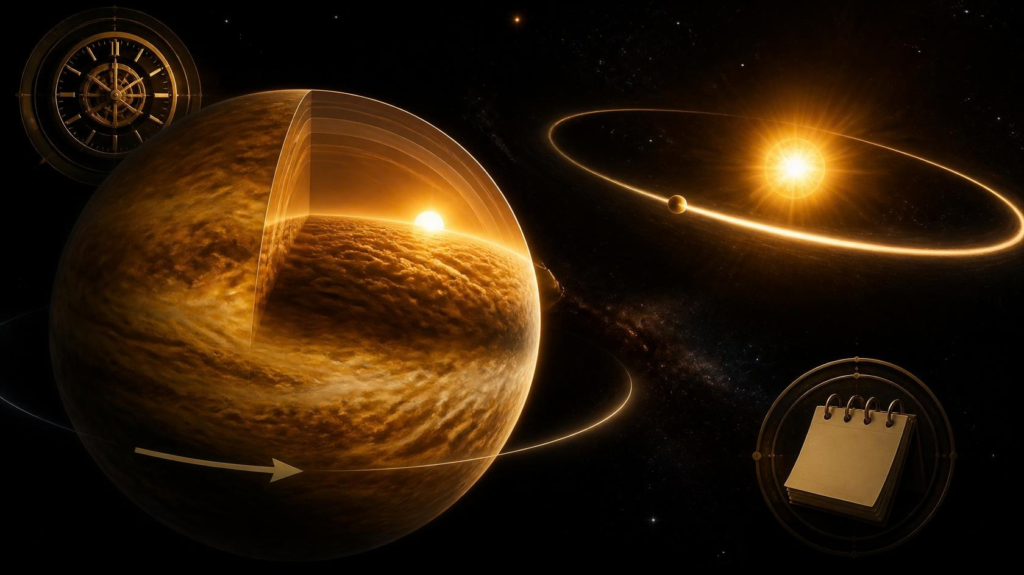
On Venus, a complete rotation takes about 243 Earth days, while one trip around the Sun takes only about 225 Earth days. That means a Venusian day, when measured by the planet’s rotation against the distant stars, is actually longer than its year.
And that is only the beginning of Venus’s strange relationship with time.
The planet also rotates in the opposite direction from Earth. If you were somehow standing on its surface, the Sun would rise in the west and set in the east. Even more confusingly, the time between one sunrise and the next would be about 117 Earth days, not 243.
Welcome to Venus—a world where the calendar, the clock, and even sunrise seem determined to break the rules.
A Planet That Looks Familiar but Behaves Differently
Venus is often described as Earth’s twin because the two planets are similar in size, mass, and general rocky composition.
Venus is only slightly smaller than Earth, and both planets have solid surfaces made of rock and metal. From space, Venus can also appear bright and beautiful, wrapped in thick clouds that reflect sunlight.
But the similarities end quickly.
Venus has a crushing atmosphere made mostly of carbon dioxide. Its surface pressure is roughly 90 times that of Earth at sea level, comparable to the pressure found deep beneath Earth’s oceans. Its surface temperature is hot enough to melt lead, making it the hottest planet in the Solar System—even hotter than Mercury, which orbits closer to the Sun.
Venus is therefore not a comfortable second Earth. It is a rocky world with extreme heat, intense pressure, thick clouds, and a very unusual clock.
First, What Do We Mean by a “Day”?
The strange statement that “a day on Venus is longer than its year” becomes easier to understand when we realize that scientists use more than one definition of a day.
On Earth, the difference between these definitions is small enough that we rarely think about it. On Venus, the difference is enormous.
A Sidereal Day
A sidereal day is the time a planet takes to rotate once relative to distant stars.
For Earth, this takes approximately 23 hours and 56 minutes. We usually use the familiar 24-hour solar day because Earth is also moving around the Sun while it rotates.
For Venus, one sidereal rotation takes approximately:
243 Earth days
That is the time required for Venus to turn once on its axis relative to the stars.
A Solar Day
A solar day is the time between one local noon and the next. It is also closely related to the time between one sunrise and the next.
Because Venus rotates very slowly and moves around the Sun at the same time, its solar day is much shorter than its sidereal day:
About 117 Earth days
So when people say that “a day on Venus is longer than its year,” they are usually talking about the planet’s rotation period, not the interval between sunrise and sunrise.
This distinction may sound technical, but it is the key to understanding the whole mystery.
Venus Takes Longer to Rotate Than to Orbit
The two most important numbers are:
| Movement | Time on Venus |
|---|---|
| One complete rotation relative to the stars | About 243 Earth days |
| One complete orbit around the Sun | About 225 Earth days |
| One sunrise to the next | About 117 Earth days |
Venus completes a trip around the Sun in approximately 224.7 Earth days. But it takes about 243 Earth days to rotate once relative to distant stars.
That means Venus can finish its year while still slowly turning through the same rotation.
To picture this, imagine a person walking around a table while slowly turning in place. The person’s body may take a long time to complete one full turn, but the walk around the table could finish first.
Venus behaves in a similar way. Its orbital journey is relatively quick, but its rotation is incredibly slow.
This is unusual in our Solar System, where most planets rotate in a matter of hours or, in the case of Earth and Mars, roughly a day.
Venus Rotates Backward
Venus is not only slow. It also rotates in the opposite direction from Earth and most of the other planets.
Earth rotates from west to east. This is called prograde rotation.
Venus rotates from east to west. This is called retrograde rotation.
Because of this backward rotation, the Sun would appear to move across the Venusian sky in the opposite direction from what we experience on Earth.
On Earth:
- The Sun rises in the east.
- The Sun moves across the sky.
- The Sun sets in the west.
On Venus:
- The Sun would rise in the west.
- The Sun would move across the sky.
- The Sun would set in the east.
NASA describes Venus as rotating retrograde and confirms that the Sun would rise in the west and set in the east for an observer on the planet’s surface.
It would be an extraordinarily disorienting experience.
Even if you had a clock, a calendar, and a clear view of the sky, your instincts would constantly tell you that the planet was moving the wrong way.
Why Is a Venusian Solar Day Only 117 Days?
At first, it may seem that the time between sunrises should be exactly the same as the time Venus takes to rotate once.
But a planet is not rotating in isolation. It is also traveling around its star.
Earth provides a useful example. Earth rotates once relative to the stars in about 23 hours and 56 minutes, but the Sun returns to the same position in the sky every 24 hours. The extra few minutes are caused by Earth’s movement along its orbit.
Venus’s effect is much more dramatic because its rotation is both extremely slow and retrograde.
While Venus slowly rotates in one direction, it is also moving around the Sun in the opposite orbital direction. These motions combine to make the Sun return to roughly the same position in the Venusian sky after about 117 Earth days.
NASA gives the length of a Venusian solar day as approximately 116.75 Earth days.
So Venus has two different “day” lengths:
- 243 Earth days for one rotation relative to the stars
- 117 Earth days from one sunrise to the next
Both are correct. They simply measure different things.
A Year on Venus Contains About Two Sunrises
The strange relationship between Venus’s rotation and orbit produces another surprising result.
A Venusian year lasts about 225 Earth days. A Venusian solar day lasts about 117 Earth days.
That means a Venusian year is long enough for the Sun to rise roughly twice.
NASA’s educational materials describe this unusual situation by noting that the Sun rises about every 117 Earth days, meaning that two sunrises can occur during one Venusian year—even though the planet has not completed a full rotation relative to the stars.
Imagine watching the Sun rise over the western horizon, waiting nearly four Earth months for it to set, and then waiting nearly four more months for the next sunrise.
That would make a single day feel longer than many human lifetimes of ordinary daily routines.
The Sky Would Not Look Like Earth’s Sky
Even if Venus had a more comfortable surface, its sky would be very different from ours.
The planet is covered by thick clouds containing sulfuric acid. These clouds block a clear view of the Sun and stars from the surface.
An observer would not experience a bright blue sky like Earth’s. Instead, the atmosphere would create a thick, hazy, yellowish environment with sunlight scattered through the dense clouds.
The Sun would not necessarily appear as a sharp, familiar disk. Its light would filter through the atmosphere, and the landscape would be illuminated by a diffuse, eerie glow.
This means that the “sunrise” on Venus would not look exactly like sunrise on Earth. The Sun’s direction would change slowly, but the thick atmosphere would make the entire scene hazy and muted.
Venus’s thick carbon-dioxide atmosphere and sulfuric-acid clouds are also responsible for much of the planet’s extreme climate.
Venus Is the Hottest Planet, Even Though Mercury Is Closer to the Sun
The unusual day-and-year relationship is not the only surprising thing about Venus.
Mercury is the closest planet to the Sun, but Venus is hotter.
The reason is Venus’s thick atmosphere, which is composed mostly of carbon dioxide. Carbon dioxide is a greenhouse gas, meaning it absorbs and re-emits infrared radiation, making it difficult for heat to escape into space.
Venus has an extreme greenhouse effect. Sunlight enters the atmosphere, warms the surface, and the resulting heat becomes trapped beneath the dense blanket of gases.
The result is a surface temperature of roughly 465–470°C across much of the planet.
That is hot enough to melt lead.
So even though Venus’s day is extraordinarily long, the planet does not experience the kind of dramatic temperature difference between day and night that might be expected on an airless world. Its dense atmosphere helps distribute heat around the planet.
The planet’s atmosphere moves heat around so effectively that even the side facing away from the Sun remains intensely hot.
What Would Happen to Seasons on Venus?
Earth experiences seasons largely because its axis is tilted by about 23.5 degrees.
As Earth travels around the Sun, different hemispheres receive more direct sunlight at different times of the year. This creates summer and winter.
Venus has a very different situation.
Its rotation is retrograde, and its axis is tilted only slightly relative to the orientation used to describe planetary rotation. NASA notes that Venus has an axial tilt of roughly three degrees in the relevant seasonal sense, which is too small to produce noticeable Earth-like seasons.
This means Venus does not have familiar spring, summer, autumn, and winter cycles.
Instead, its climate is dominated by its thick atmosphere, intense greenhouse effect, cloud structure, and atmospheric circulation.
A Venusian calendar would therefore be strange in more than one way:
- A year would be shorter than a rotation.
- Sunrise would happen in the west.
- Seasons would be barely noticeable.
- The temperature would remain dangerously high.
- The thick clouds would hide the stars and much of the Sun.
Venus is not simply a slower version of Earth. It is a completely different planetary environment.
The Clouds Move Much Faster Than the Planet
Here is another remarkable contrast.
The solid planet rotates extremely slowly. But the upper atmosphere moves around Venus much faster.
The cloud tops can circle the planet in approximately four Earth days. NASA describes this rapid atmospheric movement as super-rotation, with cloud-level winds reaching roughly 360 kilometers per hour.
This creates a strange situation:
- The solid surface takes about 243 Earth days to rotate once.
- The clouds can travel around the planet in only about four days.
- The Sun takes about 117 Earth days to return to the same position in the sky.
It is almost as if the planet has several different clocks operating at once.
The surface has one rhythm. The atmosphere has another. The Sun’s apparent movement follows a third.
Scientists are still studying how Venus’s atmospheric super-rotation is maintained. The thick atmosphere, solar heating, and complex circulation all play roles, but the complete explanation is not simple.
Why Does Venus Rotate So Slowly?
Venus’s slow retrograde rotation is one of the planet’s most interesting mysteries.
Scientists have proposed several possible explanations, including long-term gravitational effects from the Sun, interactions involving Venus’s atmosphere, and changes caused by the planet’s early history.
The rotation of a planet can be influenced over time by tides and gravitational interactions. Atmospheric tides may also matter, because the Sun heats different parts of the atmosphere and creates large-scale movements of gas.
However, there is no single simple explanation that completely settles why Venus ended up rotating so slowly and backward.
One possibility is that Venus may once have rotated in a different direction or at a different speed. Over immense periods of time, gravitational and atmospheric effects could have changed its rotation.
But Venus’s exact rotational history remains a subject of scientific investigation.
This is a useful reminder that planetary systems are not static. A planet’s current behavior is the result of billions of years of impacts, gravity, atmospheric changes, and interactions with the rest of the Solar System.
How Did Scientists Discover Venus’s Rotation?
For a long time, astronomers could not easily determine how fast Venus rotated.
The planet is covered in thick clouds, so telescopes cannot see clear surface features moving across its surface. On Earth, astronomers can track continents, cloud patterns, or other visible features to estimate rotation. Venus’s permanent cloud cover made this much more difficult.
Early estimates of Venus’s rotation varied widely.
The breakthrough came through radar observations. Radar signals could be sent toward Venus and reflected back to Earth. By carefully studying the returned signals, scientists could detect subtle changes associated with the planet’s rotation.
In 1961, radar observations from the Goldstone antenna in California helped reveal that Venus rotates extremely slowly. Later observations established the retrograde rotation period of approximately 243 Earth days.
This discovery changed our understanding of Venus.
The planet was not rotating at a speed similar to Earth’s. It was not keeping the same face toward the Sun. And it was not following the familiar pattern of the other rocky planets.
Venus had its own unusual rhythm.
A Day on Venus Is Not Just Long—It Is Conceptually Strange
On Earth, we tend to think of a day as one complete cycle of daylight and darkness.
But Venus shows that this definition is not universal.
If we define a day by rotation relative to the stars, Venus’s day lasts 243 Earth days.
If we define a day by the movement of the Sun across the sky, Venus’s day lasts about 117 Earth days.
If we define a year as one orbit around the Sun, Venus’s year lasts about 225 Earth days.
This gives us three different lengths of time:
- Rotation day: 243 days
- Solar day: 117 days
- Year: 225 days
The phrase “a day on Venus is longer than its year” is therefore both true and slightly incomplete.
It is true when referring to the planet’s sidereal rotation period.
But if someone means the interval between one sunrise and the next, then the Venusian solar day is shorter than the Venusian year.
This is not a contradiction. It is a lesson in how definitions shape our understanding of the universe.
What Would a Clock on Venus Say?
A clock designed to measure Venus’s rotation could use a 243-Earth-day cycle.
But a calendar based on the Sun would need to use a different cycle of approximately 117 Earth days.
A person living on Venus might therefore need several different timekeeping systems:
- A rotation calendar based on the stars
- A solar calendar based on sunrise and sunset
- An orbital calendar based on the planet’s year
- A local schedule based on atmospheric conditions rather than daylight
In practice, any future human mission to Venus would probably use Earth-based time for coordination with spacecraft and mission control.
That would be much more practical than trying to organize work around a sunrise that occurs only once every 117 Earth days.
Even a short mission would need to deal with the planet’s extreme heat and pressure long before its unusual calendar became a serious problem.
Venus Teaches Us Not to Assume Every Planet Works Like Earth
Earth feels normal to us because it is the planet we know best.
We are used to:
- A roughly 24-hour day
- A 365-day year
- Sunrise in the east
- Sunset in the west
- Noticeable seasons
- A relatively mild atmosphere
- A sky where stars are visible at night
But none of these features is guaranteed on another planet.
Mercury has a complicated relationship between its rotation and orbit. Mars has days that are only slightly longer than Earth’s. Jupiter rotates in less than ten hours. Uranus is tilted dramatically on its side. Neptune experiences powerful winds.
And Venus has a day longer than its year.
The Solar System is not built around one standard planetary design. Each world has its own history, motion, atmosphere, and relationship with the Sun.
Venus simply happens to be one of the strangest examples.
The Planet Where Time Runs Backward
Venus is sometimes described as a planet where time runs backward.
That is not literally true. Time itself is not moving in reverse. But several familiar patterns are reversed or rearranged:
- The planet rotates backward compared with Earth.
- The Sun rises in the west.
- A rotation takes longer than an orbit.
- A solar day is shorter than a sidereal day.
- The clouds race around the planet while the surface barely turns.
- The hottest planet is not the closest planet to the Sun.
These facts make Venus seem almost fictional.
Yet they are the result of ordinary physical laws acting over immense periods of time.
Gravity, rotation, orbital motion, atmospheric circulation, and sunlight combine to create a world that looks familiar from a distance but behaves in ways that are completely alien.
So, How Can a Day Be Longer Than a Year?
The answer is surprisingly simple:
A day measures rotation. A year measures orbit. There is no rule saying a planet must rotate faster than it travels around its star.
On Venus:
- The planet rotates once relative to the stars in about 243 Earth days.
- The planet orbits the Sun in about 225 Earth days.
- Because Venus rotates backward, the Sun rises in the west.
- The time between sunrises is about 117 Earth days.
So the statement is correct—but only when we use the scientific definition of a day based on rotation relative to the stars.
Venus reminds us that even the most familiar ideas—day, night, sunrise, sunset, and year—can become wonderfully strange when we leave Earth.
The next time you look at the evening sky and see Venus shining brightly, remember that beneath those clouds is a world where the planet takes longer to turn around than to travel around the Sun.
On Venus, the calendar can finish before the clock does.
Continue Your Journey
If you enjoyed discovering the strange ways our universe works, continue with:
A Murder of Crows: The Strange History Behind One of Nature’s Darkest Group Names
From unusual planetary time to unusual animal language, discover why a group of crows is traditionally called a “murder” and how folklore, medieval vocabulary, and crow behavior shaped the expression.
Stay Curious with Trivialwiki
Discover more fascinating stories about space, science, history, inventions, animals, unusual places, and the hidden details behind everyday life.
One Last Question
If you could safely visit Venus for one hour, would you rather experience its strange west-to-east sunrise—or watch the incredibly fast clouds race around the planet?
1 thought on “A Day on Venus Is Longer Than Its Year: The Planet Where Time Gets Strange”