
There are many wonderful names for groups of animals. A group of lions is a pride. A group of owls is often called a parliament. Flamingos gather in a flamboyance, geese form a gaggle, and ravens are sometimes described as an unkindness.
But few animal group names sound as dramatic as “a murder of crows.”
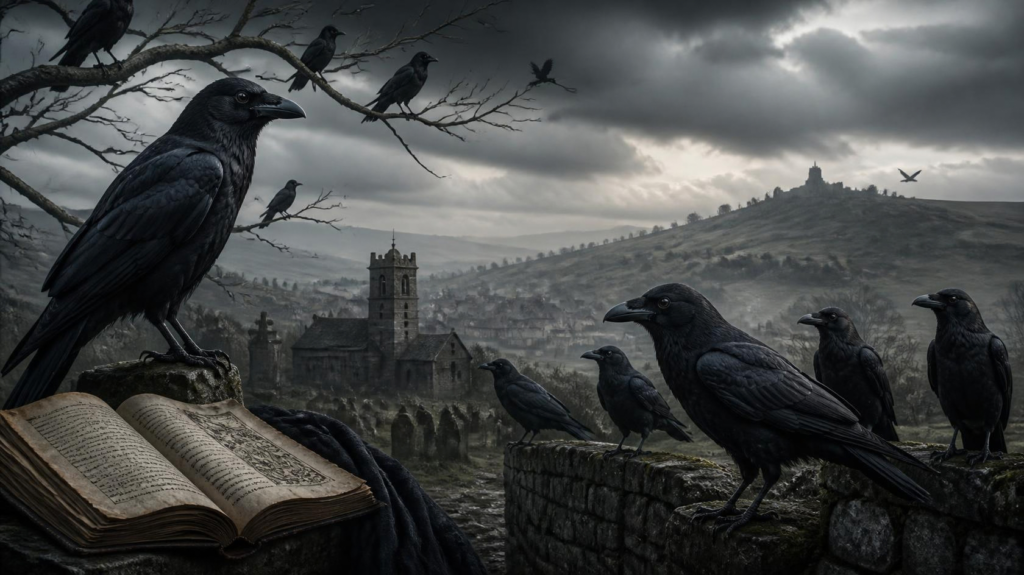
The phrase feels almost like the title of a mystery novel. It brings to mind dark skies, ancient forests, abandoned buildings, and black-feathered birds gathering together while making their sharp, unmistakable calls.
But why murder?
Do crows actually attack and kill one another? Did medieval people believe that crows held trials? Or is the phrase simply an imaginative expression created hundreds of years ago?
The real story is a mixture of medieval language, superstition, animal behavior, and the human tendency to give ordinary things wonderfully dramatic names.
First, What Exactly Is a “Murder” of Crows?
A murder of crows is a traditional collective noun for a group of crows.
It is not a scientific term. In biology, birdwatchers and researchers would usually use straightforward words such as flock, group, or gathering. The word “murder” belongs more to the colorful world of traditional English expressions.
These unusual names are often called collective nouns or, more specifically, terms of venery.
The word venery comes from an old term connected with hunting. During the Middle Ages, hunting was an important part of aristocratic life, and specialized vocabulary developed around animals, birds, hunting equipment, and the stages of the hunt.
Some of these expressions were practical. Others were playful, poetic, or deliberately impressive.
A group of crows became a “murder” in this tradition, but the exact reason the word was chosen is not completely certain.
That uncertainty is important. The phrase has a fascinating history, but there is no reliable evidence proving that one specific event or belief created it.
The Medieval World Loved Imaginative Animal Names
During the fifteenth century, English writers collected long lists of unusual names for groups of animals and people.
One important early source is the Egerton Manuscript, dating from around the middle of the fifteenth century. Another famous source is The Book of Saint Albans, published in 1486 and traditionally associated with Dame Juliana Berners.
These works included many collective names that still appear in English today.
Some names were inspired by animal behavior. Others were based on appearance, sound, movement, habitat, or folklore.
For example, the names could be:
- A pride of lions
- A charm of goldfinches
- An exaltation of larks
- A parliament of owls
- A murder of crows
- An unkindness of ravens
- A gaggle of geese
It is worth remembering that these names were not necessarily created by scientists carefully studying animal societies. They were part of a literary and cultural tradition in which language was expected to be clever, memorable, and sometimes theatrical.
The phrase “murder of crows” fits perfectly into that tradition.
It sounds striking. It creates an image. And it gives an ordinary gathering of birds an air of mystery.
The Earliest Written Forms Were Slightly Different
The expression did not always appear in the modern form “murder of crows.”
Historical references include forms such as “a mursher of crowys” and “a murther of crowes.”
These spellings reflect the changing nature of English during the late medieval period. English spelling was not standardized in the way it is today, and the same word could appear in several different forms.
The term is generally associated with the fifteenth century, although the exact history of the expression is difficult to trace.
This means that the phrase is old, but its precise creator is unknown.
There is no confirmed medieval writer who clearly explained:
“We call them a murder because of this particular behavior.”
Instead, the name appears to have survived because it was memorable and because it matched the dark reputation crows had developed in European folklore.
Why Were Crows Associated With Death?
To understand why “murder” might have seemed appropriate, we need to look at how people viewed crows in the past.
Crows are intelligent, adaptable birds that can eat a wide variety of food. They may consume seeds, insects, fruit, small animals, eggs, and carrion—the remains of dead animals.
Because of this scavenging behavior, crows and related birds were often seen near places associated with death.
In medieval Europe, crows could be found around:
- Battlefields
- Gallows and execution sites
- Cemeteries
- Slaughter areas
- Open countryside where animals had died
- Places where discarded animal remains were present
To modern observers, a crow feeding on a dead animal is part of the natural recycling process. In earlier societies, however, people often interpreted animal behavior through religion, superstition, and symbolism.
A black bird appearing near a corpse could easily be seen not as a scavenger arriving after death, but as a creature somehow connected with death itself.
The crow’s dark feathers, harsh call, and habit of gathering around carcasses strengthened this impression.
Over time, crows became associated with bad omens, misfortune, battle, darkness, and the supernatural.
The word “murder” therefore may have been a poetic way of reflecting the bird’s grim reputation.
The Crow’s Reputation Was Not Always Fair
Crows have often been portrayed as sinister or threatening, but much of that image comes from human interpretation rather than the birds’ actual nature.
Crows are not uniquely evil or unusually murderous. They are highly adaptable animals that have learned to survive around humans, farms, cities, roads, and changing environments.
Their scavenging behavior is useful to ecosystems because it helps remove dead organic matter. Their intelligence allows them to find food, remember locations, recognize threats, and adapt to new situations.
Yet the very traits that make crows successful can appear unsettling.
They are observant. They are noisy. They often gather in groups. They can remember faces. They sometimes mob predators. They may remain near dead members of their species.
To someone unfamiliar with animal behavior, these actions can look mysterious or even sinister.
The phrase “murder of crows” tells us as much about the people who named the birds as it does about the birds themselves.
The Famous Story About Crows Holding a Trial
One of the most popular explanations for the phrase claims that crows gather together to hold a kind of court.
According to this story, a group of crows may surround a member of the flock that has behaved badly. The other crows supposedly judge the bird, and the punishment is execution—hence, a “murder” of crows.
It is a wonderfully dramatic story.
It also makes for an excellent gothic legend.
However, there is no good evidence that crows conduct formal trials or execute members as punishment for bad behavior.
The story appears to be folklore that was developed later to explain an already mysterious phrase. It is an example of how people often create stories to make unusual words seem logical.
The idea may have been encouraged by real crow behavior. Crows sometimes gather around an injured or dead crow, and they can become aggressive toward individual birds under certain circumstances.
But turning these observations into a story about a medieval-style courtroom is a leap of imagination.
The crows are not holding a criminal trial. The humans are supplying the courtroom.
Do Crows Really Gather Around Dead Crows?
They do sometimes gather around dead members of their species. This behavior is often informally called a “crow funeral.”
The name is emotionally powerful, but it can be misleading if we assume that crows understand death exactly as humans do.
Research suggests that gathering around a dead crow may help living crows investigate danger. They may use alarm calls to attract other birds, inspect the location, and learn whether a predator or threatening human is nearby.
In other words, the gathering may function as a form of risk assessment.
A dead crow could indicate that a particular place is dangerous. By observing the scene, other crows may learn to avoid the same threat.
This behavior is especially interesting because crows are highly intelligent and social. They can remember dangerous people and places, communicate warnings, and learn from experiences.
To human eyes, a group of crows standing around a dead bird may resemble a funeral or solemn gathering.
To the crows, it may be closer to an investigation.
The scene looks mournful, but the biological purpose may be practical: find out what happened and avoid becoming the next victim.
Crows Can Be Aggressive, but That Does Not Make Them Murderers
Crows are capable of aggressive behavior. They defend nesting areas, protect food, and sometimes attack predators that threaten them.
This behavior is known as mobbing.
When a crow spots a hawk, owl, cat, or another potential threat, it may call loudly and approach the predator. Other crows may join in, creating a noisy and coordinated group response.
Mobbing can help drive predators away from nests or vulnerable young.
Crows may also fight with other crows over territory, food, or access to resources. Like many social animals, they have conflicts.
But ordinary aggression should not be confused with murder in the human legal or moral sense.
A crow defending its nest is not committing a crime. A group of crows harassing a predator is not carrying out a planned assassination. These are natural behaviors shaped by survival.
The dark word is a metaphor—not a scientific description.
Could the Name Have Come From Their Sound?
There are several theories about the origin of “murder,” and not all of them are connected to death.
One possibility is that the term was influenced by the sound of crows calling together. A large group of crows can be extremely noisy, especially when alarmed or gathering at a communal roost.
Some historical discussions have suggested that the word may have been related to an old rendering of the birds’ calls or to a spelling variation.
However, this explanation is not firmly established either.
The most widely repeated interpretation connects the term with crows’ association with death and carrion. But it is safest to say that this is a plausible explanation rather than a proven fact.
Language often develops through several overlapping influences. A word may begin as a joke, become associated with folklore, appear in a manuscript, and then survive simply because people enjoy saying it.
That may be what happened here.
Why Ravens Have an “Unkindness” Instead
Crows are not the only black birds with a dark collective noun.
A group of ravens is traditionally called an unkindness.
Ravens and crows belong to the same broader bird family, the corvids, and they share many characteristics. Both are intelligent, social, adaptable, and capable of scavenging.
They also appear in myths, legends, and literature as symbols of death, prophecy, mystery, and supernatural knowledge.
The different collective nouns may reflect the way medieval writers enjoyed assigning dramatic emotional qualities to animals.
A raven was “unkind.” Crows were a “murder.”
Neither term should be taken as a literal description of the birds’ personalities.
In reality, ravens and crows are not villains in nature. They are resourceful survivors with complex social lives.
The Dark Image of Crows Appears in Literature Too
Crows and ravens have inspired writers for centuries.
Their dark feathers and distinctive calls make them useful symbols in poetry, stories, and gothic fiction. They can represent death, memory, prophecy, loneliness, or an approaching change.
Writers have often used black birds because they are visually striking. A crow perched on a bare branch creates an immediate atmosphere, especially when placed against fog, a stormy sky, or an abandoned building.
But literature can reinforce stereotypes.
Once a bird becomes associated with death in stories, people may begin to interpret its real behavior through that fictional image. A crow gathering on a rooftop can seem ominous even when it is simply searching for food or communicating with other birds.
This is one reason collective nouns are so interesting. They preserve old ways of seeing the natural world.
“A murder of crows” is not just a name for a flock. It is a small surviving piece of medieval imagination.
A Group of Crows Can Also Be Called Other Names
Although “murder” is the best-known expression, crows have been given several other collective nouns.
Depending on the source, you may encounter terms such as:
- A flock of crows
- A murder of crows
- A mob of crows
- A horde of crows
- A storytelling of crows
- A parliament of crows
Some of these names are traditional, while others are less common or may have developed through modern wordplay.
The phrase “a flock of crows” is the most practical and scientifically ordinary description. “A murder of crows” is the poetic version people remember because it is so unusual.
That contrast is part of the fun.
If you see ten crows in a field, you can accurately call them a flock. If you want to make the scene sound like the opening of a gothic novel, you can call them a murder.
Both expressions point to the same birds.
The Name Says More About Humans Than Crows
The phrase “murder of crows” survives because it is vivid.
It combines an ordinary animal with a word associated with crime, violence, mystery, and death. That contrast makes the expression easy to remember.
But the name does not tell us that crows are cruel or dangerous. It reflects centuries of human storytelling.
People saw black birds near dead animals and connected them with death. They heard harsh calls and imagined warnings. They watched groups gather and created stories about secret meetings, judgments, and punishments.
Over time, these impressions became part of language.
The crows themselves continued doing what crows do: finding food, raising young, defending territory, avoiding predators, and learning how to survive.
The birds did not choose the name.
Humans did.
So, Why Is It Called a “Murder” of Crows?
The most honest answer is that the exact origin is uncertain.
The phrase comes from the tradition of imaginative animal collective nouns that became popular in medieval England. The word “murder” was likely influenced by the crow’s association with death, carrion, battlefields, gallows, and dark folklore.
The popular story about crows holding trials and executing bad members of the group is entertaining, but it is not supported by reliable evidence.
Crows do gather around dead crows, and they can behave aggressively toward threats or rivals. However, these behaviors are better explained through communication, social learning, territorial defense, and survival—not criminal justice.
So the next time you see a group of crows, remember that you are not necessarily looking at a murderous gang.
You may be looking at a highly intelligent social group, investigating danger, searching for food, protecting their territory, or simply communicating with one another.
Still, “a flock of crows” does not quite have the same atmosphere.
A murder of crows is darker, stranger, and much more memorable.
And that is probably why the phrase has survived for so long.
Continue Your Journey
If you enjoyed discovering the surprising history behind an everyday phrase, continue with:
Bubble Wrap: The Failed Wallpaper That Became Everyone’s Favorite Packaging
Bubble wrap began as an unsuccessful wallpaper experiment before becoming one of the world’s most familiar packaging materials. Its story is another fascinating example of how unexpected ideas can find surprising second lives.
Stay Curious with Trivialwiki
Discover more fascinating stories about language, history, science, inventions, animals, unusual places, and the hidden details behind everyday life.
One Last Question
If you saw a large group of crows gathering near your home, would you think they were simply looking for food—or would “a murder of crows” immediately come to mind?
1 thought on “A Murder of Crows: The Strange History Behind One of Nature’s Darkest Group Names”