
When you think of ketchup, you probably imagine a bright red bottle beside a plate of fries, a burger, or a hot dog. It is sweet, tangy, familiar, and so common that it barely seems worth questioning. 🍅
But ketchup has a surprisingly adventurous past.
It was not invented in the United States. It did not originally contain tomatoes. It was not always sweet, thick, or red. In fact, one of its earliest ancestors was a salty, fermented sauce made from fish.
Over centuries, ketchup travelled across Asia, entered British kitchens, changed ingredients several times, crossed the Atlantic, and eventually became one of the world’s most recognizable condiments.
The ketchup in your refrigerator is the result of a long culinary journey involving sailors, traders, scientists, food manufacturers, and even debates about food safety.
So how did a fermented fish sauce become the perfect partner for French fries?
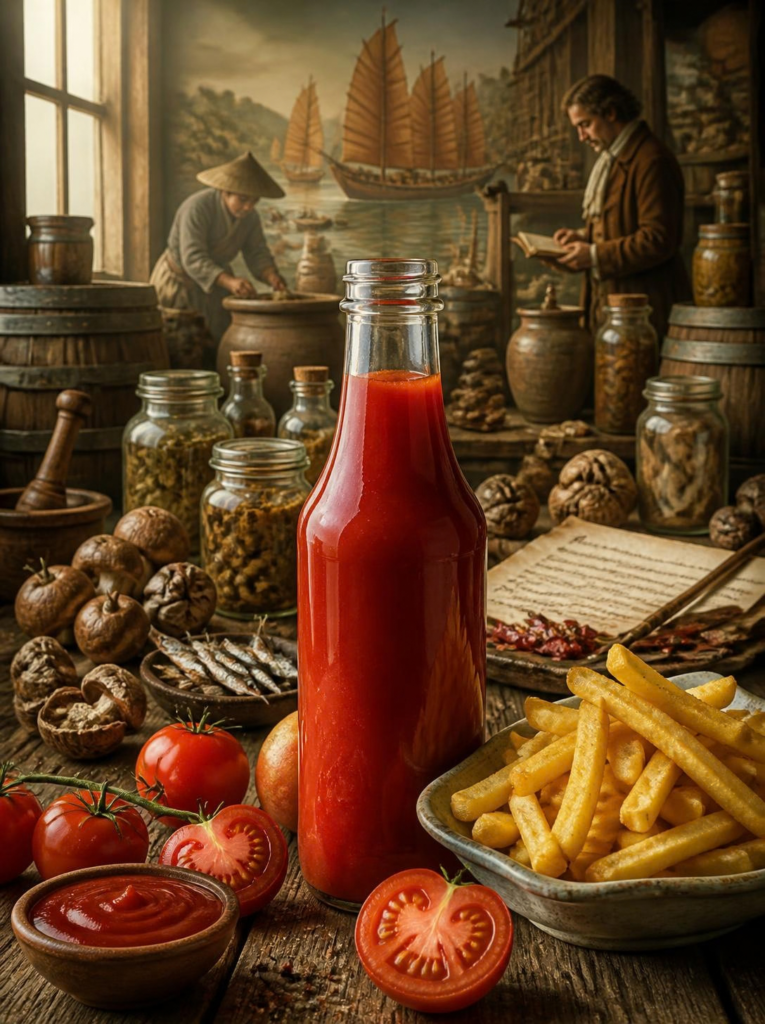
🐟 Before Tomatoes, Ketchup Was Made From Fish
The earliest ancestor of modern ketchup is generally connected to fermented fish sauces used in parts of China and Southeast Asia.
These sauces were made by fermenting fish, fish byproducts, salt, and sometimes other ingredients. Fermentation helped preserve food in a world without refrigerators, while also producing a strong, savory flavor.
One name associated with these early sauces was kê-tsiap, a term from the Hokkien Chinese language. The word referred to a type of sauce and is often considered one of the linguistic ancestors of “ketchup.”
The exact origins are complex, and food historians continue to discuss how the sauce developed and travelled. However, the broad story is clear: ketchup began as something very different from the tomato condiment we know today.
It was closer to a concentrated, salty seasoning than a sweet table sauce.
The sauce was especially useful for long journeys because fermented and salted ingredients could last much longer than fresh food. Traders and sailors encountered these sauces in Southeast Asia and carried the idea back to Europe.
This was the first major stage in ketchup’s transformation.
🌏 How Ketchup Travelled From Asia to Europe
During the 17th and 18th centuries, European traders and sailors travelled frequently through Southeast Asia. They encountered local sauces made from fermented fish, soy, spices, and other ingredients.
British travellers developed a taste for these strong, flavorful sauces and brought the idea home.
But there was a problem: the exact ingredients used in Asia were not always available in Britain.
Instead of copying the original sauce perfectly, British cooks began experimenting with local ingredients. They wanted to reproduce the rich, salty, complex flavor, even if the recipe itself had to change.
This led to a wide variety of early ketchups.
Some were made from:
- Mushrooms
- Walnuts
- Oysters
- Anchovies
- Shallots
- Lemons
- Plums
- Spices
- Vinegar
- Wine
These sauces could be thin, dark, salty, sour, or intensely savory. They were often used to improve soups, gravies, meat dishes, and fish.
At this stage, ketchup was not a single standardized recipe. It was more like a category of flavorful sauces.
🍄 Mushroom Ketchup Was Once Popular
One of the most interesting early versions was mushroom ketchup.
Instead of tomatoes, cooks used mushrooms, salt, and sometimes spices or alcohol. The mushrooms were often left to release their juices, and the liquid was collected, strained, and preserved.
The result was a dark, savory sauce with a powerful umami flavor.
Mushroom ketchup became especially popular in Britain. It was used in cooking much like modern soy sauce, Worcestershire sauce, or stock concentrate. A small amount could add depth to a dish.
Some historical accounts even associate mushroom ketchup with the household of novelist Jane Austen, although claims about personal food preferences should be treated with some caution.
The important point is that ketchup was once commonly made from ingredients that would seem completely unexpected today.
If you had opened a bottle of ketchup in the 1700s, there was a good chance it would not have been red—or made from tomatoes at all.
🍅 When Did Tomatoes Enter the Story?
Tomatoes eventually became part of ketchup’s history, but the change happened gradually.
Tomatoes originated in the Americas and were introduced to Europe after the voyages of the 15th and 16th centuries. Although tomato plants spread through Europe, many people were initially suspicious of the fruit.
Some Europeans believed tomatoes were poisonous or unhealthy. This fear was partly connected to the fact that tomatoes belong to the nightshade family, which includes several poisonous plants.
There were also practical reasons for suspicion. Wealthy Europeans sometimes used pewter plates containing lead. Acidic foods such as tomatoes could cause lead to leach into food, potentially producing poisoning. This may have contributed to the belief that tomatoes themselves were dangerous.
Over time, tomatoes became more accepted, particularly in southern Europe and later in North America.
Once tomatoes became familiar, cooks began experimenting with them in sauces, preserves, and condiments.
📜 The First Known Tomato Ketchup Recipe
The first known published American recipe for tomato ketchup appeared in 1812.
It was written by James Mease, a Philadelphia scientist and horticulturalist. His recipe used tomatoes, spices, and brandy, but it did not yet resemble the modern sweet ketchup found in supermarkets.
Mease referred to tomatoes as “love apples,” an old name sometimes used for the fruit.
His recipe was an important step because it connected the earlier ketchup tradition with the tomato.
However, the modern version of ketchup did not appear all at once. It developed through many changes involving sugar, vinegar, cooking methods, preservation, and commercial production.
Early tomato ketchups could be watery, sour, spicy, or difficult to preserve. Producers had to solve several problems before ketchup could become a reliable mass-market product.
🧂 Why Early Tomato Ketchup Was Difficult to Preserve
Tomatoes contain a great deal of water, and fresh tomato pulp spoils relatively quickly. In the 19th century, food manufacturers did not have the same refrigeration, sterilization, and packaging technology available today.
This created serious problems for ketchup producers.
Some early commercial ketchups were made using poor-quality tomatoes, leftover tomato pieces, or pulp that had already begun to spoil. Factories sometimes stored tomato pulp in unsuitable conditions, allowing fermentation, mold, and bacterial contamination to develop.
Some manufacturers used preservatives to slow down spoilage. One such chemical was sodium benzoate.
At the time, preservatives were widely used in processed foods, but concerns about their safety gradually increased. Food reformers and scientists began arguing that ketchup could be made safely through better ingredients, improved sanitation, more vinegar, more sugar, and better cooking methods.
This debate would eventually help change the entire food industry.
🏭 The Heinz Revolution
When people think of ketchup today, many immediately think of Heinz.
The Heinz company entered the ketchup business in 1876, when Henry J. Heinz began selling a tomato-based ketchup. The company was not the first to make tomato ketchup, but it helped transform the product into a dependable, widely distributed commercial food.
Heinz emphasized quality, consistency, cleanliness, and attractive packaging.
The company’s ketchup was made with tomatoes, vinegar, sugar, salt, and spices. Compared with many earlier versions, it was thicker, smoother, and more balanced in flavor.
The use of vinegar was particularly important. Vinegar helped provide the familiar tangy taste while also helping preserve the product.
Heinz also became associated with clear glass bottles. This allowed customers to see the contents rather than having to trust an opaque container.
That may seem like a small marketing decision, but at a time when food quality could be uncertain, transparency mattered.
A bottle that visibly contained clean, bright red ketchup helped communicate reliability.
🧪 Ketchup and the Pure Food Movement
Ketchup’s history is also connected to the development of modern food safety standards in the United States.
In the late 19th and early 20th centuries, some food manufacturers used questionable ingredients and poor production methods. Food products could contain artificial coloring, excessive preservatives, spoiled ingredients, or contaminants.
Food scientist Harvey Washington Wiley became one of the leading figures in the campaign for safer food production. He argued that manufacturers should use better ingredients and avoid unnecessary chemicals.
Henry Heinz supported many of these ideas.
The Heinz company worked to create a ketchup that could be preserved through a combination of ripe tomatoes, vinegar, sugar, cooking, and improved sanitation rather than relying heavily on chemical preservatives.
Research by food scientists, including Arvill Bitting and her husband, Arvil Bitting, examined ketchup production and spoilage. Their work helped identify ways to make ketchup safer and more stable.
These changes did more than improve one condiment. They contributed to wider discussions about food manufacturing, labeling, preservatives, and consumer protection.
In that sense, ketchup was not just a food product.
It became part of the history of modern food regulation.
🥫 Why Ketchup Became Thick and Sweet
Modern ketchup is usually thick, smooth, sweet, and tangy. But these qualities developed over time.
Early ketchups were often thinner and more savory. As tomato ketchup became popular in the United States, producers gradually adjusted the recipe to suit changing tastes.
Sugar helped soften the acidity of tomatoes and vinegar. Vinegar added tanginess and improved preservation. Cooking reduced water content and created a thicker consistency.
Tomatoes also contain pectin, a natural substance that helps create structure and thickness. The use of ripe tomatoes and improved cooking methods helped manufacturers produce a more consistent sauce.
By the late 19th and early 20th centuries, tomato ketchup had become increasingly recognizable as the condiment we know today.
The combination of sweetness, acidity, saltiness, and umami made it appealing with a wide range of foods.
It worked with meat, potatoes, sandwiches, eggs, sausages, and eventually fast food.
🔤 Ketchup, Catsup, or Catchup?
You may have noticed that ketchup is sometimes spelled catsup.
Both “ketchup” and “catsup” have been used historically. Older spellings also included “catchup” and other variations.
The differences developed as the word moved between languages, regions, cookbooks, and commercial brands.
“Ketchup” eventually became the dominant spelling in many parts of the world, while “catsup” remained in use in some places and on certain product labels.
The spelling difference does not necessarily indicate a different type of sauce. In many cases, it is simply a historical or branding variation.
The word itself has travelled almost as much as the sauce.
Its journey from Asian fermented fish sauces to British recipes and American tomato products left behind several different spellings.
🌐 Ketchup Has Many Global Relatives
Although modern Western ketchup is strongly associated with tomatoes, many countries have their own versions of ketchup and related sauces.
In the Philippines, for example, banana ketchup is a popular condiment made using bananas, sugar, vinegar, and spices. It developed partly because tomatoes were not always readily available, while bananas were abundant.
Banana ketchup is often colored red, making it visually similar to tomato ketchup even though its main ingredient is different.
Other countries use sauces based on mushrooms, fruits, chilies, fermented beans, or fish.
This variety reminds us that ketchup has never been one fixed recipe. It has always adapted to local ingredients and tastes.
The tomato version became globally dominant in many places, but the wider ketchup family remains much more diverse.
🍟 How Ketchup Became a Fast-Food Icon
Ketchup’s modern popularity grew alongside the rise of mass-produced food and fast food.
As hamburgers, hot dogs, French fries, sandwiches, and other convenient foods became more common, ketchup became a natural companion.
Its flavor is especially useful because it combines several taste sensations at once:
- Sweetness from sugar and tomatoes.
- Acidity from vinegar.
- Saltiness from salt.
- Savory depth from tomatoes and spices.
- A soft, smooth texture that spreads easily.
This makes ketchup versatile. It can brighten bland foods, balance salty foods, and add moisture to dry foods.
Its bright color also makes it visually noticeable. A small red line of ketchup can make a plain plate of fries look more appetizing.
Over time, ketchup became more than a sauce. It became part of the visual identity of casual dining and fast food.
🧴 Why Is Ketchup So Difficult to Pour?
There is also some interesting science in the humble ketchup bottle.
Ketchup is a non-Newtonian fluid, meaning its flow behavior changes depending on how force is applied.
When left alone, ketchup can behave like a thick gel. When shaken, tapped, or squeezed, it begins to flow more easily.
This is why a bottle may appear completely stuck until it suddenly releases too much ketchup at once.
The familiar glass bottle created another challenge: users had to shake or tap it to encourage the sauce to move. Later squeeze bottles made dispensing easier by allowing people to apply pressure directly.
The problem is a perfect example of how everyday products are shaped by both food chemistry and packaging design.
Even the simple act of getting ketchup onto a plate involves physics.
🧠 A Condiment With a Surprisingly Complicated Past
Ketchup may seem like one of the simplest foods in the kitchen, but its history includes global trade, language changes, fermentation, colonial encounters, tomato cultivation, industrial manufacturing, food safety debates, and consumer marketing.
It began as a savory fermented sauce associated with Asia. British cooks experimented with mushrooms, walnuts, oysters, and anchovies. American cooks introduced tomatoes and gradually developed a sweeter, thicker version.
Companies such as Heinz helped standardize the product and make it widely available. Scientists and reformers helped improve its safety and consistency.
Today, ketchup is found in homes, restaurants, school cafeterias, fast-food outlets, and kitchens around the world.
Yet its ancient ancestor would probably be almost unrecognizable to a modern ketchup lover.
The next time you squeeze ketchup onto your fries, remember that you are using the final chapter of a story that began with fermented fish sauce thousands of miles away.
🍅 From Fish Sauce to French Fries
The story of ketchup shows how food changes as it moves between cultures.
A sauce created for preservation became a traded product. Traders introduced it to new regions. Cooks changed the ingredients to suit local tastes. Scientists improved its safety. Manufacturers standardized it. Consumers turned it into an everyday favorite.
Few foods demonstrate cultural adaptation quite as clearly as ketchup.
It is a reminder that familiar objects and flavors often have complicated histories hidden beneath their ordinary appearance.
That red bottle on the table is not just a condiment.
It is the result of centuries of travel, experimentation, and reinvention.
Continue Your Journey
If you enjoyed discovering how an everyday food can have a surprising global history, continue your journey with our previous post:
The Faroe Islands: Where Roads Meet the Ocean
Share the Curiosity 🌍
If this story changed the way you look at ketchup, share it with someone who always puts ketchup on their fries.
- Facebook: https://facebook.com/Trivialwiki
- Instagram: https://instagram.com/trivialwiki
- YouTube: https://youtube.com/@trivialwiki
- Pinterest: https://pinterest.com/Trivialwiki
What Do You Think?
Would you have tried the original fish-based ancestor of ketchup, or do you prefer the familiar sweet tomato version we use today? 🍟
1 thought on “The Curious History of Ketchup”