
Take a look at the keys in your pocket.
Whether they belong to your home, office, mailbox, or an old storage cabinet, you’ll notice something interesting. Most keys have a series of ridges and grooves along one edge that resemble teeth.
We use keys almost every day, yet few people stop to wonder why they are shaped this way.
Why do keys have teeth?
Why aren’t they smooth pieces of metal?
And how can such a simple object prevent unauthorized access while allowing the correct person to open a lock in seconds?
The answer lies in a clever piece of engineering that has evolved over thousands of years. Behind every key is a surprisingly sophisticated system designed to recognize a unique pattern and grant access only to those who possess it.
The humble key may seem ordinary, but it is one of humanity’s oldest and most successful security technologies.
🏺 The First Keys Were Enormous
Modern keys are small enough to fit comfortably in a pocket.
Ancient keys were very different.
Some of the earliest known locks appeared thousands of years ago in ancient Egypt. These locks were often made from wood and could be much larger than the metal locks we use today.
The corresponding keys were also large.
Instead of carrying a compact metal keyring, a person might carry a wooden device large enough to attract attention.
Although primitive by modern standards, these early locks introduced an important concept: access could be controlled through a specific mechanism that responded only to a matching key.
That idea remains at the heart of modern lock design.
🔐 The Challenge of Security
At its most basic level, a lock must answer a simple question:
“Is this the correct key?”
The challenge is creating a system that reliably distinguishes authorized keys from all others.
A smooth piece of metal would not provide much security.
Anyone could create a similar object.
Instead, locks require unique physical patterns.
The ridges and grooves on a key serve as a form of mechanical identification.
Much like a password, the pattern must match what the lock expects.
If the pattern is wrong, the lock remains closed.
🦷 Why Keys Have Teeth
The “teeth” on a key are actually carefully cut notches.
Each notch has a specific depth and position.
Together, these cuts create a unique pattern.
When the key enters the lock, the teeth interact with internal components designed to recognize that pattern.
The lock essentially “reads” the shape of the key.
If every notch is positioned correctly, the internal mechanism aligns and the lock opens.
If even one notch is incorrect, the system fails.
The teeth are not decorative.
They are the key’s identity.
⚙️ How Pin Tumbler Locks Work
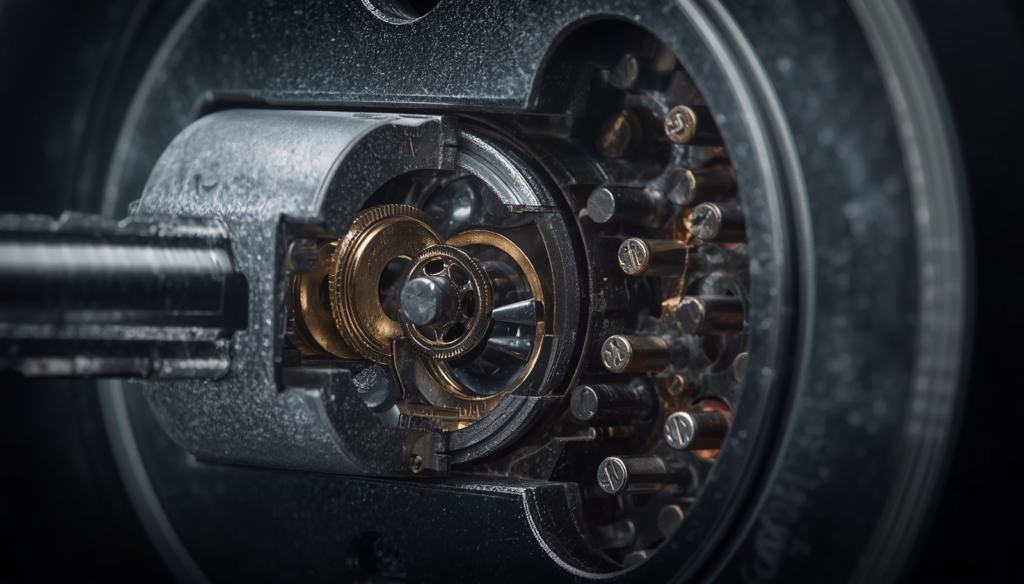
One of the most common lock designs used today is the pin tumbler lock.
Although the internal mechanism is hidden, its operation is surprisingly elegant.
Inside the lock are several pairs of small pins.
When no key is present, these pins block the lock from turning.
As the correct key slides into the lock, its teeth lift each pin to a precise height.
If every pin reaches the correct position, a line known as the shear line becomes aligned.
Once this happens, the lock cylinder can rotate and the door can open.
The entire process takes less than a second.
Yet it relies on remarkable precision.
🔑 Millions of Possible Combinations
The power of keys comes from variation.
A manufacturer can create countless combinations by altering the depths and positions of the cuts.
Even small differences create entirely different keys.
This allows thousands—or even millions—of unique combinations to exist.
As a result, the key that opens your front door is extremely unlikely to open someone else’s.
The system achieves security not through complexity alone but through the enormous number of possible patterns.
🏠 Why Some Keys Look Different
Not all keys are designed the same way.
House keys, car keys, padlock keys, and high-security keys often have different shapes and cutting patterns.
Some keys have teeth on one side.
Others have cuts on both sides.
Modern high-security keys may use dimples, grooves, or laser-cut patterns rather than traditional teeth.
The goal remains the same.
The lock must recognize a specific pattern while rejecting all others.
Over time, lock manufacturers have developed increasingly sophisticated ways of achieving this.
🚗 The Evolution Beyond Traditional Keys
In recent years, many people have begun using electronic access systems.
Cars may use key fobs.
Offices may use access cards.
Homes increasingly feature smart locks.
At first glance, it might seem as though traditional keys are disappearing.
Yet the underlying principle remains remarkably similar.
Whether a lock checks a metal pattern, an electronic code, or a wireless signal, it is still answering the same question:
“Do you have the correct credentials?”
Modern systems changed the technology but preserved the idea.
🧠 Keys as Physical Passwords
One useful way to think about a key is as a physical password.
A password works because the correct sequence of characters unlocks access.
A key works because the correct sequence of cuts unlocks a mechanism.
In both cases, success depends on matching an expected pattern.
This comparison helps explain why keys have remained effective for so long.
They provide a simple and reliable method of authentication.
Long before computers existed, people were already using physical passwords made from metal.
🌍 An Invention That Changed Everyday Life
Locks and keys may seem unremarkable today because they are everywhere.
Homes, offices, vehicles, lockers, gates, safes, and countless other objects rely on them.
Yet their impact on society has been enormous.
Secure storage encourages commerce.
Protected homes provide safety.
Controlled access allows organizations to manage valuable resources.
The simple combination of a lock and key helped make modern life possible.
Few inventions have become so widespread while attracting so little attention.
💡 The Hidden Engineering in Your Pocket
The next time you pick up a key, take a closer look at its teeth.
Those tiny ridges represent centuries of engineering development.
They are carefully designed to interact with hidden mechanisms inside a lock, lifting pins to precise heights and proving that the correct key has arrived.
What appears to be a simple piece of metal is actually a cleverly engineered security device.
Its design has endured for generations because it solves a universal problem.
Who should be allowed in—and who should stay out?
For thousands of years, the answer has often depended on a few tiny teeth.
🔑 Continue Your Journey
If you enjoyed discovering the hidden engineering behind everyday objects, don’t miss our previous post:
👉 The Arctic Tern: The World’s Greatest Traveler
Learn how a small seabird performs the longest migration of any known animal, traveling from the Arctic to Antarctica and back every year.
📬 Stay Connected with Trivialwiki
👉 Facebook: https://facebook.com/Trivialwiki
👉 Instagram: https://instagram.com/trivialwiki
👉 YouTube: https://youtube.com/@trivialwiki
👉 Pinterest: https://pinterest.com/Trivialwiki
Learn. Explore. Discover.
Keys are among the oldest security technologies still used today, and their tiny teeth function much like physical passwords. Have you ever wondered how many locks and keys you interact with during a typical day? Share your thoughts in the comments! 🔐🔑
1 thought on “Why Do Keys Have Teeth?”