
When people think about engineers, they usually imagine humans.
They picture architects designing skyscrapers, workers constructing bridges, or teams building canals and highways. Engineering seems like a uniquely human skill—one that requires planning, tools, and complex problem-solving.
Yet deep in forests, wetlands, and river valleys across North America and parts of Europe, another engineer has been quietly transforming landscapes for millions of years.
The engineer is not a human.
It is a beaver.
Armed with nothing more than powerful teeth, instinct, and determination, beavers construct dams, create ponds, redirect waterways, and alter entire ecosystems. Their projects can be seen from space and often influence the lives of countless other plants and animals.
In fact, few creatures shape their environment as dramatically as beavers.
The story of these remarkable rodents reveals that some of nature’s greatest engineers walk on four legs and have flat tails.
🦫 More Than Just a Large Rodent
Beavers are among the largest rodents in the world.
Adults can weigh more than 20 kilograms, making them significantly larger than the mice and squirrels most people associate with the rodent family.
At first glance, beavers appear perfectly designed for life in the water.
Their broad tails act as rudders while swimming. Their webbed feet help them move efficiently through ponds and streams. Their dense fur provides insulation against cold temperatures.
But their most famous feature is their teeth.
Beaver teeth never stop growing.
The bright orange color comes from iron-rich enamel, which makes them exceptionally strong and resistant to wear.
These teeth function like natural woodworking tools, allowing beavers to cut through trees with remarkable efficiency.
🌳 Why Beavers Cut Down Trees
A common misconception is that beavers cut trees solely for food.
While they do eat bark, twigs, and certain plant materials, food is only part of the story.
Trees are also building materials.
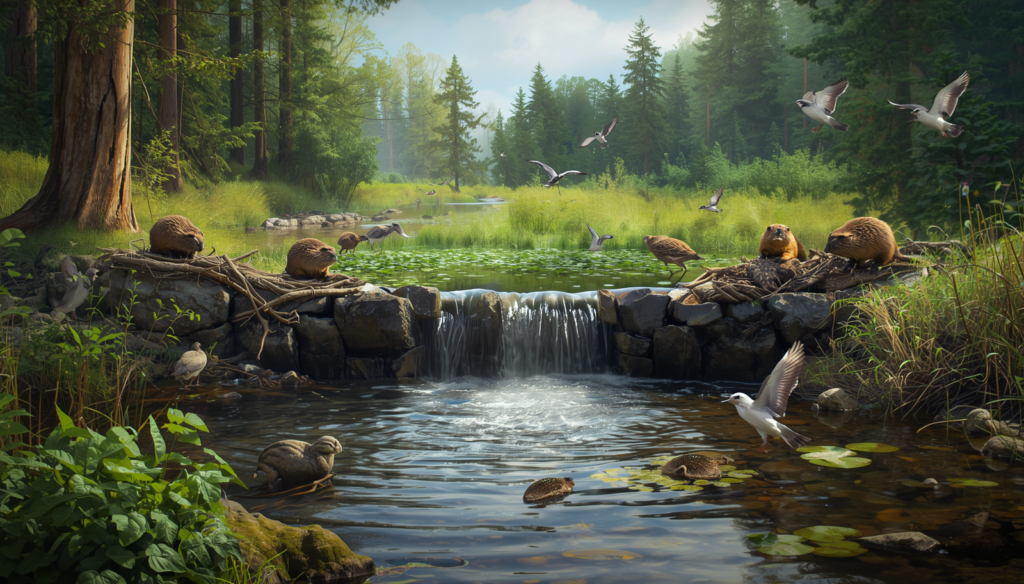
Beavers use branches, logs, mud, and vegetation to construct dams and lodges.
The lodge serves as a home, while the dam serves a much larger purpose.
Together, these structures help create the environment beavers need to survive.
In many ways, beavers are not simply adapting to nature.
They are actively redesigning it.
🌊 The Purpose of a Beaver Dam
The most famous beaver structure is the dam.
Unlike human dams, which are often built to generate electricity or store water, beaver dams serve a different purpose.
They slow the flow of rivers and streams.
As water accumulates behind the dam, a pond forms.
This pond provides safety.
Beavers are vulnerable to predators such as wolves, bears, coyotes, and large cats. Deep water creates a protective barrier around their lodge, making it much harder for predators to reach them.
The pond also allows beavers to transport building materials more easily.
What begins as a survival strategy ends up transforming the surrounding landscape.
🏗️ Building Without Blueprints
One of the most fascinating aspects of beaver engineering is that it occurs without formal planning.
No beaver attends engineering school.
No beaver studies architecture.
Yet beavers consistently construct structures that achieve their goals.
Scientists believe much of this behavior is instinctive.
The sound of running water appears to trigger dam-building activity. If beavers hear water flowing through a gap, they often respond by adding more material until the leak is reduced.
Over time, this simple behavior can produce surprisingly sophisticated structures.
Some beaver dams stretch hundreds of meters in length.
One famous dam in Canada is so large that it can be identified in satellite imagery.
🌿 Creating Entire Ecosystems
The effects of a beaver dam extend far beyond the beavers themselves.
When a pond forms, it creates new habitats for countless other species.
Fish, amphibians, birds, insects, and aquatic plants often benefit from the calmer waters.
Wetlands begin to develop.
These wetlands support extraordinary biodiversity.
In many regions, areas with active beaver populations contain more species than neighboring areas without them.
This is why scientists often refer to beavers as ecosystem engineers.
Their construction projects create environments that help many other organisms thrive.
💧 Nature’s Flood Managers
Modern societies spend enormous resources trying to manage water.
Engineers build reservoirs, retention ponds, and flood-control systems.
Interestingly, beavers often perform similar functions naturally.
Beaver ponds slow the movement of water through a landscape.
This can reduce downstream flooding during periods of heavy rain.
The ponds also help store water during dry seasons.
As climate change increases concerns about floods and droughts, some conservationists have begun studying how beaver-created wetlands can contribute to natural water management.
In some areas, humans are even encouraging beaver populations to return because of these benefits.
🌎 The Surprising Return of the Beaver
For centuries, beavers were heavily hunted.
Their fur was highly valued, and populations declined dramatically in many regions.
By the nineteenth century, some areas had lost most of their beavers.
As a result, countless wetlands disappeared.
Streams flowed differently. Ecosystems changed.
In recent decades, however, conservation efforts have helped many beaver populations recover.
As beavers return, researchers have observed the reappearance of ponds, wetlands, and wildlife habitats.
The landscape itself begins changing once again.
It is a powerful reminder of how much influence a single species can have.
🚀 Engineering Lessons from Nature
Human engineers increasingly study natural systems for inspiration.
This approach, known as biomimicry, involves learning from solutions that evolved in nature.
Beavers provide an excellent example.
Their dams demonstrate how simple materials can create resilient structures.
Their ponds illustrate natural methods of managing water.
Their ability to improve ecosystems while solving their own survival challenges offers valuable lessons for sustainable design.
Sometimes nature solves problems in ways humans never considered.
💡 The Tiny Builders with a Massive Impact
Most people will never see a beaver constructing a dam.
The animals are often active at dawn, dusk, or during the night.
Yet their influence is visible throughout the landscapes they inhabit.
A small group of beavers can transform a narrow stream into a thriving wetland.
They can create habitats, support biodiversity, manage water, and reshape entire ecosystems.
Few animals have such a profound effect on the world around them.
The next time you encounter a pond in a forest or notice a dam across a stream, consider what may have created it.
There is a good chance the engineer was not human at all.
It may have been one of nature’s most remarkable builders—a beaver.
🦫 Keep Exploring
If you enjoyed learning about surprising forces that shape our world, don’t miss our previous post:
👉 Why Is Vanilla So Expensive?
Discover how a tropical orchid, hand pollination, and years of careful cultivation make vanilla one of the world’s most expensive flavors.
📬 Stay Connected with Trivialwiki
👉 Facebook: https://facebook.com/Trivialwiki
👉 Instagram: https://instagram.com/trivialwiki
👉 YouTube: https://youtube.com/@trivialwiki
👉 Pinterest: https://pinterest.com/Trivialwiki
Learn. Explore. Discover.
Beavers build dams to protect themselves, but their construction projects end up creating entire ecosystems that support countless other species. Do you think any other animal rivals the beaver when it comes to engineering skills? Share your thoughts in the comments! 🦫🌊
1 thought on “Nature’s Engineers: How Beavers Reshape Entire Landscapes”