
Imagine sending a message from India to the United States.
Or joining a video call with someone in Europe.
Or watching a video hosted on a server thousands of kilometers away.
Most people assume that this information travels through satellites orbiting high above Earth. After all, the internet feels wireless. Data appears to move invisibly through the air, arriving almost instantly from the other side of the planet.
But the reality is far more surprising.
The modern internet depends not on satellites, but on a vast network of cables lying on the ocean floor.
Stretching across seas and oceans, these cables form the hidden infrastructure that carries the overwhelming majority of international internet traffic. They connect continents, power global communication, and support everything from financial markets to social media.
Without them, the modern world would look very different.
These are the invisible highways beneath the oceans.
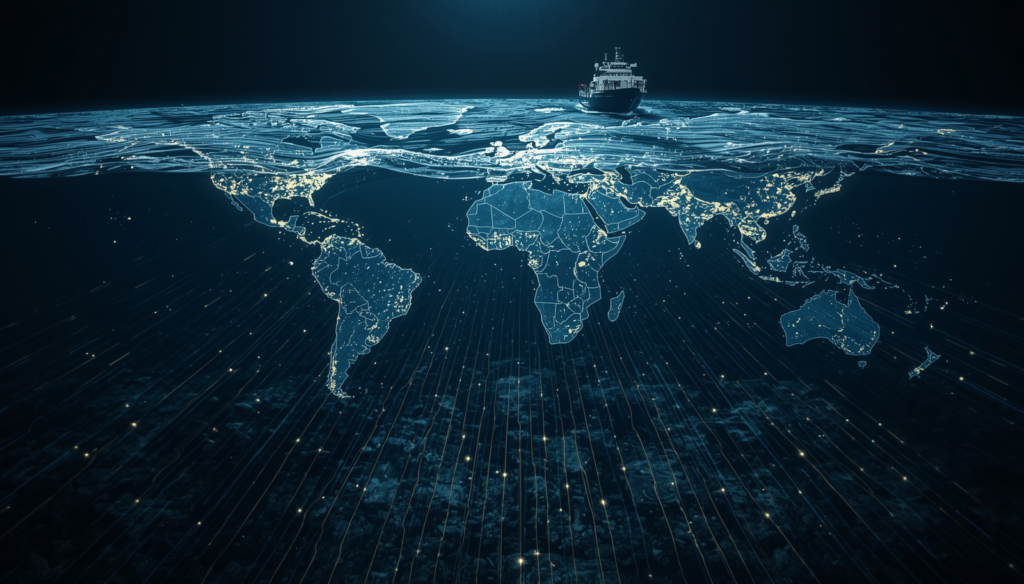
🌊 A Global Network Hidden in Plain Sight
When people imagine the internet, they often picture data floating through space or bouncing between satellites.
While satellites do play an important role in certain situations, they carry only a small fraction of global internet traffic.
Instead, more than 95% of international data travels through submarine fiber-optic cables laid across the ocean floor.
These cables connect countries and continents through a massive physical network.
Every email, video stream, online purchase, and cloud backup may pass through multiple underwater cables before reaching its destination.
In many ways, the internet is less like a cloud and more like an enormous plumbing system hidden beneath the sea.
📜 The Story Begins with the Telegraph
The idea of underwater communication is older than many people realize.
In the mid-19th century, the world was already searching for ways to communicate across long distances.
The solution arrived in the form of the telegraph.
Engineers began laying insulated cables beneath rivers and coastal waters. Eventually, they attempted something far more ambitious: connecting continents.
In 1858, one of the first transatlantic telegraph cables linked North America and Europe.
The achievement was celebrated around the world.
For the first time, messages that previously took weeks to travel by ship could be transmitted in minutes.
Although early cables were unreliable and difficult to maintain, they demonstrated that global communication through underwater cables was possible.
The modern internet would eventually build upon this same idea.
💡 From Copper Wires to Light
Today’s submarine cables are vastly more advanced than their telegraph-era ancestors.
Modern systems use fiber-optic technology, which transmits information using pulses of light rather than electrical signals.
Inside each cable are extremely thin strands of glass capable of carrying enormous amounts of data.
These light signals travel at incredible speeds across thousands of kilometers.
A single modern cable can carry millions of simultaneous phone calls, video streams, financial transactions, and internet connections.
The amount of information flowing through these cables every second is almost impossible to imagine.
🚢 Laying Cables Across Entire Oceans
Installing submarine cables is one of the world’s most complex engineering operations.
Specialized cable-laying ships transport massive spools of cable across oceans.
Engineers carefully survey the seabed before installation begins. They must avoid underwater hazards such as:
- volcanic regions
- steep underwater cliffs
- earthquake zones
- busy shipping routes
As the ship follows a planned route, the cable is slowly lowered to the ocean floor.
In deep ocean areas, the cable simply rests on the seabed.
Closer to shore, where fishing equipment and ship anchors could damage it, sections are often buried beneath the seafloor for protection.
The entire process can take months.
🌍 Connecting the Continents
Today, hundreds of submarine cable systems connect nearly every populated continent.
Some routes link neighboring countries.
Others cross entire oceans.
Major cables connect:
- North America and Europe
- Asia and Europe
- Asia and Australia
- Africa and Europe
- South America and North America
Together, these links form a global communications web.
When you open a website hosted in another country, your data may travel through multiple cable systems before reaching the server and returning with the information you requested.
All of this happens in fractions of a second.
💰 Why Financial Markets Depend on Them
Few industries rely on submarine cables more heavily than global finance.
Modern stock exchanges process enormous volumes of transactions every second.
In some cases, fractions of a second can determine whether a trade succeeds or fails.
As a result, financial institutions invest heavily in fast, reliable cable connections between major financial centers.
For traders, reducing transmission time by even a tiny amount can have significant economic value.
This makes submarine cables some of the most strategically important infrastructure in the world.
🦈 Do Sharks Really Attack Internet Cables?
One of the internet’s most persistent myths involves sharks.
Over the years, reports emerged of sharks occasionally biting underwater cables.
The story became so popular that it developed an almost legendary status.
While shark encounters have occurred, they are relatively rare and are not considered a major threat to modern cable systems.
Today’s cables are protected by multiple layers of insulation and shielding.
In reality, fishing equipment, ship anchors, and natural disasters pose much greater risks.
Still, the image of sharks investigating the internet’s hidden infrastructure remains one of the more amusing aspects of submarine cable history.
🌋 The Challenges Beneath the Sea
Despite their durability, submarine cables are not invincible.
Earthquakes, underwater landslides, and accidental damage can occasionally disrupt service.
When a cable breaks, specialized repair ships are dispatched to locate the problem.
Engineers use sophisticated equipment to retrieve damaged sections from the seabed, repair them, and carefully return them to service.
Depending on the location, repairs can take days or even weeks.
Given the vast distances involved, maintaining this global network is a remarkable achievement.
🚀 The Future of Global Connectivity
As internet usage continues growing, demand for submarine cables continues to increase.
Cloud computing, video streaming, artificial intelligence, and global business operations all require ever-greater amounts of bandwidth.
New cables are constantly being planned and installed.
Some of the world’s largest technology companies now invest directly in submarine cable projects to support their global services.
The hidden highways beneath the oceans are becoming more important with every passing year.
💡 The Infrastructure Most People Never See
The modern world depends on countless systems operating quietly in the background.
Submarine cables are among the most important.
They receive little attention compared to satellites, smartphones, or social media platforms, yet they make those technologies possible.
Every day, billions of people rely on a network they rarely think about.
Beneath the waves, thousands of kilometers of fiber-optic cables connect continents, carry information, and keep the global economy running.
The next time you send a message across the world, remember that it probably isn’t traveling through space.
More likely, it is racing through a glass strand lying silently on the floor of the ocean.
🌐 Keep Exploring
If you enjoyed learning about the hidden systems that quietly shape our world, don’t miss our previous post:
👉 The Netherlands: The Country That Refused to Drown
Discover how centuries of engineering helped a nation reclaim land from the sea and become one of the world’s leaders in water management.
📬 Stay Connected with Trivialwiki
👉 Facebook: https://facebook.com/Trivialwiki
👉 Instagram: https://instagram.com/trivialwiki
👉 YouTube: https://youtube.com/@trivialwiki
👉 Pinterest: https://pinterest.com/Trivialwiki
Learn. Explore. Discover.
The internet may feel wireless, but most international data travels through cables lying deep beneath the oceans. Were you surprised to learn that the world’s digital communication depends on physical cables? Share your thoughts in the comments! 🌊🌐
1 thought on “The Invisible Highways Beneath the Oceans”