
Take a look around you for a moment.
Your wireless earbuds, smartwatch, keyboard, computer mouse, car audio system, fitness tracker, and even some home appliances may all be communicating using the same technology. It has become so common that most people hardly notice it anymore.
That technology is Bluetooth.
Today, Bluetooth powers billions of devices worldwide, helping them exchange information without cables. It has become one of the most important wireless standards ever created.
Yet despite its modern appearance, Bluetooth carries a surprisingly ancient name.
The story behind that name takes us back more than a thousand years to the age of Viking kings, medieval kingdoms, and political alliances. It is a tale that connects one of the world’s oldest historical figures to one of its most widely used technologies.
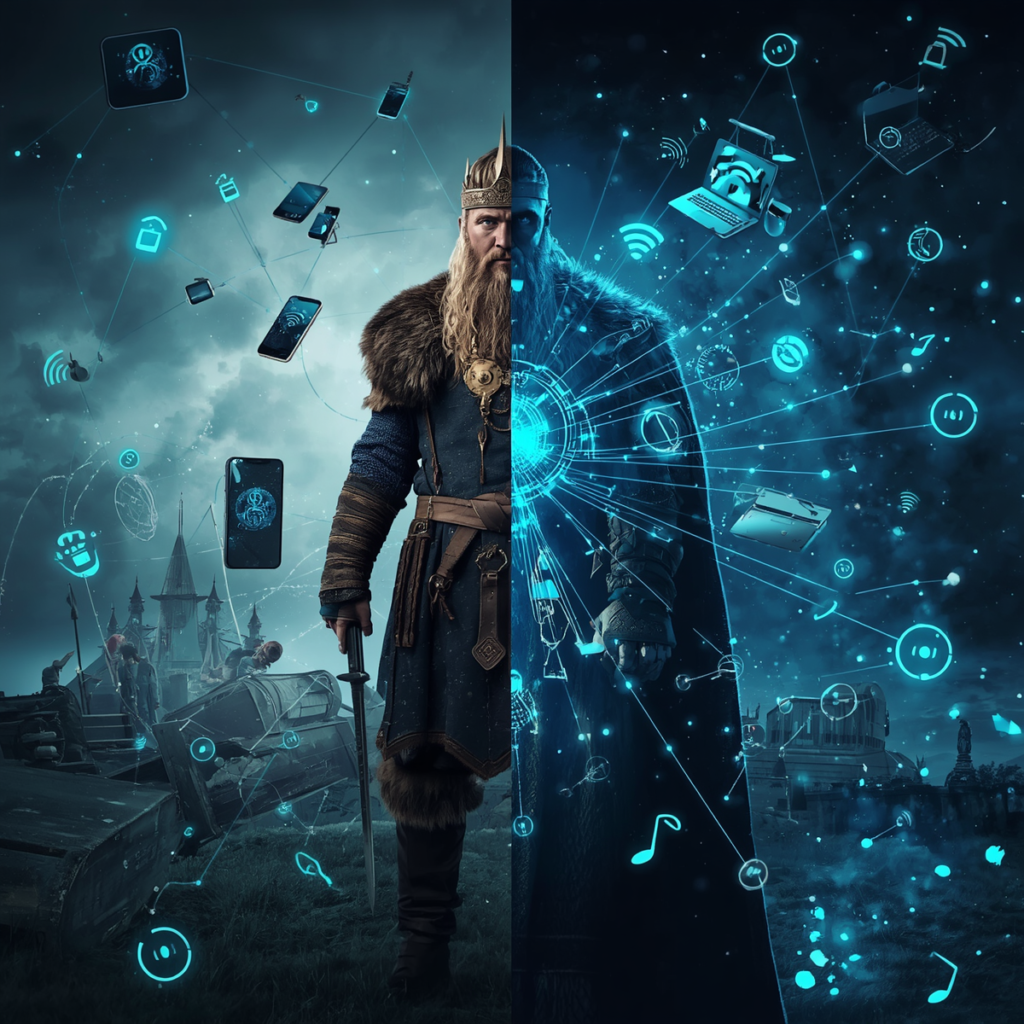
⚔️ A King from the Viking Age
The Bluetooth name comes from a real person: Harald Bluetooth, a Viking king who ruled parts of Denmark and Norway during the 10th century.
Known in Danish as Harald Blåtand, he lived during a period when Scandinavia was divided among competing tribes and regional rulers. One of Harald’s greatest achievements was uniting large portions of Denmark and Norway under a single rule.
Historians credit him with helping bring stability to the region and strengthening political ties between previously fragmented groups.
Although details of his life are sometimes difficult to separate from legend, his reputation as a unifier became the key reason his name would eventually be borrowed by the technology industry centuries later.
At the time, nobody could have imagined that a Viking king would one day become associated with smartphones, laptops, and wireless headphones.
📱 The Birth of a Wireless Standard
Fast forward to the 1990s.
Technology companies were facing a growing problem. Electronic devices were becoming increasingly common, but connecting them often required a confusing collection of cables and connectors.
Manufacturers wanted a simple way for devices to communicate wirelessly over short distances.
Several major companies, including Ericsson, Intel, Nokia, and IBM, began collaborating to create a universal wireless communication standard.
The goal was ambitious. They wanted computers, phones, printers, and other devices from different manufacturers to work together seamlessly.
In many ways, they were trying to unite separate technological worlds.
🧠 Why the Name “Bluetooth” Was Chosen
During the development process, engineers needed a temporary codename for the project.
One of the engineers involved was fascinated by Viking history and suggested the name “Bluetooth.”
The comparison seemed surprisingly appropriate.
Just as King Harald Bluetooth had united different kingdoms, the new wireless standard would unite different electronic devices and allow them to communicate with one another.
What began as a temporary project name quickly gained popularity among the development team.
Eventually, the codename became the official name of the technology.
The name stuck, and Bluetooth was born.
🔷 The Hidden Meaning in the Bluetooth Logo
The connection to Harald Bluetooth goes even deeper.
The familiar Bluetooth logo is not simply a random symbol.
It is actually a combination of two ancient runic characters from the Viking alphabet.
These runes represent the initials of Harald Bluetooth:
H for Harald and B for Bluetooth.
Designers combined the two runes into a single symbol, creating the logo that appears on billions of devices today.
Every time someone pairs a headset or connects a wireless speaker, they are interacting with a symbol inspired by a king who lived more than a millennium ago.
🌍 How Bluetooth Changed Everyday Life
When Bluetooth first appeared, its capabilities were relatively modest.
Early versions transferred data slowly and were often used for simple tasks such as connecting phones to hands-free accessories.
Over time, however, the technology improved dramatically.
New generations of Bluetooth became faster, more reliable, and more energy efficient.
Today it powers countless applications, including wireless audio, wearable devices, smart home systems, medical equipment, gaming controllers, and vehicle communication systems.
Many people use Bluetooth dozens of times each day without even realizing it.
Its success lies in its simplicity. Devices can connect quickly without complicated setup procedures or physical cables.
🎧 Why Wireless Earbuds Depend on Bluetooth
One of Bluetooth’s most visible successes is the rise of wireless earbuds.
For decades, headphones relied on cables connecting directly to music players and phones.
Bluetooth removed that limitation.
Modern earbuds can stream high-quality audio while fitting comfortably into a pocket-sized charging case. Advances in Bluetooth technology have reduced delays, improved sound quality, and extended battery life.
As a result, wireless listening has become the norm rather than the exception.
A technology named after a Viking king now helps millions of people listen to music, podcasts, and phone calls every day.
🚀 Constantly Evolving Technology
Bluetooth continues to evolve.
Recent versions focus on improving efficiency and supporting the growing number of connected devices in homes and workplaces.
The technology is also playing an increasingly important role in the Internet of Things, where everyday objects communicate with one another.
From smart watches monitoring health to sensors managing industrial equipment, Bluetooth is quietly expanding into new areas of modern life.
Its future may be even more important than its past.
💡 A Thousand-Year Journey
Few technology names have a story as unusual as Bluetooth.
Most people assume it is simply a technical term invented by engineers. In reality, it is a tribute to a Viking ruler whose greatest achievement was bringing different groups together.
More than a thousand years after his reign, Harald Bluetooth’s legacy survives in an unexpected way.
Every time a smartphone connects to a speaker or a laptop pairs with a keyboard, a tiny piece of Viking history lives on.
It is a remarkable reminder that innovation often draws inspiration from the past.
Sometimes the path from medieval kingdoms to modern technology is shorter than it seems.
Continue Exploring on Trivialwiki
If you enjoyed discovering the surprising stories hidden behind everyday technology, don’t miss our previous post:
📬 Stay Connected with Trivialwiki
👉 Facebook: https://facebook.com/Trivialwiki
👉 Instagram: https://instagram.com/trivialwiki
👉 YouTube: https://youtube.com/@trivialwiki
👉 Pinterest: https://pinterest.com/Trivialwiki
Learn. Explore. Discover.
Bluetooth connects billions of devices every day, but its name comes from a Viking king who lived more than a thousand years ago. What other everyday technology do you think might have a surprising origin story? Share your thoughts in the comments! 📱⚔️