
A happy accident more than 9,000 years in the making — and the story of how it changed the world.
There is a food sitting in your refrigerator right now that might be older than the wheel. It has been found in the tombs of Egyptian pharaohs, praised by Roman emperors, perfected by medieval monks, and adored across six continents. Yet no one deliberately invented it. Cheese — in all its hundreds of forms — arrived on this planet by complete accident, the result of a thirsty traveller, the blazing desert sun, and a stomach.
Literally a stomach.
This is the unlikely, oddly wonderful origin story of one of humanity’s most beloved foods.
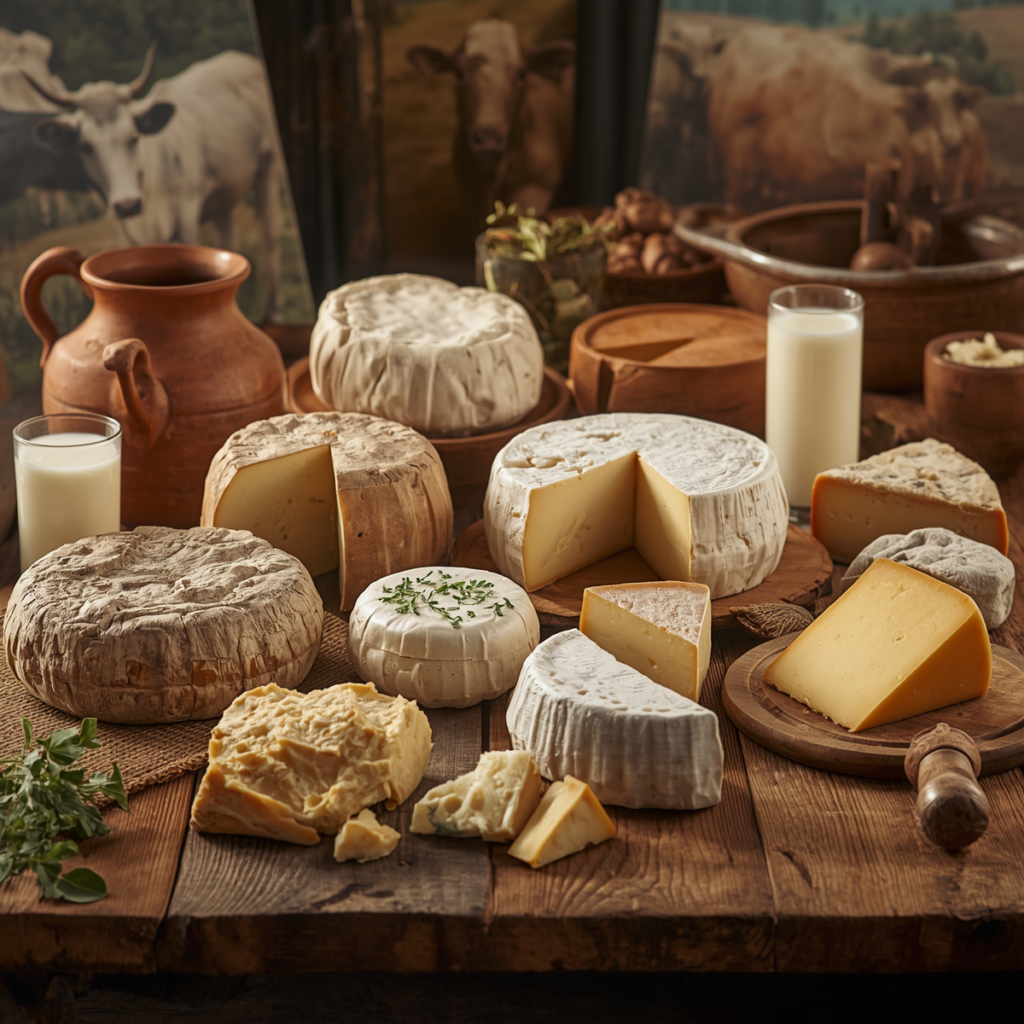
🐐 The Accidental Kitchen
Picture this: somewhere in the ancient Middle East, roughly 7,000 to 9,000 years ago, a nomad sets out on a long desert journey. He is carrying milk — because freshly domesticated animals like goats and sheep had recently become part of daily life — stored in a bag made from the dried stomach of an animal. It was, essentially, the ancient world’s version of a water bottle.
Hours later, after the desert heat had done its work and his horse had done the rocking, he opens the bag to find his milk has transformed. It has separated into a thick, jiggly solid and a watery liquid. The solid, thanks to natural enzymes called rennet that live in animal stomach linings, had curdled perfectly. And when he tasted it — perhaps out of desperation, perhaps out of curiosity — he found it surprisingly good.
No one sat down to invent cheese. It invented itself, and humanity was clever enough to notice.
The watery by-product left behind was whey. The solid was the world’s first cheese. And with that, without any deliberate plan or recipe or kitchen, one of the great culinary discoveries in human history had been made.
🏺 Written in Stone — and Found in Tombs
What makes cheese’s ancient credentials so remarkable is that we do not have to rely purely on legend. There is physical evidence scattered across the ancient world, and some of it is extraordinary.
In Switzerland, shards of pottery dating back 8,000 years appear to have functioned as cheese strainers. In Poland and Croatia, ceramic sieves more than 7,000 years old have been found containing dried remnants of what chemical analysis confirmed was cheese. The Sumerians — who gave us writing and the wheel — left cuneiform texts referencing cheese as far back as 4,000 years ago. And Linear B tablets from Bronze Age Crete record cheese in what amounts to an ancient inventory spreadsheet.
| ~9,000 Approx. years cheese has been made | 3,300 Age (years) of oldest solid cheese residue found | 1,800+ Named cheese varieties in the world today | 400+ Cheese varieties produced in France alone |
But perhaps the most stunning discovery came from the ancient Egyptian necropolis at Saqqara. Archaeologists excavating the tomb of Ptahmes — a high-ranking official who served under pharaohs Seti I and Ramesses II in the 13th century BCE — found a solidified whitish mass inside broken clay jars. Analysis confirmed it was cheese made from sheep and goat’s milk, making it approximately 3,200 to 3,300 years old. It is, to date, the oldest solid cheese residue ever discovered on earth.
There is a dark footnote to this discovery: the ancient cheese contained traces of a bacterium responsible for brucellosis, an infectious disease caused by consuming unpasteurised dairy. If confirmed, that residue also represents the oldest known evidence of this disease in human history. Even 3,000 years ago, cheese came with fine print.
🏛️ Greece, Rome, and the Birth of Variety
By the time the ancient Greeks got involved, cheese was no longer just sustenance — it was culture. The Greeks attributed its origins to Aristaeus, a son of Apollo, framing it as a divine gift to humanity. Cheese from goat and ewe’s milk appeared in pastries and at feasts. Homer mentions it in the Odyssey. Athletes at the Olympic Games reportedly trained on diets that included cheese.
Then came the Romans, and with them, scale. Roman cheesemakers developed dedicated rooms for aging cheese, experimented with new techniques, and spread the craft across their vast empire. When Roman legions marched into England, Gaul, and beyond, cheesemaking travelled with them. It was during this period that the idea of distinct regional cheeses began to take root — a concept that would later bloom spectacularly in France and Italy.
⛪ The Monks Who Made It an Art Form
After the fall of Rome, it was European monks who quietly kept the art of cheesemaking alive — and elevated it into something approaching fine craft. Monasteries had the space, the labour, the patience, and the scholarly inclination to experiment across seasons and years. Many of the world’s most beloved cheese styles were either created or perfected behind monastery walls.
Roquefort, the sharp and iconic blue cheese from southern France, was mentioned in records at the monastery of Conques as early as 1070 CE. The monks of various orders developed aged styles with complex rinds and interiors, laying the groundwork for the extraordinary diversity of European cheese we know today.
🧀 Cheese Crosses the Atlantic
By the time the Pilgrims prepared to set sail for the Americas in 1620, cheese was considered a staple worthy of the voyage — and so it was loaded onto the Mayflower alongside everything else needed to start a new world. Cheesemaking spread quickly in the colonies, though for more than two centuries it remained a local, small-farm tradition.
It wasn’t until 1851 that the first cheese factory in the United States opened its doors, built by Jesse Williams in Oneida County, New York. That single factory marked the beginning of a transformation from artisanal to industrial — a shift that would eventually make cheese one of the most consumed foods on the planet.
🔬 The Science Behind the Accident
The happy accident has a very satisfying explanation. Rennet — the enzyme that first turned that nomad’s saddlebag of milk into curds — is found naturally in the stomach linings of ruminant animals like sheep, goats, and cows. When milk encounters rennet, proteins called caseins begin to cluster together and solidify. Add warmth, motion, and time, and you get cheese.
Different microorganisms thrive in different environments, which is why cheese made in a cool Alpine cave tastes nothing like cheese made in a warm Mediterranean farmhouse. Every wheel, wedge, and crumble of cheese is essentially a record of the conditions it was born into — the temperature, the bacteria, the humidity, the hands that worked it. It is, in a sense, geography you can taste.
💡 A Food That Outlasted Empires
What is remarkable about cheese is not just its age, but its resilience. It has survived the fall of Rome, the Black Death, the Industrial Revolution, and the invention of the refrigerator. Today, over 1,800 named varieties of cheese exist worldwide, from the crumbly white freshness of Indian paneer to the pungent intensity of a cave-aged Limburger.
A nomad’s travel mishap, replicated and refined over millennia, now fills supermarket aisles, restaurant menus, and midnight refrigerator raids in every corner of the globe. Not bad for an accident.
✨ Final Thoughts
The story of cheese is, in many ways, a story about human curiosity. No one sat down to invent it. But when it appeared — curdled and strange in the bottom of an animal-stomach bag — someone tasted it anyway. And then someone shared the method. And then someone improved it. And then monks spent centuries perfecting it. And then factories scaled it. And then you put it on your pasta, your crackers, your everything.
From a desert traveller’s oversight to one of the world’s most consumed foods, cheese is proof that some of the greatest discoveries in history were not planned at all. They just happened — and someone was paying enough attention to notice.
Continue Exploring on Trivialwiki
📖 “Burning the Midnight Oil” — A blog post about this phrase and its origin
📬 Stay Connected with Trivialwiki
👉 Facebook
👉 Instagram
👉 YouTube
👉 Pinterest
Learn. Explore. Discover.
Over to you: If cheese was discovered by accident, what other everyday food do you think might have had an equally surprising origin? Drop your thoughts in the comments — we’d love to hear your best guess!