
Today, the word “deadline” is part of everyday life.
Students rush to meet assignment deadlines.
Professionals work late to finish projects before deadlines.
Writers and journalists live by them.
In modern usage, a deadline simply means a fixed point in time by which something must be completed.
But the origin of this word is far more serious — and far darker — than its current meaning suggests.
The term “deadline” did not begin in offices or classrooms.
It began in a place where crossing a line could mean losing your life.
⛓️ The Original Meaning of “Deadline”
The word “deadline” first appeared during the American Civil War in the 1860s.
At that time, it had a very literal meaning.
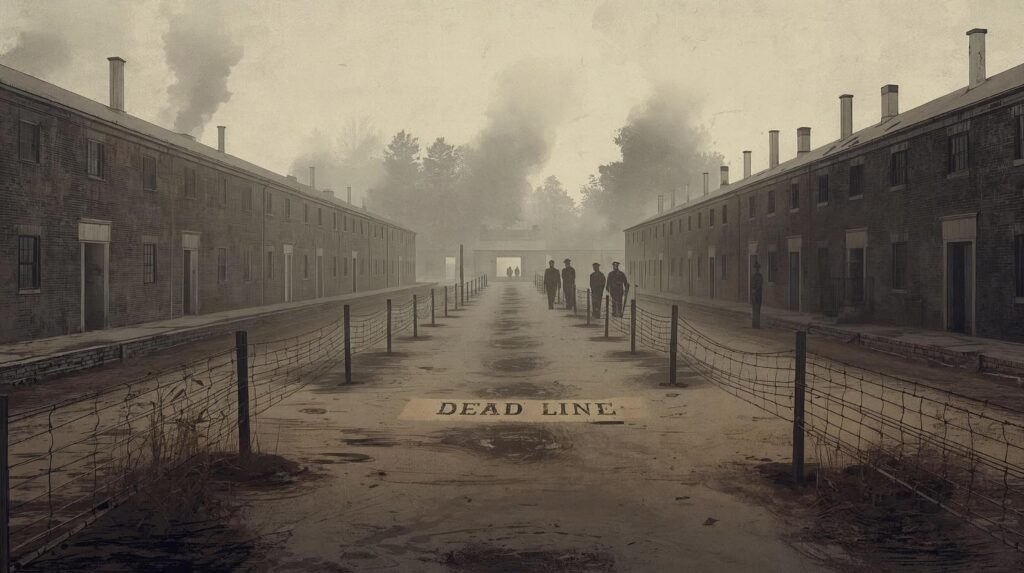
In prisoner-of-war camps, a “dead line” was a physical boundary drawn inside the camp. Prisoners were strictly forbidden from crossing this line.
If they did, guards were authorized to shoot them.
The line was often marked by a fence, a trench, or simply a visible boundary.
It served as a warning: crossing this line could have fatal consequences.
The term was used in records and testimonies describing prison conditions during the war.
🏚️ Life Inside Civil War Prison Camps
Conditions in many Civil War prison camps were extremely harsh.
One of the most well-known camps was Andersonville Prison in Georgia.
Thousands of prisoners were held in overcrowded conditions with limited food, poor sanitation, and inadequate shelter.
Within the camp, the “dead line” was enforced strictly.
Prisoners who approached or crossed it risked being shot by guards.
The term “deadline” in this context was not metaphorical.
It was a real boundary associated with life and death.
📜 How the Word Entered Everyday Language
After the Civil War, the term “deadline” gradually began to appear in other contexts.
By the late 19th and early 20th centuries, it started to be used in printing and journalism.
Newspapers needed to finalize articles before going to print, and the time by which content had to be submitted became known as a deadline.
The meaning shifted from a physical boundary to a time limit.
Although the context changed, the underlying idea remained similar: a point that must not be crossed.
🧠 From Physical Boundary to Time Pressure
Over time, the word “deadline” lost its direct association with prison camps and took on a broader meaning.
Instead of representing a literal line, it came to represent a limit in time.
The urgency remained.
Missing a deadline might not carry life-or-death consequences, but it still often involves pressure, stress, and consequences.
This shift shows how language can transform dramatically over time, adapting to new contexts while retaining traces of its original meaning.
🌍 A Word Used Everywhere Today
Today, “deadline” is used across countless fields.
You’ll find it in:
– education
– business
– publishing
– project management
– law and government
In each case, it refers to a fixed point by which a task must be completed.
Few people using the word today think about its origins in Civil War prison camps.
Yet that history remains embedded in the language.
🔍 How Language Evolves Over Time
The story of “deadline” is a powerful example of how words evolve.
Many terms that we use casually today once had very different meanings.
As societies change, words are adapted, repurposed, and redefined.
Sometimes their original meanings fade into history, leaving only a hint of their past behind.
In the case of “deadline,” a word born from strict physical boundaries became a universal concept of time and urgency.
💡 A Word with a Hidden Past
Next time you hear someone mention a deadline, it may seem like just another part of daily life.
But behind that simple word lies a history rooted in one of the most difficult periods of American history.
It reminds us that language carries stories — even when we are no longer aware of them.
A word that once marked a line between life and death now marks the moments we must meet our commitments.
Sometimes the words we use every day have deeper histories than we imagine.
Continue Exploring on Trivialwiki
If you enjoyed discovering the hidden history behind everyday expressions, don’t miss our previous post:
👉 “Rule of Thumb” and the Misunderstood Saying
Explore how a common phrase developed from practical measurement rather than the myth many believe.
📬 Stay Connected with Trivialwiki
📬 Stay Connected with Trivialwiki
👉 Facebook: https://facebook.com/Trivialwiki
👉 Instagram: https://instagram.com/trivialwiki
👉 YouTube: https://youtube.com/@trivialwiki
👉 Pinterest: https://pinterest.com/Trivialwiki
Learn. Explore. Discover.
The word “deadline” has a surprisingly intense origin — what other everyday words do you think might have hidden histories? Share your thoughts in the comments! 📜
1 thought on ““Deadline” and the Word That Came from Prison Camps”