
If intelligence had a standard shape, the octopus would break it.
No skeleton. No backbone. No social structure like wolves or dolphins. And yet, octopuses solve puzzles, escape sealed containers, recognize individual humans, and appear to make decisions that feel eerily deliberate.
What makes this even stranger is how their intelligence is built.
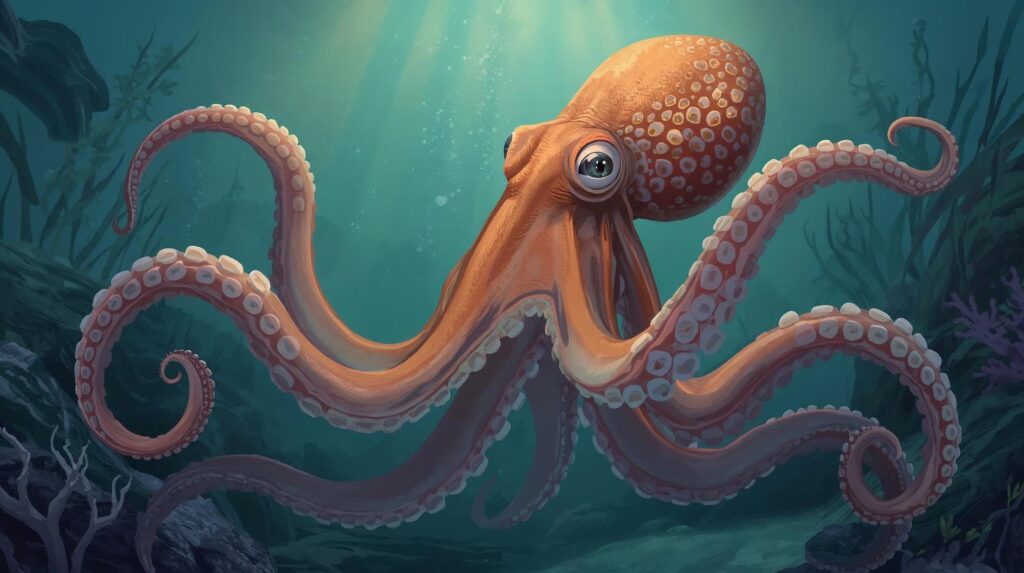
An octopus has three hearts, blue blood, and nine brains — a biological setup so unusual that it forces scientists to rethink what intelligence even means.
This isn’t just a smart animal.
It’s a completely different model of being smart.
🧠 Nine Brains, Not One
Let’s start with the most astonishing fact.
An octopus doesn’t have a single centralized brain like humans do. Instead:
- One main brain sits between its eyes
- Eight additional “mini-brains” are distributed across its arms
Each arm contains its own dense network of neurons — capable of processing information, making decisions, and reacting independently.
In practical terms, this means an octopus can do multiple things at once, with different arms responding to different stimuli simultaneously.
The arms don’t wait for instructions.
They think locally.
✋ Arms That Know What to Do
An octopus arm can explore, grasp, and manipulate objects even if it’s temporarily disconnected from the central brain.
Researchers have observed arms:
- Searching for food independently
- Solving simple tasks on their own
- Reacting faster than conscious processing would allow
The main brain sets goals.
The arms figure out how.
This distributed intelligence is closer to a network than a command center — more like the internet than a single computer.
❤️ Three Hearts and Blue Blood
The octopus body is just as unconventional as its mind.
It has:
- Two hearts that pump blood to the gills
- One heart that circulates blood to the rest of the body
Its blood is blue because it uses copper-based hemocyanin instead of iron-based hemoglobin. This works better in cold, low-oxygen environments — but it’s less efficient overall.
Interestingly, when an octopus swims, one heart temporarily stops beating. Swimming becomes exhausting, which is why octopuses prefer crawling along surfaces instead.
Even their movement strategy is shaped by biology.
🧩 Intelligence Without a Template
Octopus intelligence didn’t evolve along the same path as mammals.
They don’t have:
- Long lifespans
- Social learning traditions
- Parental teaching
Most octopuses live just one to two years. They hatch alone, grow fast, and figure out the world entirely on their own.
And yet, they demonstrate:
- Problem-solving
- Tool use
- Memory
- Curiosity
- Play-like behavior
This challenges the idea that intelligence requires long childhoods or social structures.
Apparently, there’s more than one way to build a mind.
🔐 Masters of Escape and Problem-Solving
Octopuses are famous escape artists — and not by accident.
They’ve been observed:
- Unscrewing jar lids
- Opening aquarium doors
- Navigating mazes
- Slipping through impossibly small gaps
An octopus can fit through any opening larger than its beak — the only hard part of its body.
What’s remarkable isn’t just that they escape, but how they do it. They appear to assess situations, test solutions, and adapt when something doesn’t work.
This isn’t trial-and-error chaos.
It looks intentional.
🎭 Masters of Disguise and Deception
Octopuses don’t just think — they communicate visually.
Their skin can change:
- Color
- Texture
- Pattern
All within milliseconds.
They use this ability to:
- Blend into surroundings
- Signal aggression or submission
- Confuse predators
- Mimic other animals
Some species can impersonate venomous fish or sea snakes convincingly enough to scare predators away.
This isn’t passive camouflage.
It’s active deception.
🧠 A Short Life, A Fast Mind
One of the most puzzling aspects of octopus intelligence is its brevity.
After mating, many octopuses stop eating and die shortly after reproduction. Females guard their eggs obsessively, often starving themselves in the process.
Their lives are intense, compressed, and fleeting.
Which raises a haunting question:
Why evolve such intelligence for such a short life?
Some scientists believe octopus intelligence is a survival response — a rapid, flexible mind in a dangerous, ever-changing environment.
Think fast, adapt faster, or die.
🌊 Intelligence That Feels Alien
When people interact with octopuses, they often describe the experience as unsettling.
Not frightening — alien.
Octopuses don’t behave like mammals or fish. Their gaze lingers. Their movements feel deliberate. Their reactions seem thoughtful.
It’s intelligence without familiar emotional cues.
A reminder that minds don’t have to resemble ours to be real.
💡 Rethinking What Intelligence Means
The octopus forces us to reconsider a deeply human assumption: that intelligence must look like us.
Here is a creature with:
- No spine
- No long-term culture
- No shared learning
Yet it thinks, solves, adapts, and surprises.
Intelligence, it turns out, isn’t a ladder with humans at the top.
It’s a landscape — and the octopus occupies a very strange, fascinating corner of it.
🧠 A Mind Built Differently — Not Lesser
Calling octopuses “weird” misses the point.
They aren’t failed versions of something else. They are successful in their own way, shaped by millions of years of evolution into something both efficient and extraordinary.
Three hearts.
Nine brains.
One of the most unusual minds on Earth.
Continue Exploring on Trivialwiki
If you enjoyed discovering how intelligence can take unexpected forms, don’t miss our previous post:
👉 Time in 60s and 12s: An Ancient System We Still Live By
A fascinating look at how ancient human decisions still shape the way we experience time today.
📬 Stay Connected with Trivialwiki
–––––––––––––––––––––––––––––
👉 Facebook: https://facebook.com/Trivialwiki
👉 Instagram: https://instagram.com/trivialwiki
👉 YouTube: https://youtube.com/@trivialwiki
👉 Pinterest: https://pinterest.com/Trivialwiki
Learn. Explore. Discover.
–––––––––––––––––––––––––––––
Octopuses show us that intelligence doesn’t need a familiar shape — what other animals do you think are smarter than we give them credit for?
Share your thoughts in the comments and let the curiosity swim deeper 🐙
1 thought on “Octopus Intelligence: The Animal With Three Hearts and Nine Brains”