
Today, chocolate is everywhere.
It fills supermarket shelves, appears in birthday cakes, sweetens desserts, and serves as one of the world’s most popular treats. Whether it’s a simple chocolate bar, a luxurious truffle, or a steaming cup of hot cocoa, billions of people enjoy chocolate every year.
Because it is so common, it’s easy to assume chocolate has always been an everyday snack.
But for most of its history, chocolate was anything but ordinary.
Long before it became a candy bar, chocolate was a sacred drink consumed by kings, warriors, and nobles. Its story stretches across ancient civilizations, ocean voyages, royal courts, and global trade routes. Few foods have traveled such a remarkable journey from luxury to everyday indulgence.
🌿 Where Chocolate Begins
The story of chocolate starts with a tropical tree known as Theobroma cacao.
Its scientific name is fittingly dramatic. Theobroma roughly translates to “food of the gods.”
The cacao tree grows naturally in the warm regions of Central and South America. Inside its colorful pods are cacao beans, the raw ingredient from which chocolate is made.
Thousands of years ago, indigenous peoples discovered that these beans could be fermented, roasted, and processed into a unique beverage.
That discovery would eventually change culinary history.
🏺 The First Chocolate Drinkers
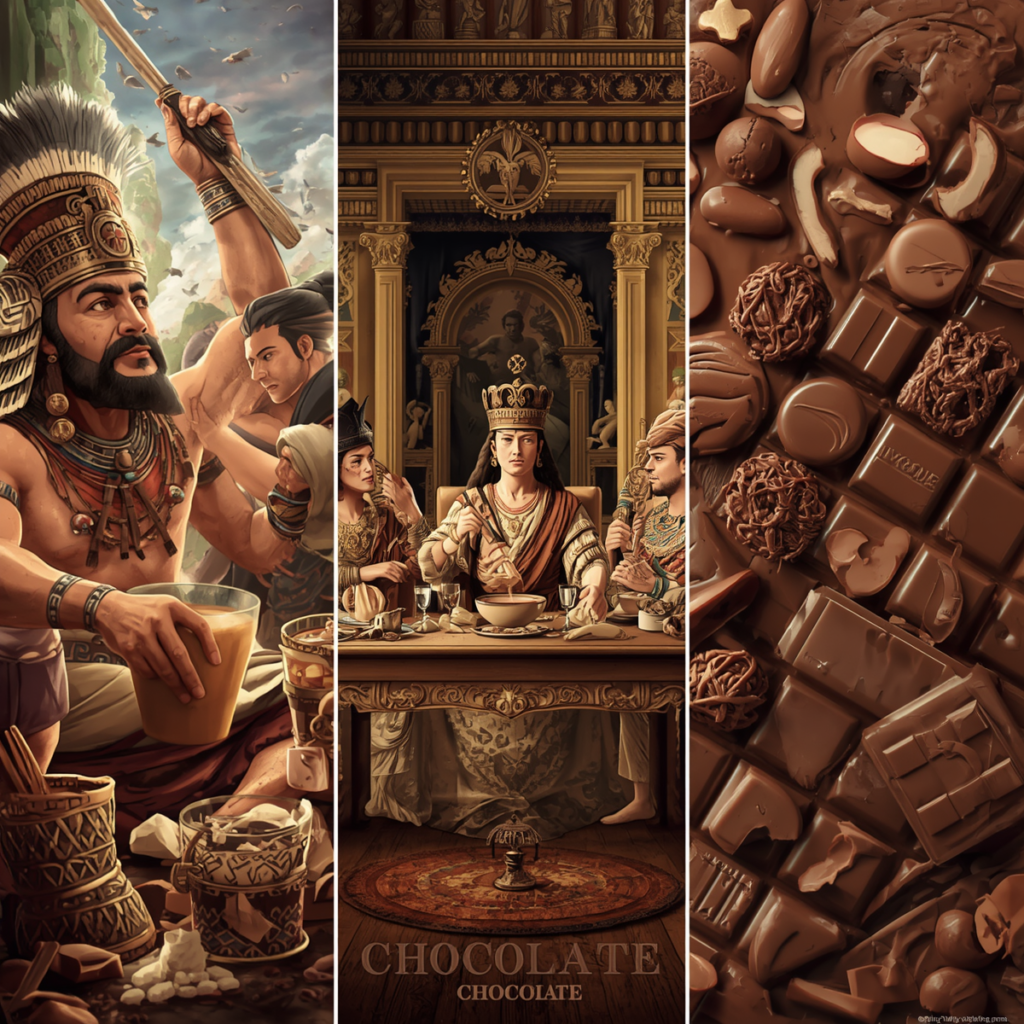
Some of the earliest known chocolate consumers were the ancient peoples of Mesoamerica, including the Olmecs, Mayans, and later the Aztecs.
However, the chocolate they drank would seem very strange to modern tastes.
Unlike today’s sweet chocolate drinks, ancient chocolate was often bitter, spicy, and sometimes mixed with ingredients such as chili peppers, herbs, or maize.
The beverage was typically frothed to create a rich foam, which was considered one of its most desirable features.
For these civilizations, chocolate was not merely food. It held social, cultural, and even religious significance.
👑 A Drink for Kings and Nobles
Among the Mayans and Aztecs, chocolate became closely associated with wealth and status.
Historical records suggest that rulers, nobles, priests, and elite warriors often consumed chocolate during ceremonies, feasts, and important events.
The Aztec emperor Montezuma II is frequently associated with chocolate, with historical accounts describing its presence at the royal court.
Chocolate was valuable enough that cacao beans sometimes functioned as a form of currency.
People could use them to acquire goods and services, making chocolate one of the rare foods that was also a form of money.
In many ways, cacao beans were as important economically as they were culturally.
🚢 Chocolate Crosses the Atlantic
The course of chocolate history changed dramatically in the 16th century.
Following European exploration of the Americas, Spanish travelers encountered cacao and brought it back to Europe.
At first, the drink remained relatively unknown outside elite circles.
However, Europeans soon began adapting it to their own tastes.
One of the most important changes was the addition of sugar.
This transformed chocolate from a bitter ceremonial beverage into a sweeter and more approachable drink.
As sugar became more widely available, chocolate gained popularity among European aristocrats.
Soon, it was being served in royal courts across Spain, France, and other parts of Europe.
☕ Europe’s New Luxury Beverage
For several centuries, chocolate remained an expensive luxury.
In many cities, special establishments known as chocolate houses emerged.
These venues were somewhat similar to coffeehouses and became gathering places for wealthy patrons.
Drinking chocolate became fashionable among Europe’s upper classes.
Its exotic origins, high cost, and association with royalty added to its prestige.
For ordinary people, however, chocolate remained largely out of reach.
That would eventually change with advances in industry and manufacturing.
⚙️ The Industrial Revolution Changes Everything
The 19th century marked a turning point in chocolate’s history.
New machinery allowed manufacturers to process cacao more efficiently and on a much larger scale.
One major breakthrough came when producers learned how to separate cocoa butter from cacao solids.
This innovation made it possible to create smoother, more consistent chocolate products.
Soon, companies began producing chocolate in forms that would be familiar today.
Chocolate bars, candies, and cocoa powders became increasingly available to the public.
What had once been a luxury enjoyed by kings gradually became accessible to ordinary families.
🍫 The Birth of the Modern Chocolate Bar
The chocolate bar as we know it emerged during the 1800s.
Manufacturers experimented with different recipes and production methods, improving both texture and flavor.
The introduction of milk chocolate made the product even more popular.
Chocolate quickly evolved from a specialty beverage into one of the world’s favorite snacks.
By the early 20th century, major chocolate brands had become household names across many countries.
The transformation was extraordinary.
A drink once reserved for royalty had become a treat enjoyed by people of all backgrounds.
🌍 A Truly Global Industry
Today, chocolate is produced and consumed on an enormous scale.
Cacao is grown primarily in tropical regions, while manufacturing and consumption occur around the world.
The industry supports millions of farmers, workers, traders, and businesses.
At the same time, growing demand has encouraged discussions about sustainability, fair trade practices, and environmental responsibility.
Chocolate’s global success brings both opportunities and challenges.
Its story continues to evolve.
💡 More Than Just a Sweet Treat
Chocolate’s journey is about much more than food.
It reflects exploration, trade, cultural exchange, technological innovation, and changing consumer tastes across centuries.
Few products have traveled so far geographically and socially.
What began as a sacred beverage in ancient civilizations became a luxury for European royalty and eventually transformed into a beloved treat enjoyed by billions.
The next time you unwrap a chocolate bar, you’re holding the result of a story that spans thousands of years and multiple continents.
From royal courts and sacred ceremonies to convenience stores and kitchen cupboards, chocolate has truly conquered the world.
Continue Exploring on Trivialwiki
If you enjoyed learning about the remarkable journey of one of the world’s most beloved foods, don’t miss our previous post:
👉 From Viking Wars to Wireless Earbuds: The Story Behind Bluetooth
Discover how a Viking king from the 10th century unexpectedly gave his name to one of the world’s most important wireless technologies.
📬 Stay Connected with Trivialwiki
👉 Facebook: https://facebook.com/Trivialwiki
👉 Instagram: https://instagram.com/trivialwiki
👉 YouTube: https://youtube.com/@trivialwiki
👉 Pinterest: https://pinterest.com/Trivialwiki
Learn. Explore. Discover.
Chocolate began as a sacred drink for ancient rulers before becoming a global favorite. What’s your favorite chocolate-based treat, and did you know how fascinating its history was? Share your thoughts in the comments! 🍫
1 thought on “Chocolate: The Royal Drink That Conquered the World”