
Imagine standing in the middle of a busy city. Buses rumble past, pedestrians hurry across crossings, and office workers move between towering buildings. Everything seems familiar. Yet, beneath your feet, another world may be operating quietly in the darkness.
There could be kilometres of railway tunnels, underground shopping passages, forgotten quarries, buried waterways, drainage channels, water pipes, electrical cables, and even remnants of streets that existed long before today’s traffic and skyscrapers arrived.
Most of us think of a city as a place built upwards and outwards. But cities also grow downwards. As populations increase and land becomes expensive, the space beneath our streets becomes just as valuable as the space occupied by buildings.
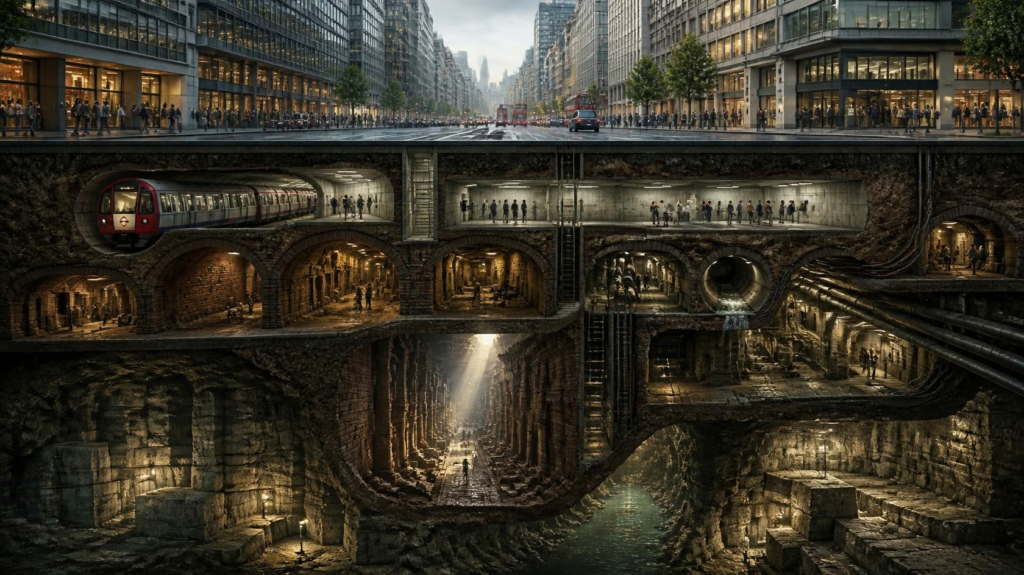
Some underground spaces are impressive engineering achievements. Others are accidental time capsules, preserving fragments of cities that existed generations ago. Together, they reveal a fascinating side of urban life that most people rarely consider.
🏙️ Why Do Cities Build Underground?
Land is one of a city’s most valuable resources. In crowded urban centres, finding space for another road, railway line, shopping area, or public utility can be difficult. Building underground offers a way to expand without taking over more surface land.
There is another reason. Many essential urban systems work better when they are separated from everyday activity. Water pipes, electrical cables, communication lines, sewers, and transport infrastructure need protected routes through densely populated areas.
Putting these systems underground can free up street space, reduce exposure to weather, and allow roads and buildings to coexist with infrastructure that would otherwise compete for room.
But the underground world is rarely a single, neatly designed network. It is usually a collection of systems built at different times for different purposes. A railway tunnel may run near an old sewer. A modern utility corridor may pass through ground that once contained a quarry. The basement of an old building may sit beside a much newer underground shopping complex.
The result is an invisible urban landscape that has grown layer by layer.
🚶 Montreal: A City Connected Beneath the Snow
In Montreal, Canada, the underground world is not merely a place for pipes and trains. It is also part of everyday public life.
The city is famous for RESO, an extensive pedestrian network beneath its downtown district. Its connected passages link shopping centres, office buildings, hotels, educational institutions, cultural venues, and metro stations.
The network extends for roughly 32 kilometres, allowing people to travel between many destinations without always returning to street level. During the harsh winter months, this can be particularly useful. People can walk between buildings while avoiding much of the snow, wind, and cold outside.
The system developed alongside Montreal’s downtown buildings and transport infrastructure. Instead of treating every building as an isolated structure, connected underground spaces make the city function more like a continuous indoor environment.
RESO is not a secret city hidden from its residents. It is a deliberate part of Montreal’s urban design. But for someone unfamiliar with it, discovering how much of the downtown can be navigated below ground can feel like finding a second city beneath the first.
It demonstrates that underground space can be more than functional infrastructure. With careful planning, it can become an extension of public life.
🧱 Seattle: The Streets That Were Left Behind
Some underground cities were never intended to exist.
In 1889, a devastating fire destroyed a large part of Seattle’s commercial centre. As the city rebuilt, officials faced several problems, including the area’s low-lying terrain and drainage difficulties. Streets were regraded and raised, while new buildings were constructed around the changed street levels.
This transformation left behind unusual spaces beneath parts of today’s Pioneer Square district. Former ground-floor areas, passages, and building entrances became lower than the new sidewalks and roads.
In effect, parts of the old city were left underneath the rebuilt one.
These spaces are now associated with Seattle’s Underground, where visitors can explore surviving passages and remnants of the nineteenth-century streetscape. They offer a physical reminder that cities do not always replace their past completely. Sometimes, they simply build over it.
Think about what that means: a place that once stood at street level can become a basement without the original building disappearing. The street above changes, but the earlier version remains below.
Seattle’s underground is a striking example of how disaster, engineering decisions, and urban growth can create an unexpected historical layer.
🪨 Paris: A City Built Above a Labyrinth
Paris has another kind of hidden world beneath its elegant streets.
For centuries, limestone and other materials were extracted from underground quarries to provide stone for buildings and monuments. As mining expanded, galleries spread through parts of the ground beneath the city. These excavations supplied materials for the city above, but they also created a challenge: abandoned galleries could weaken the ground and contribute to collapses.
In the eighteenth century, Paris authorities established a system for inspecting and consolidating old quarries. Some of these underground spaces later took on another role.
The famous Paris Catacombs were created in former quarries after overcrowded cemeteries raised serious public-health concerns. Beginning in the late eighteenth century, human remains were transferred into the underground site, which became a municipal ossuary.
Today, the accessible Catacombs contain carefully arranged remains and provide a glimpse into an extraordinary chapter of the city’s history.
It is important to distinguish the Catacombs from the much larger network of underground quarries. The two are often confused, yet the ossuary occupies only a portion of the broader subterranean landscape.
Paris illustrates how the underground can contain several histories at once: geology, mining, public health, engineering, and the changing ways a city manages its dead.
🚇 The Invisible Machines That Keep Cities Alive
Historic passages and underground pedestrian networks attract attention because they are unusual. Yet some of the most important hidden spaces are the ones that people rarely think about.
Beneath roads and buildings lie systems that carry clean water into homes, remove wastewater, distribute electricity, and support communication networks. In many cities, stormwater drains and tunnels also help move rainwater away from streets during heavy downpours.
Transport tunnels carry millions of passengers through urban areas. Some cities have underground service corridors that allow workers to access utility equipment without repeatedly digging up roads. Large buildings may contain extensive basement levels for mechanical equipment, storage, loading, and emergency systems.
These systems are not always connected into one giant underground network. Their layout depends on a city’s geography, age, engineering standards, and development history. Some routes are mapped in detail; others may be old, altered, or poorly documented.
Maintaining this hidden infrastructure is a major challenge. A leaking pipe can undermine the ground. A damaged sewer can affect public health. An unrecorded utility line can complicate a construction project. Even when the surface looks perfectly normal, engineers may need to investigate what lies underneath before beginning work.
The underground city, therefore, is not just a curiosity. It is part of the machinery that allows modern urban life to continue.
🌊 The Rivers That Disappeared Beneath the Streets
One of the most surprising features of some cities is that natural waterways have been buried.
As settlements expanded, small rivers and streams were sometimes redirected, covered, or incorporated into drainage systems. Land that once formed a riverbank could later become a road, a building site, or a public square.
The reasons varied. Cities needed space for development, wanted to manage flooding, or sought to control polluted waterways. In some cases, covering a stream was considered a practical solution to unpleasant conditions.
But burying a river does not make its water disappear. The flow must still go somewhere, and the channel continues to respond to rainfall and changes in the surrounding landscape.
This can matter when intense rain overwhelms drainage capacity. Water follows gravity and the terrain, not the modern street map. Areas built over former waterways may face particular challenges when drainage systems are insufficient.
Urban planners increasingly recognise the value of understanding natural water systems. Restoring waterways where practical, improving drainage, and creating green spaces that absorb rainwater can help cities manage water more intelligently.
The lesson is simple: a city can hide its landscape, but it cannot completely escape the forces of nature.
🔦 Why the Underground Is Difficult to Explore
It may be tempting to imagine that anyone could discover these hidden spaces by finding a basement door or an open maintenance hatch. In reality, underground environments can be extremely dangerous.
Poor ventilation, flooding, unstable structures, electrical equipment, contaminated water, and hazardous gases can create serious risks. Some tunnels are active transport or utility facilities where unauthorised entry could endanger both the explorer and the people using the system.
Many underground areas are also private, restricted, or protected heritage sites. Their existence on a map does not mean that they are open to the public.
The safest way to discover these places is through authorised tours, museums, official visitor routes, and historical records. These can reveal remarkable details without putting people at unnecessary risk.
For engineers and historians, exploration also requires careful documentation. Old plans must be compared with present conditions, and structures need to be assessed before they can be safely entered or reused.
🌍 Will Future Cities Grow Further Down?
As cities become more crowded, underground development will continue to play an important role. New transport links, utility corridors, flood-management systems, and carefully designed public spaces can help cities use land more efficiently.
However, building underground is expensive. Excavation can disturb existing infrastructure, groundwater, and nearby foundations. Ventilation, lighting, drainage, fire safety, and emergency access all require careful planning.
The best approach is not to move everything underground. Parks, open streets, natural waterways, and accessible public spaces remain essential. Instead, cities need to decide which functions benefit from being below ground and which should remain visible and accessible above it.
Future urban planning may also make better use of digital maps and three-dimensional models to record what lies beneath streets and buildings. A clearer picture of underground infrastructure can help engineers avoid damage, coordinate construction, and prepare for extreme weather.
The most successful hidden cities will not necessarily be the largest ones. They will be the ones designed to work safely with the city above.
✨ A Second City Beneath the First
The next time you walk down a busy street, remember that the city you see is only part of the story.
Below the pavement may be a railway carrying commuters, a pipe delivering drinking water, a forgotten section of an earlier street, or a tunnel carved into rock long before today’s buildings existed.
These spaces tell us that cities are not static collections of buildings. They are living systems, constantly changing as people solve problems, develop new technologies, and adapt to the land beneath them.
Some underground spaces were built with grand plans. Others appeared through accidents, disasters, or decisions made generations ago. Together, they reveal a hidden dimension of urban life.
We may spend our days looking up at skyscrapers, but the story of civilisation also continues beneath our feet.
🔎 Continue Exploring on Trivialwiki
Continue your journey with The Ancient Indian Stepwells That Solved a Modern Water Problem and discover how ingenious historical water structures helped communities adapt to seasonal shortages.
📬 Stay Connected with Trivialwiki
Follow Trivialwiki for more fascinating stories about history, science, engineering, geography, technology, and the everyday mysteries around us.
👉 Facebook: https://facebook.com/Trivialwiki
👉 Instagram: https://instagram.com/trivialwiki
👉 YouTube: https://youtube.com/@trivialwiki
👉 Pinterest: https://pinterest.com/Trivialwiki
Trivialwiki — Learn. Explore. Discover.
📚 References
- City of Montreal — RESO, Montreal’s Underground Pedestrian Network: https://montreal.ca/articles/reso-le-reseau-souterrain-de-montreal-13713
- City of Seattle — Pioneer Square Preservation District: https://www.seattle.gov/neighborhoods/historic-preservation/historic-districts/pioneer-square-preservation-district
- Seattle Department of Transportation — Historical underground spaces beneath Pioneer Square: https://sdotblog.seattle.gov/2010/02/25/sdot-work-down-under/
- Paris Catacombs — Official site history: https://www.catacombes.paris.fr/en/history/site-history
- Paris Catacombs — Geology and former underground quarries: https://www.catacombes.paris.fr/en/history/geology-and-quarries
💬 What would surprise you most to discover beneath your own city—a buried river, an abandoned street, or a vast network of tunnels? Share your thoughts in the comments; curiosity grows best when it’s shared.