
Imagine living in a place where summer temperatures climb above 40°C, the monsoon arrives only for a few months, and the nearest dependable source of water gradually sinks below ground as the dry season continues. There are no electric pumps, no modern pipelines, and no water tankers arriving at your doorstep.
How would you collect water when it is available, store it for the dry months, and make sure people can still reach it when the water level falls?
Centuries ago, communities across parts of India developed a remarkable answer. They built enormous structures that descended deep into the earth, using flights of stairs to connect the surface with underground water. These were the stepwells of India—ingenious combinations of water-storage systems, architectural masterpieces, and community spaces.
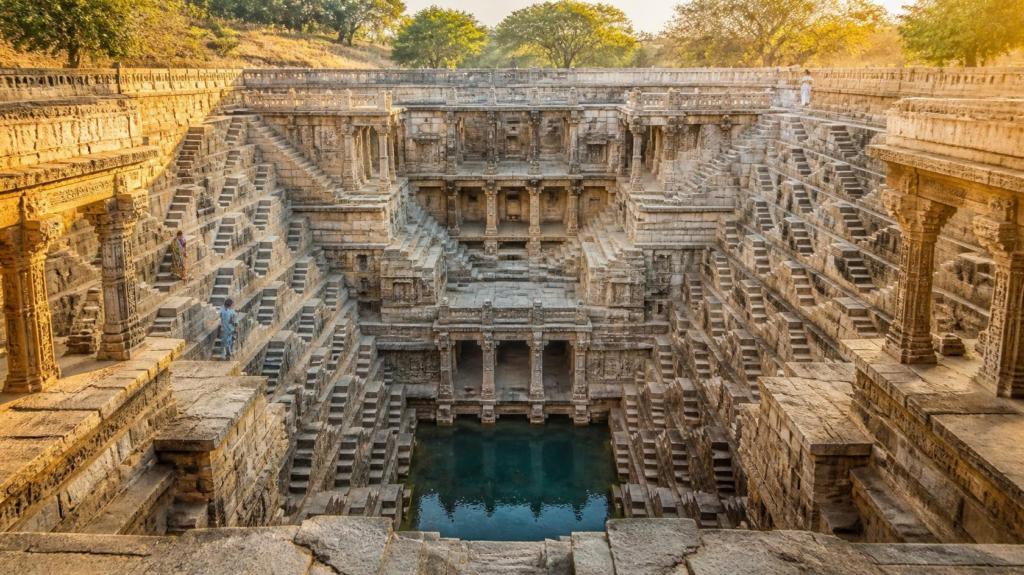
Today, many of these structures are celebrated for their intricate carvings and extraordinary geometry. Yet their most important achievement was practical: they helped people access water in regions where rainfall was seasonal and water security could determine the survival of entire communities.
Their story reveals how ancient Indian engineers responded to environmental challenges with creativity, patience, and a deep understanding of local conditions.
💧 Why India Needed a Different Kind of Well
India’s climate has always presented a complex water-management challenge. Much of the country depends on the monsoon, which brings a large share of annual rainfall within a relatively short period. Some regions receive abundant rain, while others experience long dry spells and irregular rainfall.
Collecting water during the wet season is only part of the problem. The greater challenge is ensuring that enough water remains accessible when the rains disappear.
Ordinary wells can provide access to groundwater, but their usability depends on how deep the water lies. As groundwater levels fall, reaching the water becomes more difficult. A well that is easy to use after the monsoon may become inconvenient during the hottest months.
Stepwells offered a different approach. Instead of relying on a narrow opening at ground level, builders constructed descending flights of steps that allowed people to move towards the water.
As the water level changed, users could continue down the staircase to reach it, provided sufficient water remained in the well. The structure made access easier across changing water levels and provided a protected space around the water source.
Stepwells were particularly important in parts of western India, including present-day Gujarat and Rajasthan, where seasonal water availability shaped everyday life. They were not identical in design or purpose, but they shared a remarkable principle: architecture could help communities adapt to the changing availability of water.
🪜 A Well You Could Walk Into
At first glance, a traditional stepwell can look more like an underground palace than a water source.
Instead of approaching a small opening and lowering a bucket, visitors descend through a carefully constructed sequence of stairs, landings, platforms, and sometimes covered pavilions. The walls may feature elaborate stonework, columns, balconies, and sculpted figures.
The descending design was functional as well as beautiful. It allowed people to reach water at different depths and created a substantial built space around the well.
Many stepwells also provided shade as people descended below ground level. Their walls and architectural features could create a cooler environment than the exposed surface, although the temperature and conditions varied from one structure to another.
Building such a structure required careful planning. The builders needed to understand the local ground, groundwater conditions, materials, structural stability, and the forces acting on the walls. A deep excavation had to remain stable while allowing people to reach the water safely.
The result was an unusual form of infrastructure: a public utility that could also serve as a place of rest, gathering, and architectural expression.
🏛️ Chand Baori: A Staircase That Seems to Have No End
One of India’s most striking stepwells stands in Abhaneri, Rajasthan. Known as Chand Baori, it is a remarkable example of how geometry and practical engineering came together in traditional water architecture.
According to Rajasthan Tourism, the structure was built by King Chanda of the Nikumbha dynasty in the ninth century. It contains approximately 3,500 narrow, symmetrical steps arranged in a dramatic pattern along its sides.
From the upper level, the repeated triangular shapes create an almost optical illusion. Staircases descend in precise rows, forming a geometric pattern that becomes more striking as the eye moves towards the bottom.
But the design was not created simply to impress visitors. The steps provided access to the water below, while the structure helped accommodate changes in the water level.
One side features a multi-storeyed pavilion with carved windows, galleries, and balconies. The arrangement illustrates how some stepwells combined practical water access with spaces for gathering and architectural display.
Chand Baori also reminds us that ancient infrastructure did not have to be plain or purely functional. Communities could invest enormous craftsmanship in structures that served everyday needs.
Today, visitors travel to Abhaneri to admire its architecture. What began as a response to the need for water has become a lasting symbol of India’s engineering and artistic heritage.
👑 Rani-ki-Vav: When Water Architecture Became Art
If Chand Baori demonstrates the power of geometric design, Rani-ki-Vav in Patan, Gujarat, shows how elaborate stepwells could become monumental works of art.
Built in the eleventh century, Rani-ki-Vav was initially constructed as a memorial to a king. It is now recognised as a UNESCO World Heritage Site.
The structure descends through seven levels of stairs and sculpted architectural spaces. Its walls contain hundreds of principal sculptures and more than a thousand smaller carvings, depicting religious, mythological, and other subjects.
UNESCO describes the monument as an inverted temple, a design that reflects the cultural and spiritual significance associated with water.
The idea is fascinating. Water was essential for daily survival, agriculture, and settlement, but it could also carry profound religious and cultural meaning. At Rani-ki-Vav, these ideas came together in a structure that was both functional and deeply symbolic.
The construction also demonstrates considerable technical skill. The builders had to organise a deep, multi-level structure around a water source while creating spaces capable of supporting elaborate stonework.
Interestingly, Rani-ki-Vav no longer functions as it originally did as a water well. Changes affecting the Saraswati River and local groundwater conditions altered its original relationship with the water supply. Yet the structure remains an exceptional record of how people once combined engineering, water management, and artistic expression.
🌡️ More Than a Place to Collect Water
Stepwells were not simply holes in the ground. Many became important spaces within their communities.
People came to collect water, rest in the shade, and meet others. Some structures incorporated pavilions and areas associated with religious activity. Their location and design could make them significant landmarks within a settlement.
The cooler spaces within certain stepwells were particularly useful in hot weather. Descending below ground reduced exposure to direct sunlight, while the massive stone structure and its shaded spaces influenced the local environment.
However, it would be misleading to assume that every stepwell served exactly the same purpose. Their designs varied considerably, and their social, religious, and architectural roles depended on the location and period in which they were built.
What they shared was their relationship with a resource that shaped everyday life. Water collection was not a minor chore in a dry region; it was an essential activity around which communities organised themselves.
A stepwell could therefore serve as a practical water source and a meaningful public space at the same time.
🧱 How Did Ancient Builders Make Them Last?
Constructing a deep stepwell was a major engineering undertaking. Builders needed to excavate the ground, create stable walls, construct stairs and platforms, and make the structure work with local groundwater conditions.
Stone and masonry were used in many historic stepwells, although construction techniques and materials varied. The arrangement of walls, supports, columns, and terraces helped create a stable structure around the excavated space.
Water management also required an understanding of the local environment. A stepwell depended on groundwater being available at a reachable depth, and its usefulness could change as groundwater levels shifted.
This is an important distinction: a stepwell did not create water. It provided access to water that was available underground. If groundwater levels fell too far or the local hydrology changed, even a beautifully built stepwell could lose its original function.
The survival of a structure also depended on maintenance, environmental conditions, and later changes to the surrounding landscape.
Some stepwells became buried, damaged, or neglected over time. Others survived well enough to become important historical monuments. Their continued existence gives us an opportunity to study traditional construction, water management, and architectural design.
🌍 What Can Modern Cities Learn from Stepwells?
Modern cities have technologies that ancient builders could not have imagined. Pipelines, reservoirs, treatment plants, electric pumps, and computer-controlled distribution networks allow water to reach homes across enormous distances.
Yet water security remains a major challenge. Groundwater depletion, irregular rainfall, rapid urbanisation, and the loss of natural drainage areas can place pressure on supplies.
Stepwells offer useful historical lessons, although they are not a complete solution to today’s water problems.
The first lesson is that water infrastructure must be designed around local conditions. Ancient builders responded to seasonal rainfall and groundwater availability rather than relying on one universal design.
The second is the importance of storing and managing water rather than thinking only about how to obtain it. Modern rainwater harvesting, groundwater recharge, and watershed management can help communities make better use of rainfall when supported by suitable local planning.
The third lesson is that infrastructure can be part of community life. Water systems work best when they are maintained, understood, and valued by the people who depend on them.
Stepwells cannot replace modern treatment and distribution systems, and restoring an old structure does not automatically solve groundwater shortages. But their underlying approach—working with local geography, respecting water as a limited resource, and designing for long-term use—remains relevant.
💡 A Monument to Human Ingenuity
When we look at Chand Baori or Rani-ki-Vav today, it is easy to focus on the spectacular staircases and carvings. Their beauty deserves admiration, but it is only part of the story.
These structures were built in response to a fundamental human challenge: how to make water accessible when nature does not provide it evenly throughout the year.
The people who designed them combined knowledge of construction, groundwater, local climate, and community needs. They created infrastructure that could serve practical purposes while expressing the artistic and cultural values of their time.
Their achievements also remind us that innovation is not always about inventing something entirely new. Sometimes it means understanding a problem deeply and adapting available materials and knowledge to solve it.
Long before modern discussions about sustainable water management, India’s stepwells demonstrated the importance of planning for scarcity, adapting to the environment, and treating essential infrastructure as something worth building carefully.
The next time you see photographs of an ancient stepwell, look beyond the steps. You are looking at a record of how people learned to live with their environment—and how an urgent need for water inspired some of India’s most remarkable architecture.
Continue Exploring on Trivialwiki
In our previous article, “What Happens Between an Airplane Landing and Taking Off Again?”, we explored the hidden teamwork and engineering that keep modern aviation moving.
Discover how ground crews unload baggage, refuel aircraft, prepare cabins, and coordinate the many tasks required before an airplane can take off again.
📬 Stay Connected with Trivialwiki
Follow Trivialwiki for more fascinating stories about history, science, engineering, geography, and the world around us.
- Facebook: https://facebook.com/Trivialwiki
- Instagram: https://instagram.com/trivialwiki
- YouTube: https://youtube.com/@trivialwiki
- Pinterest: https://pinterest.com/Trivialwiki
Trivialwiki — Learn. Explore. Discover.
Have you ever visited a stepwell in India? Which fascinates you more—the remarkable geometry of Chand Baori or the detailed sculptures of Rani-ki-Vav? Share your thoughts in the comments!
References
1. UNESCO World Heritage Centre — Rani-ki-Vav (the Queen’s Stepwell) at Patan, Gujarat https://whc.unesco.org/en/list/922/
2. Rajasthan Tourism — Chand Baori, Abhaneri https://www.tourism.rajasthan.gov.in/chand-baori.html
3. UNESCO — Rani-ki-Vav (The Queen’s Stepwell) https://www.unesco.org/en/articles/rani-ki-vav-queens-stepwell
4. Ministry of Culture, Government of India — Rani-ki-Vav (the Queen’s Stepwell) at Patan, Gujarat https://www.indiaculture.gov.in/rani-ki-vav-queen%E2%80%99s-stepwell-patan-gujarat
2 thoughts on “The Ancient Indian Stepwells That Solved a Modern Water Problem”