
When we think about ancient roads, we often imagine dusty paths, horse carts, muddy tracks, and travelers moving slowly through the countryside. Modern roads, by contrast, seem like one of humanity’s greatest engineering achievements: smooth asphalt, painted lanes, bridges, tunnels, drainage systems, and vehicles traveling at high speed.
Yet some ancient roads—especially those built by the Romans—have survived for thousands of years. Certain sections are still visible today, and some modern roads even follow their original routes.
This raises an intriguing question:
How could people who lived without modern machinery, computers, heavy construction vehicles, or advanced surveying equipment build roads that sometimes outlast roads constructed today?
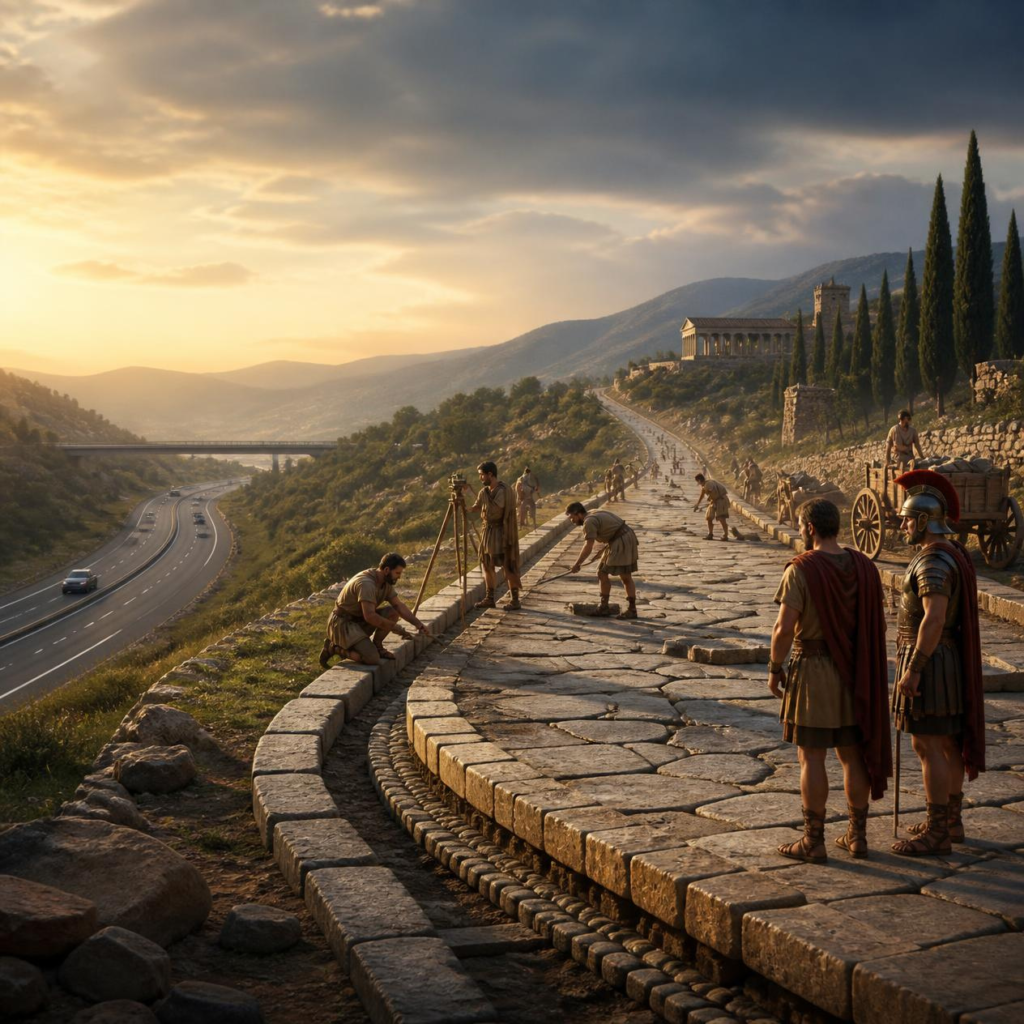
The answer is not that ancient roads were always better. Most ancient roads were slower, rougher, narrower, and less comfortable than modern highways. But the best ancient roads were built with a different philosophy: they were designed as long-lasting infrastructure rather than simply as surfaces for vehicles.
Their builders understood drainage, foundations, materials, terrain, gradients, and maintenance. They also invested enormous amounts of labor into construction.
The result was a road system that could remain functional for centuries—and in some cases, millennia.
The Ancient Road That Became a Legend
One of the most famous examples is the Via Appia, or Appian Way, built by the Romans beginning in 312 BCE.
It connected Rome with important settlements in southern Italy and later became part of a much larger road network.
The road was not merely a dirt track. It was a carefully engineered route designed to support the movement of soldiers, merchants, officials, animals, and supplies.
Roman roads were built across a huge empire, from Britain and Spain to North Africa and the Middle East. Their quality varied considerably, but major roads often followed a recognizable construction method.
The Romans understood that a road was only as strong as what lay beneath it.
A smooth surface placed on weak, wet ground would quickly develop ruts and cracks. A strong foundation with good drainage, however, could remain stable for a very long time.
This principle remains important today.
Ancient Roads Were Built in Layers
A major Roman road was often constructed in several layers, rather like a modern engineered road.
The exact design varied depending on location, soil, materials, and purpose, but a typical road might include:
- Prepared ground.
- A foundation layer of large stones.
- Smaller stones or gravel to fill gaps.
- A compacted layer of sand, gravel, or crushed material.
- A durable upper surface made from fitted stones or paving slabs.
The bottom layers distributed weight and helped prevent the road from sinking into soft ground. The upper layers created a relatively stable surface for traffic.
This layered structure is one of the major reasons some ancient roads survived so well.
Modern roads also use layered construction. A typical modern road may contain compacted subgrade, subbase, base course, asphalt, and sometimes concrete. The materials and machinery have changed, but the basic engineering idea is remarkably similar.
The ancient builders understood a principle that still governs road construction:
A road’s strength comes from its entire structure, not just from its visible surface.
Drainage Was More Important Than Appearance
One of the biggest enemies of roads is water.
Rainwater can seep into cracks, weaken the foundation, wash away soil, and cause the road surface to break apart. In cold climates, water that freezes and expands can create even more damage.
Ancient engineers recognized that water had to be moved away from the road.
Many Roman roads were built with a slightly raised or curved surface so that rainwater flowed toward the edges rather than collecting in the center.
They also used:
- Ditches along the sides.
- Raised roadbeds in wet areas.
- Culverts beneath the road.
- Drainage channels.
- Carefully designed slopes.
- Bridges over streams and rivers.
Some roads were built on raised embankments to keep them above flood-prone ground.
This may sound basic, but poor drainage remains one of the most common causes of road deterioration today. A road with an excellent surface can still fail if water is allowed to damage the layers beneath it.
In that sense, ancient road builders were not doing something mysterious. They were applying sound engineering principles with great discipline.
Why Roman Roads Often Had a Slightly Raised Center
Many Roman roads were built with a gently curved surface known as a camber.
The center of the road was slightly higher than the edges. This allowed rainwater to run off naturally.
A road that is completely flat may collect puddles, especially if the surface develops small depressions. Over time, standing water can enter cracks and weaken the structure.
The raised center helped keep the road relatively dry.
Modern roads also use camber or cross slope for the same reason. The difference is that modern roads can be shaped and measured with precision machinery, while ancient builders relied on surveying tools, experience, templates, and practical observation.
The underlying principle, however, has not changed.
The Romans Chose Routes Carefully
A road’s durability depends not only on how it is built but also on where it is built.
Roman surveyors carefully considered:
- Terrain.
- River crossings.
- Hill gradients.
- Soil conditions.
- Access to settlements.
- Military needs.
- Trade routes.
- Water drainage.
- Construction materials.
Roman roads were sometimes remarkably straight, especially across open land. Straight routes made travel more predictable and reduced unnecessary distance.
However, the idea that every Roman road was perfectly straight is a myth. Roads also curved around mountains, wetlands, cliffs, rivers, and other obstacles.
A road built across unsuitable terrain can be expensive to maintain, no matter how strong its surface is. By selecting practical routes and managing slopes, ancient engineers reduced some of the problems that would otherwise damage the road.
Why Some Ancient Roads Used Large Stone Slabs
Major Roman roads sometimes used large, tightly fitted paving stones on the surface.
These stones were extremely durable and could withstand heavy use. They were especially useful in important urban areas, military routes, and locations where long-term reliability mattered.
Stone paving had several advantages:
- It resisted wear.
- It could support heavy loads.
- Damaged stones could sometimes be replaced individually.
- It did not soften in hot weather like some older forms of road material.
- It could remain usable for long periods when properly maintained.
But stone paving also had disadvantages.
It could be uncomfortable for fast-moving vehicles, noisy for carts, slippery when wet, and expensive to construct. Uneven stones could also create a rough ride.
So while a stone-paved Roman road might outlast an asphalt road, it was not necessarily better for speed, comfort, or traffic capacity.
A road designed for marching soldiers and carts has different priorities from a modern highway designed for thousands of cars and trucks.
Ancient Roads Were Not All Paved
It is important not to imagine every Roman road as a perfectly stone-paved highway.
The Roman road network included many different types of routes.
Some major roads had carefully fitted stone surfaces. Others used gravel, compacted earth, or simpler construction methods. Local roads and rural tracks could be much less impressive.
The quality depended on:
- The road’s strategic importance.
- Available materials.
- Local geography.
- Expected traffic.
- Government funding.
- The wealth of the region.
- Whether the road was intended for permanent use or rapid military movement.
The most impressive surviving roads are often the best-built examples. This creates a selection effect: we remember the extraordinary roads more easily than the countless ordinary paths that disappeared.
Ancient roads were not universally superior. Some were excellent, some were practical, and many were probably poor.
The Importance of Compaction
A road surface can fail if the material beneath it is loose.
When vehicles or animals repeatedly travel over a road, loose soil can shift and form ruts. Water can then collect in those ruts, accelerating damage.
Ancient builders used heavy stones, repeated traffic, hand tools, and other methods to compact road materials.
They did not have modern vibrating rollers, but they understood that the ground needed to be prepared and stabilized.
Compaction improves the strength and stability of a road by reducing empty spaces between particles. It also limits the amount of movement that occurs under repeated loads.
Modern construction uses sophisticated machinery to achieve controlled compaction, but the goal is the same.
The ancient engineers had fewer tools, yet they understood the importance of preparing the ground properly.
Roman Roads Were Designed for Maintenance
A road is not truly successful simply because it is strong when first built. It must also remain usable over time.
Roman governments and military authorities often maintained important roads through organized labor and public responsibility.
Roadside ditches had to be cleared. Damaged stones needed to be replaced. Bridges required repairs. Vegetation had to be controlled, and flood damage had to be addressed.
In some places, local communities were responsible for maintaining sections of roads. In other cases, military units, officials, or specialized workers carried out repairs.
This is a lesson modern societies sometimes overlook:
Infrastructure lasts when maintenance is continuous.
Even a beautifully constructed road will deteriorate if drainage channels become blocked, cracks are ignored, or heavy traffic exceeds the design capacity.
Some modern roads may fail earlier not because their original engineering was poor, but because maintenance was delayed, underfunded, or badly managed.
Why Ancient Roads Had Fewer Vehicles
A major reason some ancient roads lasted so long is that they carried far less traffic than modern roads.
Roman roads certainly experienced heavy use. Armies, wagons, animals, merchants, and travelers moved across the empire. But the volume and speed of traffic were generally much lower than on modern highways.
Today, roads may experience:
- Thousands of vehicles per day.
- Heavy trucks carrying enormous loads.
- High-speed traffic.
- Repeated braking and acceleration.
- Tire friction.
- Fuel and chemical spills.
- Snow-clearing operations.
- Road salt.
- Constant vibration.
Heavy trucks are particularly damaging because their weight places enormous stress on road foundations.
A road that survives centuries of carts may deteriorate much faster under modern freight traffic.
Therefore, comparing an ancient road with a modern highway requires caution. The roads may have been exposed to very different levels of stress.
Modern Roads Are Built for Different Goals
Ancient roads were often designed for durability, movement of armies, administration, and trade.
Modern roads must serve many additional purposes:
- High travel speeds.
- Large traffic volumes.
- Smooth driving.
- Low vehicle noise.
- Accessibility.
- Safety standards.
- Drainage.
- Emergency services.
- Public transportation.
- Heavy freight.
- Environmental regulations.
- Utility networks.
- Urban development.
A modern asphalt road may not last as long as a stone-paved ancient road, but it offers advantages that ancient roads could never provide.
Asphalt is relatively smooth, quiet, and comfortable. It can be laid quickly, repaired efficiently, and adapted to different traffic requirements.
Modern roads also use advanced materials, sensors, surveying equipment, laboratory testing, and computer-based design.
The comparison is therefore not simply “ancient good, modern bad.” It is a comparison between infrastructure designed for different environments and expectations.
Asphalt Is Not Necessarily a Weak Material
People sometimes assume that asphalt roads are inferior because they can develop potholes, cracks, and ruts.
But asphalt is a highly useful engineering material.
It provides:
- A smooth driving surface.
- Flexibility under changing temperatures.
- Relatively fast construction.
- Easier repairs.
- Reduced noise compared with rough stone.
- Good performance when properly designed and maintained.
Asphalt roads can last for decades under suitable conditions. Their lifespan depends on climate, traffic, drainage, construction quality, materials, and maintenance.
The problem is not that asphalt is inherently poor. It is that modern roads are often subjected to extraordinary loads and environmental stresses.
A heavily used highway is doing a much more demanding job than a lightly trafficked ancient route.
Why Ancient Roads Could Be So Expensive
The durability of major ancient roads came at a considerable cost.
Building a road required enormous amounts of labor. Workers had to:
- Clear vegetation.
- Excavate soil.
- Move heavy stones.
- Construct drainage.
- Prepare foundations.
- Cut and fit paving stones.
- Build bridges.
- Maintain the route.
Without excavators, bulldozers, trucks, and cranes, much of this work had to be done manually or with animal power.
A major road project could require years of effort and a large workforce.
Ancient states could sometimes mobilize soldiers, enslaved people, local laborers, prisoners, and specialized workers. The economic and human costs could be immense.
This is an important part of the story. A road might be extraordinarily durable because the builders invested far more labor per kilometer than modern societies are willing or able to invest in every road today.
Modern engineering often seeks an efficient balance between cost, speed, durability, and usability. Ancient governments sometimes prioritized strategic importance over economic efficiency.
The Role of Roman Military Power
Roman roads were closely connected with military expansion.
Armies needed reliable routes to move soldiers, weapons, food, messages, and supplies. Roads helped Rome control distant territories and respond quickly to rebellions or threats.
Military needs encouraged the construction of roads that were:
- Direct.
- Strong.
- Reliable.
- Easy to identify.
- Connected to forts and settlements.
- Suitable for transporting supplies.
The Roman state had strong reasons to invest in major roads. A durable road was not just public infrastructure. It was an instrument of military power and imperial administration.
This political commitment helped create a connected network across large parts of Europe, North Africa, and western Asia.
Modern roads are often funded and managed through more complex systems involving governments, private contractors, budgets, regulations, and competing priorities. The political structure behind construction can influence the quality of the final result.
Why Some Ancient Roads Survived While Others Disappeared
Not every ancient road survived.
Many roads were destroyed by:
- Flooding.
- Earthquakes.
- Landslides.
- War.
- Neglect.
- Urban expansion.
- Farming.
- Quarrying.
- New roads being built over them.
- Changes in trade routes.
The roads that remain visible today are often those built with excellent materials, located in stable terrain, protected from major environmental damage, or preserved by later communities.
Some ancient roads were also buried beneath modern roads or incorporated into newer routes.
Therefore, surviving ancient roads should not be treated as proof that all ancient roads were exceptionally durable. They are the surviving examples of a much larger and more varied system.
The Myth of “Better Than Modern Roads”
The title “better than modern roads” is fascinating, but it needs qualification.
Ancient roads could be better than some modern roads in certain ways:
- They might have stronger stone foundations.
- They might use thicker construction layers.
- They might have excellent drainage.
- They might be maintained for centuries.
- They might carry much less traffic.
- Their construction may have prioritized long-term durability.
But modern roads are generally superior in many other ways:
- They support much higher speeds.
- They carry far more vehicles.
- They are smoother.
- They are wider.
- They provide better lighting and signage.
- They can be designed for accessibility.
- They use advanced safety engineering.
- They can be built and repaired much faster.
- They can accommodate heavy modern vehicles.
A Roman road may survive for 2,000 years as a visible structure, but that does not mean it would perform well as a modern motorway.
Imagine driving a modern car at highway speed over uneven stone paving. The road might be historically impressive, but it would be noisy, uncomfortable, and potentially dangerous.
Durability is only one measure of road quality.
What Modern Engineers Can Learn from Ancient Roads
Ancient roads still offer valuable lessons.
1. Drainage Must Be a Priority
Water can destroy even strong roads. Proper drainage should be part of the design from the beginning.
2. Foundations Matter
A beautiful surface cannot compensate for weak or unstable ground beneath it.
3. Materials Should Match the Environment
Different climates, soils, and traffic loads require different construction methods.
4. Maintenance Is Essential
Regular inspection and repair can prevent small problems from becoming major failures.
5. Infrastructure Needs Long-Term Planning
Roads should be designed for their expected lifespan, not simply for immediate completion.
6. Route Selection Matters
A carefully chosen route can reduce construction difficulties and maintenance costs.
7. Durability Has a Price
Long-lasting infrastructure often requires greater investment at the beginning.
These lessons are not ancient secrets. They are enduring engineering principles that remain relevant today.
Did the Romans Invent Roads?
The Romans did not invent roads.
Roads and paths existed thousands of years before Rome. Ancient civilizations in Mesopotamia, Egypt, Persia, China, and elsewhere built routes for trade, transport, administration, and military movement.
What made the Romans famous was the scale, organization, and consistency of their road network.
They developed a system in which roads connected cities, military bases, ports, bridges, and administrative centers across a vast empire.
Roman road construction combined older techniques with their own engineering practices. Their achievement was not inventing the idea of a road, but turning road-building into a major tool of state power.
Ancient Roads Were Also Built in Other Civilizations
Roman roads are the most famous examples in Europe, but other civilizations created impressive transportation systems.
The Persian Empire developed the Royal Road, which helped connect distant regions and support communication.
Inca engineers built roads across the Andes, including routes through steep mountains and difficult terrain. Their roads used stairs, retaining walls, bridges, and carefully planned surfaces.
Ancient Chinese states built extensive road networks and transport routes, while other civilizations developed causeways, stone paths, and raised roads across wetlands.
Each civilization adapted road construction to its own environment.
A mountain road required different solutions from a desert route. A wetland causeway required different engineering from a paved urban street.
The broader lesson is that ancient engineering was often highly sophisticated, even when the builders lacked modern machinery.
Why Ancient Roads Feel More Impressive Today
There is also a psychological reason ancient roads seem extraordinary.
When we see a stone road built thousands of years ago, we are looking at something that survived enormous changes in history. Empires collapsed, languages changed, cities moved, and technologies evolved—but parts of the road remained.
That survival gives the road a sense of mystery and achievement.
A modern road may be better engineered for today’s needs, but it is not yet old enough to demonstrate its long-term endurance.
We cannot know whether a modern highway will still be visible in 2,000 years. We can only design it as well as possible and maintain it responsibly.
Ancient roads benefit from the power of hindsight. We see the ones that survived, while the failures have often vanished from the landscape.
Conclusion: Ancient Roads Were Built to Endure
Some ancient roads really were remarkably durable, especially the best Roman roads. Their builders understood the importance of strong foundations, layered construction, drainage, route planning, suitable materials, and regular maintenance.
But ancient roads were not automatically better than modern roads.
They were built for different purposes, carried different types of traffic, and often required enormous amounts of manual labor. Modern roads are smoother, faster, safer, and better suited to the demands of cars, buses, trucks, and modern cities.
The most useful comparison is not between “ancient” and “modern.” It is between good engineering and poor engineering.
A well-designed road with a strong foundation, effective drainage, suitable materials, and proper maintenance can last a very long time—whether it was built by Roman engineers or modern construction teams.
The ancient Romans did not possess our machines or digital tools. But they understood something that every road builder still needs to remember:
If you want a road to last, do not focus only on the surface. Build the entire system properly—and take care of it afterward.
Continue Your Journey
If you enjoyed discovering how ancient engineers solved practical problems, continue your journey with our article:
Why Do We Say “Bless You” After Someone Sneezes?
From Roman roads to everyday expressions, history is filled with ordinary things that have surprisingly fascinating origins.
Follow Trivialwiki
Discover more fascinating explanations, surprising facts, and curious stories:
- Facebook: https://facebook.com/Trivialwiki
- Instagram: https://instagram.com/trivialwiki
- YouTube: https://youtube.com/@trivialwiki
- Pinterest: https://pinterest.com/Trivialwiki
Would you rather travel on a perfectly preserved Roman road or a modern highway—and why?
1 thought on “Why Were Some Ancient Roads Better Than Modern Roads?”