
How One Country Introduced an Alternative Way to Think About National Progress
What if a country’s success were measured not only by how much money it earns, how quickly its economy grows, or how many buildings it constructs—but also by how healthy, connected, secure, and satisfied its people feel?
That question lies at the heart of Gross National Happiness, the idea that made the Himalayan kingdom of Bhutan famous around the world.
Bhutan is often described as the country that chose happiness over economic growth. That description is catchy, but the real story is more nuanced. Bhutan has not rejected development, modern technology, education, infrastructure, or economic progress. Instead, it has argued that these things should serve a larger purpose: improving the overall well-being of people and protecting the natural and cultural foundations of society.
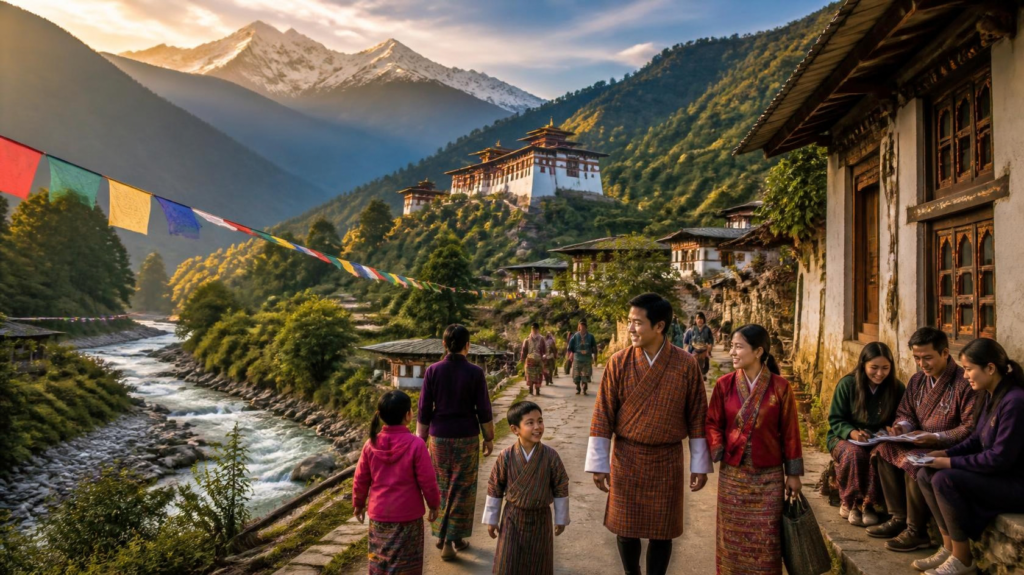
The result is one of the most unusual national development philosophies in the world.
Instead of asking only, “How much has the country produced?”, Bhutan also asks questions such as:
- Are people healthy?
- Do they have time for family and community?
- Are they able to preserve their culture?
- Do they trust the institutions around them?
- Is the environment being protected?
- Do people feel that their lives have meaning and balance?
This approach does not offer a magical formula for making everyone happy. It is an attempt to redefine what a successful country should look like.
The Country Behind the Idea
Bhutan is a small, landlocked kingdom in the eastern Himalayas, situated between India and China. Its landscape includes steep mountains, deep valleys, forests, rivers, and high-altitude regions.
For centuries, Bhutan developed with a strong sense of cultural independence. Its Buddhist traditions, distinctive architecture, festivals, clothing, and relationship with the natural environment became important parts of national identity.
Bhutan’s geography also shaped its development. The mountains made transportation difficult, settlements were scattered, and the country remained relatively isolated from much of the outside world for a long time.
Modern development arrived gradually. Bhutan introduced planned economic development in the twentieth century, expanded roads and public services, and eventually opened more widely to the outside world.
But as the country modernized, its leaders faced a difficult question:
How can Bhutan become more prosperous without losing the cultural, environmental, and social qualities that make it Bhutan?
Gross National Happiness emerged partly as an answer to that question.
The King Who Challenged the Usual Definition of Progress
The idea of Gross National Happiness is closely associated with King Jigme Singye Wangchuck, Bhutan’s fourth king.
During the 1970s, he emphasized that national progress should not be measured only through Gross Domestic Product, or GDP. Economic growth mattered, but it was not enough on its own.
The central argument was simple:
A country can become richer without necessarily becoming happier, healthier, fairer, or more connected.
A nation might experience rising incomes while also facing pollution, social isolation, cultural loss, stress, inequality, or environmental destruction.
Bhutan’s philosophy therefore placed happiness and well-being at the center of development discussions.
The phrase “Gross National Happiness” became internationally recognizable because it challenged a familiar assumption: that economic output is the best overall measure of national success.
What Is Gross Domestic Product?
To understand why Bhutan’s approach attracted attention, it helps to understand GDP.
Gross Domestic Product measures the monetary value of goods and services produced within a country over a particular period. It is useful for understanding economic activity. It can show whether an economy is expanding or shrinking, and it helps governments, businesses, and researchers compare economic performance.
But GDP has limits.
For example, GDP may rise when people spend money treating illnesses, repairing damage after disasters, or dealing with pollution. Those activities may increase economic output, but they do not necessarily mean that people are living better lives.
GDP also does not directly measure:
- The quality of family relationships
- People’s sense of purpose
- Community trust
- Leisure time
- Cultural belonging
- Environmental health
- Mental well-being
- The fairness of access to opportunities
Bhutan’s approach does not claim that GDP is useless. Rather, it argues that GDP is only one part of the picture.
A country needs economic resources to build hospitals, schools, roads, and homes. But those resources should ultimately contribute to human well-being rather than become the only definition of success.
Happiness Is More Than Feeling Cheerful
The word “happiness” can sometimes sound like a temporary emotion—something that changes from one moment to the next.
In Bhutan’s development philosophy, happiness is broader than simply feeling cheerful.
It is closer to overall well-being, including physical health, emotional balance, social relationships, security, cultural belonging, and the ability to live a meaningful life.
A person may not feel happy every day. People experience grief, stress, disappointment, and uncertainty. A serious national policy cannot eliminate all difficult emotions.
Gross National Happiness is therefore not about forcing citizens to smile or pretending that problems do not exist. It is about creating conditions in which people have a reasonable opportunity to live healthy, secure, meaningful, and balanced lives.
This distinction is important. Happiness in the Bhutanese context is not merely entertainment or pleasure. It includes the deeper conditions that make life worth living.
The Four Pillars of Gross National Happiness
Bhutan’s original framework is commonly explained through four main pillars.
1. Sustainable and Equitable Socioeconomic Development
The first pillar recognizes that people need material security.
Food, housing, healthcare, education, employment, transportation, and access to basic services all affect quality of life. A person who cannot access medical care or support a family cannot easily enjoy lasting well-being.
But Bhutan’s approach adds two important ideas: development should be sustainable and equitable.
Sustainable development means that progress should not destroy the resources future generations will need. Equitable development means that the benefits of progress should not be concentrated among only a small section of society.
A country may become wealthier overall while many people remain excluded. Gross National Happiness asks whether development is reaching people fairly.
2. Environmental Conservation
Bhutan places unusual importance on the natural environment.
Its forests, mountains, rivers, wildlife, and ecosystems are not viewed only as economic resources. They are also connected to health, culture, spirituality, climate stability, and national identity.
Environmental conservation is therefore a central part of national progress.
Protecting forests can help preserve biodiversity, regulate water supplies, reduce erosion, and support communities. Clean air and water directly influence public health. Natural landscapes also provide spaces for recreation, reflection, and cultural practices.
The underlying idea is that a damaged environment can eventually damage human well-being.
Economic growth that destroys the natural systems supporting life may produce short-term gains but create long-term losses.
3. Preservation and Promotion of Culture
Bhutan is known for its distinctive cultural identity. Traditional architecture, religious practices, festivals, clothing, arts, and social customs remain important parts of public life.
The cultural pillar argues that development should not automatically mean replacing traditional ways of life with outside models.
Culture can provide people with a sense of belonging and continuity. It connects generations and gives communities shared symbols, stories, and practices.
At the same time, cultural preservation can be complicated. Traditions may evolve, and not every tradition is equally comfortable or accessible for everyone. A modern society must balance cultural continuity with individual freedom, inclusion, and change.
Bhutan’s approach nevertheless emphasizes that cultural identity should be treated as an important national asset rather than an obstacle to modernization.
4. Good Governance
The fourth pillar is good governance.
This means that public institutions should work in ways that support people’s welfare. Government decisions should be responsible, transparent, effective, and attentive to the needs of citizens.
Good governance matters because even excellent policies can fail if institutions are corrupt, inefficient, or disconnected from the public.
Healthcare, education, environmental protection, and economic development all depend on how decisions are made and how resources are distributed.
In this sense, Gross National Happiness is not simply a personal wellness philosophy. It is also a question of public administration:
Does the government create conditions that help people live better lives?
From Four Pillars to Nine Domains
Over time, Bhutan developed a more detailed framework to measure Gross National Happiness.
The framework is commonly organized into nine domains:
- Psychological well-being
- Standard of living
- Good governance
- Health
- Education
- Community vitality
- Cultural diversity and resilience
- Time use
- Ecological diversity and resilience
These domains show how broad the concept is.
Psychological well-being considers how people experience their lives. Standard of living examines material conditions. Health and education look at essential public services. Community vitality considers relationships and social support.
Time use is especially interesting. It recognizes that how people spend their time matters. A person may earn a high income but have no time for rest, family, friends, or community life.
Ecological diversity and resilience reflect the belief that a healthy environment is part of a healthy society.
Together, the nine domains attempt to create a more complete picture of national well-being than economic statistics alone can provide.
How Can Happiness Be Measured?
Measuring happiness sounds difficult. After all, happiness is personal, and people may interpret the word differently.
Bhutan addresses this by using surveys and indicators across the nine domains. Instead of asking only whether someone feels happy at a particular moment, the framework examines multiple aspects of life.
Questions may explore health, education, living standards, relationships, safety, cultural participation, time balance, and psychological well-being.
This creates a multidimensional picture.
A person may have strong community support but poor access to healthcare. Another may have a comfortable income but experience loneliness or extreme work pressure. A third may have good education and health but feel economically insecure.
The purpose is not to reduce an entire human life to one perfect number. It is to identify strengths, weaknesses, and areas where public policy may need improvement.
The measurement system has also evolved over time. Bhutan’s Gross National Happiness Index has been refined to reflect changing conditions and improve the way well-being is assessed.
Is Bhutan Really the Happiest Country in the World?
This is where the popular image of Bhutan needs some clarification.
Bhutan is famous for Gross National Happiness, but that does not automatically mean it is officially ranked as the happiest country in every international happiness report.
Different studies measure happiness in different ways. Some focus on people’s self-reported life satisfaction. Others examine income, social support, health, freedom, generosity, and trust. Bhutan’s own framework measures a wider collection of well-being conditions.
Therefore, it is misleading to say that Bhutan has eliminated unhappiness or that every citizen is happier than people in other countries.
Bhutan faces real challenges, including economic limitations, employment concerns, migration, inequality, access to services in remote areas, and the pressures of modernization.
The significance of Bhutan is not that it has created a perfect society.
Its importance lies in the fact that it made well-being an explicit national policy objective and developed institutions to think about it systematically.
Happiness and the Cost of Modernization
Bhutan’s story is especially interesting because it is a country in transition.
Modernization can bring enormous benefits: better healthcare, improved education, digital connectivity, new jobs, easier transportation, and greater access to information.
But it can also introduce new pressures.
Young people may move from rural areas to cities. Traditional occupations may become less attractive. Imported lifestyles may influence local culture. Housing costs may rise. People may compare their lives with images of wealth and success displayed online.
Economic growth can create opportunities while also producing stress and inequality.
Gross National Happiness asks whether modernization is improving people’s lives as a whole.
This does not mean Bhutan should refuse change. It means change should be evaluated carefully.
A new road is valuable if it connects communities to schools, hospitals, markets, and opportunities. But development planners may also need to consider environmental damage, cultural disruption, and whether the benefits reach the people who need them most.
Why Time Use Matters
One of the most distinctive elements of the Gross National Happiness framework is its attention to time.
Modern economies often reward productivity. People are encouraged to work longer, earn more, consume more, and move faster.
But time is a limited resource. Once a day has passed, it cannot be recovered.
Time spent sleeping, caring for children, helping relatives, participating in community activities, practicing religion, enjoying nature, or simply resting can influence well-being.
These activities may not always generate income, but they can be essential to a meaningful life.
By including time use in its framework, Bhutan challenges the assumption that every valuable activity must be measured in money.
It raises a question that many people around the world recognize:
What is the point of earning more if there is no time left to enjoy life?
Can Happiness Be a Government Responsibility?
A government cannot directly make every individual happy. Personal happiness depends on personality, relationships, circumstances, choices, and events that public policy cannot fully control.
However, governments can influence the conditions in which people live.
They can provide access to healthcare, education, clean water, safe housing, public transportation, social protection, and fair legal systems. They can protect the environment and create opportunities for employment. They can reduce corruption and improve public trust.
These actions do not guarantee happiness, but they can reduce avoidable suffering and give people more opportunities to flourish.
This is the strongest practical argument behind Gross National Happiness.
The government is not expected to manufacture happiness. It is expected to remove barriers and create conditions that support well-being.
Why the Idea Spread Beyond Bhutan
Bhutan’s philosophy attracted international attention because many countries began questioning whether economic growth alone was enough.
The global financial crisis, rising inequality, environmental degradation, climate change, burnout, and mental health concerns all encouraged people to rethink the meaning of progress.
Economists, policymakers, universities, and international organizations began exploring broader measures of well-being.
The United Nations established the International Day of Happiness in 2012, helping bring happiness and well-being into global public discussion. International reports also began examining how people evaluate their lives and what social conditions influence life satisfaction.
Bhutan did not invent the idea that happiness matters. Philosophers, religious traditions, and political thinkers had discussed human flourishing for thousands of years.
But Bhutan helped give the idea a modern national identity.
It turned a philosophical question into a development framework:
What should a country measure if its ultimate purpose is to improve human lives?
Gross National Happiness Is Not an Anti-Money Philosophy
It would be a mistake to interpret Gross National Happiness as a belief that money does not matter.
Money matters greatly when people lack food, shelter, healthcare, education, or financial security. Poverty can create intense stress and limit people’s choices.
Economic development can improve lives by reducing deprivation and expanding opportunities.
The Bhutanese approach is better understood as an argument about priorities.
Economic growth is valuable, but it should not be treated as the final goal. It should be judged by how it contributes to broader well-being.
A country may need economic growth to fund hospitals and schools. But once those systems exist, policymakers should also ask whether people can access them, whether services are fair, and whether the environment can support them over time.
The question is not “GDP or happiness?”
It is:
How can economic activity support a healthier, fairer, more meaningful society?
The Challenges and Criticisms
Gross National Happiness is inspiring, but it is not free from criticism.
One challenge is measurement. Happiness and well-being are complex, and surveys may be influenced by culture, expectations, language, and personal interpretation.
Another challenge is implementation. It is easier to announce that happiness matters than to design policies that improve it. Governments must make difficult choices about budgets, infrastructure, jobs, conservation, and social services.
There is also the question of whose happiness is being measured. A policy that benefits one community may inconvenience another. Preserving a cultural practice may be meaningful for some people but restrictive for others.
Bhutan has also experienced tensions between cultural preservation, national identity, modernization, and individual rights. These realities show that a happiness-based framework does not automatically solve political or social problems.
The most useful way to view Gross National Happiness is not as a perfect answer, but as a reminder that national progress involves trade-offs and human consequences.
What Other Countries Can Learn
Countries do not need to copy Bhutan exactly to learn from its approach.
A government could continue tracking GDP while also measuring:
- Access to healthcare
- Educational outcomes
- Mental health
- Environmental quality
- Income inequality
- Community trust
- Work-life balance
- Housing security
- Public safety
- Access to nature and recreation
Businesses could also apply similar thinking. Instead of measuring success only through revenue and productivity, they could consider employee health, job satisfaction, retention, fairness, and long-term social impact.
Individuals can ask related questions in their own lives.
Am I earning enough to feel secure? Do I have time for people I care about? Is my work meaningful? Am I healthy? Do I belong to a community? Am I living according to my values?
These questions do not replace financial planning or practical goals. They make those goals part of a wider picture.
A Different Definition of a Successful Country
Bhutan’s most important contribution may not be a single index or survey.
It may be the courage to ask a basic question that many societies overlook:
What is progress for?
If economic growth is the only goal, a country may become richer while people become more stressed, disconnected, or environmentally vulnerable.
If happiness is understood too narrowly, it may become a vague slogan.
Gross National Happiness tries to occupy the space between these extremes. It recognizes the importance of material progress while arguing that development should also protect health, culture, relationships, nature, time, and human dignity.
It is not a promise that a country can make everyone happy.
It is a reminder that a country’s success should ultimately be judged by the lives people are able to lead.
Final Thought
Bhutan became famous for Gross National Happiness because it challenged one of the most deeply accepted ideas in modern economics: that a nation’s progress can be summarized mainly through the size of its economy.
The Himalayan kingdom proposed a broader vision.
A successful country should be economically capable, environmentally responsible, culturally confident, well governed, socially connected, and attentive to the physical and psychological well-being of its people.
That vision is not perfect, and Bhutan still faces serious challenges. But its central question remains powerful:
If a country becomes wealthier but its people lose their health, time, community, culture, and peace of mind, can we really call that progress?
Perhaps the most valuable lesson from Bhutan is not that happiness should replace every other national measure.
It is that happiness and human well-being should never be forgotten when we decide what progress means.
Continue Your Journey
If you enjoyed exploring how Bhutan measures national progress differently, continue your journey with:
A Day on Venus Is Longer Than Its Year: The Planet Where Time Gets Strange
From the way a country measures happiness to the strange way a planet experiences time, the world is full of surprising ideas that challenge what we think we know.
Stay Curious with Trivialwiki
Follow Trivialwiki for more fascinating facts, unusual ideas, and stories that make ordinary knowledge feel extraordinary:
- Facebook: https://facebook.com/Trivialwiki
- Instagram: https://instagram.com/trivialwiki
- YouTube: https://youtube.com/@trivialwiki
- Pinterest: https://pinterest.com/Trivialwiki
If you could add one new measure to judge your country’s progress, what would it be—and why?