
Imagine trying to park a spacecraft in space.
Not for a few hours. Not for a few days. But for years, or even decades.
At first glance, this sounds impossible. Spacecraft orbit planets, circle stars, and constantly move through the cosmos. Everything in space seems to be in motion.
Yet hidden among the gravitational forces of the Solar System are special locations where spacecraft can effectively “park” while using very little fuel to maintain their position.
These remarkable locations are known as Lagrange Points, and they have become some of the most valuable real estate in space.
Modern observatories, scientific missions, and future exploration projects rely on them. Although invisible to the naked eye, these points play a crucial role in humanity’s efforts to explore the universe.
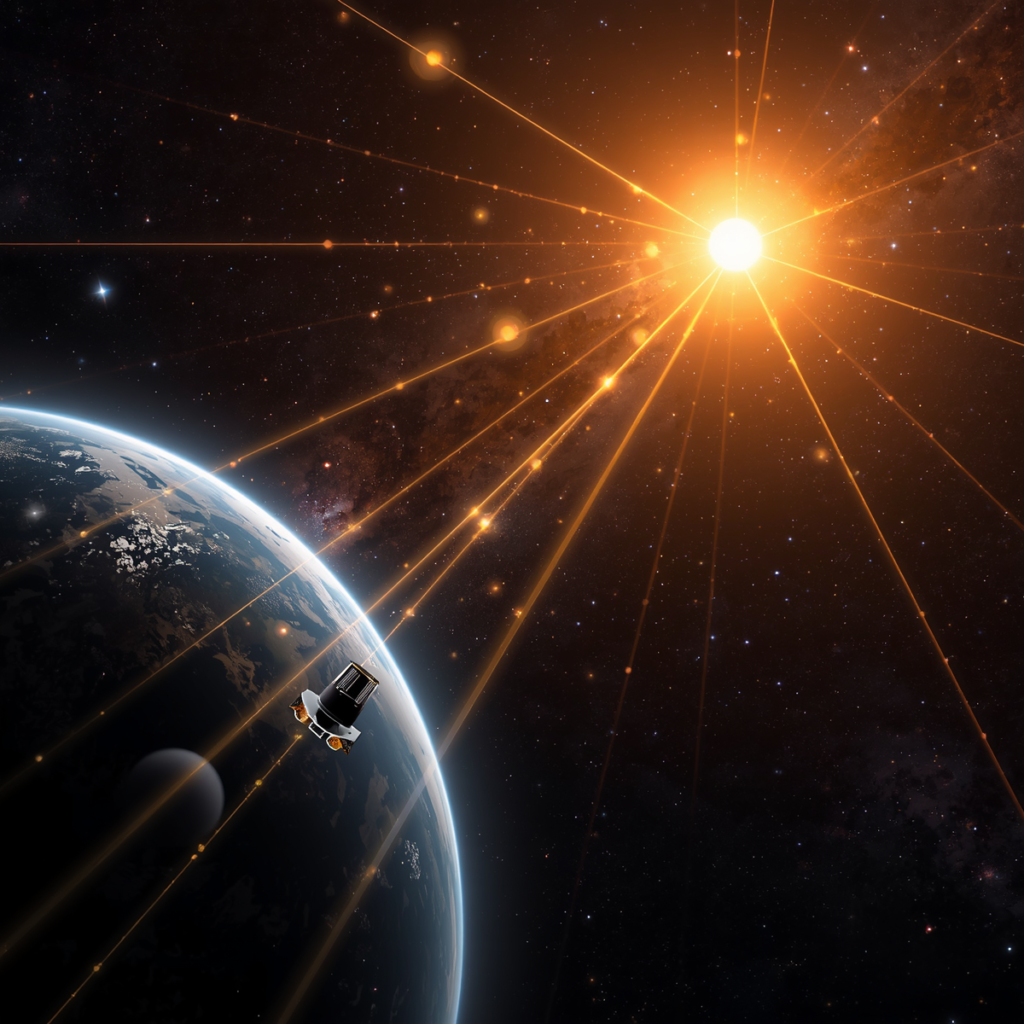
🌌 A Mathematical Discovery from the 18th Century
The story begins in the late 1700s with the work of Italian-French mathematician Joseph-Louis Lagrange.
Scientists were studying a difficult problem involving gravity.
Imagine two massive objects, such as the Earth and the Sun. Both exert powerful gravitational forces, and anything placed between them is constantly being pulled in different directions.
Lagrange discovered that under certain conditions, there are specific locations where these gravitational forces and orbital motion balance each other in a remarkable way.
At these locations, a smaller object can maintain a relatively stable position with far less effort than would normally be required.
These locations became known as Lagrange Points.
⚖️ The Cosmic Tug-of-War
To understand Lagrange Points, imagine standing in the middle of a tug-of-war.
One team pulls from one side while another team pulls from the opposite side.
If the forces balance perfectly, you remain in position.
Something similar happens in space.
The gravity of the Earth pulls on a spacecraft. The gravity of the Sun also pulls on it. Meanwhile, the spacecraft itself is moving through space and experiencing orbital forces.
At certain locations, these effects combine in a way that creates a gravitational balance.
The result is a region where a spacecraft can remain in a relatively stable position while consuming very little fuel.
It is one of the most elegant examples of celestial mechanics.
🛰️ The Five Special Points
For any pair of large celestial bodies, such as the Earth and the Sun, there are five Lagrange Points.
Scientists label them L1, L2, L3, L4, and L5.
Each has unique characteristics and advantages.
Some are located between the two objects. Others lie beyond them. Two of the points form stable positions that lead and follow a planet along its orbit.
These points are not physical objects or structures.
They are simply locations in space where gravity and motion create special conditions.
Yet these invisible coordinates have become extraordinarily useful.
☀️ L1: The Perfect Solar Observation Post
One of the most useful Lagrange Points is L1.
Located between the Earth and the Sun, it provides an uninterrupted view of our star.
Spacecraft positioned near L1 can continuously monitor solar activity, including:
solar flares,
solar wind,
and magnetic storms.
Because these events can affect satellites, communications systems, and power grids on Earth, early warning is extremely valuable.
Several solar observation missions have used this location to watch the Sun around the clock.
🔭 L2: Humanity’s New Window to the Universe
If L1 is ideal for studying the Sun, L2 is perfect for observing deep space.
Located on the opposite side of Earth from the Sun, L2 provides a stable environment where spacecraft can keep the Sun, Earth, and Moon behind them.
This greatly reduces unwanted heat and light interference.
Because of these advantages, some of humanity’s most advanced space telescopes have been placed near L2.
The most famous example is the James Webb Space Telescope.
From its position near L2, the telescope can observe distant galaxies, exoplanets, and ancient cosmic structures with extraordinary precision.
In many ways, L2 has become humanity’s premier observation deck for the universe.
🌍 Natural Objects Also Gather There
Lagrange Points are not only useful for spacecraft.
Nature uses them too.
At the stable L4 and L5 points, gravity can trap natural objects for millions of years.
Astronomers have discovered groups of asteroids occupying these locations around several planets.
The most famous examples are the Trojan asteroids associated with Jupiter.
These ancient objects travel alongside the planet as it orbits the Sun, occupying gravitationally stable regions discovered mathematically centuries before they were observed.
It is a remarkable example of theory predicting reality.
🚀 Why Future Space Exploration Depends on Them
As humanity expands its presence in space, Lagrange Points may become even more important.
Future concepts include:
space telescopes,
communications hubs,
fuel depots,
and even gateways for missions to the Moon and Mars.
Because spacecraft located near these points require less fuel for station-keeping, they offer significant advantages for long-duration missions.
Some space agencies have proposed using Lagrange Points as transportation hubs that connect different parts of the Earth-Moon system.
The idea resembles airports or railway junctions—except on a cosmic scale.
🧠 A Hidden Feature of the Solar System
One of the most fascinating aspects of Lagrange Points is that they are completely invisible.
You cannot see them through a telescope.
They have no color, shape, or physical structure.
Yet their influence is real.
They are hidden features of the Solar System, carved not from rock or metal but from mathematics and gravity.
Their existence reminds us that space is not empty. It contains patterns, structures, and opportunities waiting to be discovered.
💡 The Most Valuable Addresses in Space
When people imagine prime real estate, they often think of famous streets, luxury neighborhoods, or waterfront properties.
Space has its own valuable locations.
Lagrange Points offer stability, efficiency, and strategic advantages that make them some of the most sought-after destinations beyond Earth.
They are invisible parking spots where gravity does most of the work.
What began as an elegant mathematical discovery in the 18th century has become an essential tool for modern space exploration.
As humanity ventures farther into the cosmos, these hidden crossroads may become the foundation for the next great era of discovery.
Continue Exploring on Trivialwiki
If you enjoyed learning about the hidden structures that make space exploration possible, don’t miss our previous post:
👉 Chocolate: The Royal Drink That Conquered the World
Discover how a sacred cacao beverage consumed by ancient rulers evolved into one of the world’s most beloved treats.
📬 Stay Connected with Trivialwiki
👉 Facebook: https://facebook.com/Trivialwiki
👉 Instagram: https://instagram.com/trivialwiki
👉 YouTube: https://youtube.com/@trivialwiki
👉 Pinterest: https://pinterest.com/Trivialwiki
Learn. Explore. Discover.
Lagrange Points are invisible locations where gravity creates natural parking spots in space. If humanity builds large space stations in the future, would you place them near a planet, on the Moon, or at a Lagrange Point? Share your thoughts in the comments! 🌌🚀
1 thought on “The Invisible Parking Spots of Space”