
In 1977, humanity launched a spacecraft with a mission expected to last just a few years. No one imagined that nearly half a century later, it would still be alive—quietly whispering data back to Earth from a place no human-made object had ever reached before.
That spacecraft is Voyager 1.
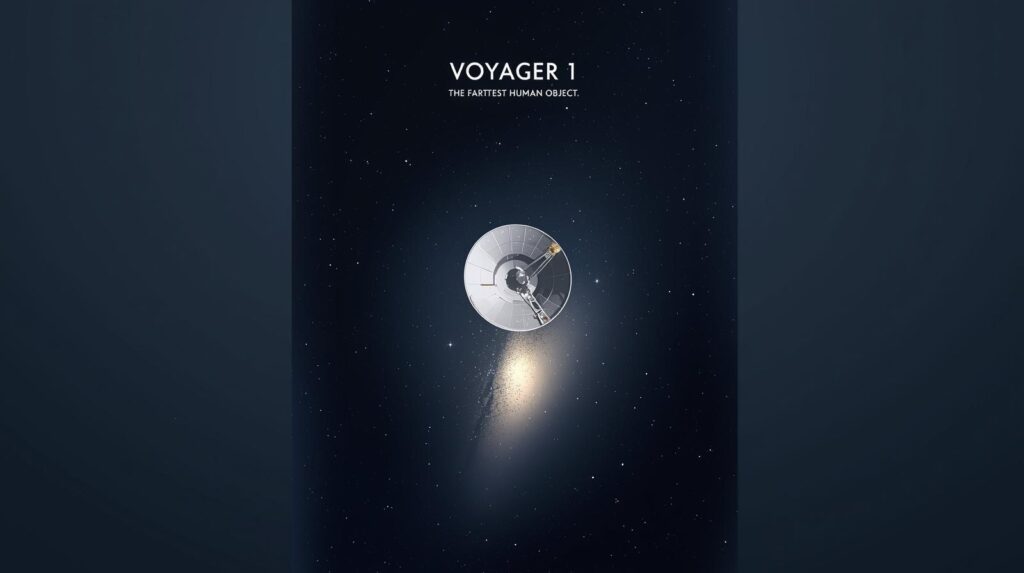
Today, Voyager 1 is the farthest object ever created by humans, traveling through the darkness between stars. It has left our solar system behind, entered interstellar space, and continues to communicate with Earth using technology older than most of the people reading this.
Its story is one of ambition, ingenuity, and a deeply human desire to explore the unknown.
🌍 A Mission That Wasn’t Meant to Last This Long
Voyager 1 was launched by NASA on September 5, 1977, originally designed to study Jupiter and Saturn. At the time, scientists hoped it might survive long enough to send back detailed images and data from those distant planets.
And it did exactly that—magnificently.
Voyager 1 revealed:
- Jupiter’s massive storms and volcanic moons
- Saturn’s complex rings and atmospheric layers
After completing its primary mission, Voyager 1 didn’t stop. Instead, NASA made a bold decision: let it keep going.
The spacecraft was placed on a trajectory that would send it out of the solar system entirely, turning a planetary mission into a historic journey toward the stars.
🧭 How Far Has Voyager 1 Traveled? (The Numbers Are Staggering)
Voyager 1 is currently over 24 billion kilometers (15 billion miles) away from Earth—and still moving.
To put that into perspective:
- Light from the Sun takes over 22 hours to reach Voyager 1
- Radio signals from Voyager 1 take nearly a full day to reach Earth
- It travels at roughly 61,000 km/h (38,000 mph)
In 2012, Voyager 1 officially crossed the boundary known as the heliopause, becoming the first human-made object to enter interstellar space—the region between stars.
It’s not orbiting anything.
It’s not coming back.
It’s simply… drifting onward.
📡 How Is Voyager 1 Still Communicating With Earth?
This is perhaps the most astonishing part of the story.
Voyager 1 still sends data back using:
- A transmitter weaker than a refrigerator light bulb
- A 3.7-meter antenna
- Technology built in the 1970s
NASA receives these signals using the Deep Space Network, a set of massive antennas spread across Earth.
Even now, Voyager 1 continues to send:
- Magnetic field data
- Plasma readings
- Information about cosmic radiation
Engineers regularly perform miracles—rewriting software, switching to backup systems, and conserving power—to keep the spacecraft alive.
Eventually, its power source (radioisotope thermoelectric generators) will fade. But until then, Voyager 1 keeps talking.
🎵 The Golden Record: Humanity’s Message to the Universe
Perhaps the most poetic part of Voyager 1 is what it carries.
Attached to the spacecraft is the Golden Record—a gold-plated copper disc designed to communicate who we are, should any intelligent life ever find it.
The record includes:
- Greetings in 55 human languages
- Sounds of Earth: wind, rain, laughter, a baby crying
- Music from around the world, from Bach to traditional folk songs
- Images of human life, science, anatomy, and culture
It’s not a message expecting a reply.
It’s a message that says:
“We were here. This is who we were.”
Long after Earth changes—or even disappears—Voyager 1 will still carry that message across the galaxy.
🔮 What Will Happen to Voyager 1 in the Future?
At some point in the coming years, Voyager 1 will fall silent.
When it does:
- It will continue drifting through space
- It may pass near other star systems in tens of thousands of years
- It will outlast every monument ever built on Earth
Voyager 1 may very well become the last evidence of human civilization, long after our planet has changed beyond recognition.
🌌 Why Voyager 1 Still Matters
Voyager 1 reminds us of something profound:
That curiosity can push us beyond fear.
That fragile machines can survive the unimaginable.
That even small signals, sent across vast darkness, can still be heard.
It is not just a spacecraft.
It is a story about humanity itself.
🔗 Reference: Previous Post
👉 Why We Hang Stockings: The Real Story Behind Christmas Stockings
📬 Stay Connected with Trivialwiki
–––––––––––––––––––––––––––––
📬 Stay Connected with Trivialwiki
👉 Facebook: https://facebook.com/Trivialwiki
👉 Instagram: https://instagram.com/trivialwiki
👉 YouTube: https://youtube.com/@trivialwiki
👉 Pinterest: https://pinterest.com/Trivialwiki
Learn. Explore. Discover.
–––––––––––––––––––––––––––––
Interesting. Its aiming for the stars.