
Some of the most useful inventions in the world were not created in laboratories or planned through years of research.
Instead, they were discovered by accident.
Velcro — the familiar fastening system used in shoes, jackets, bags, and even space suits — is one of those inventions. Its story begins not with engineers, but with a simple walk in the countryside.
A curious observation during that walk eventually led to one of the most widely used fastening technologies in modern life.
🌿 A Walk That Sparked an Idea
The story of Velcro begins in 1941 with a Swiss engineer named George de Mestral.
After returning from a walk in the mountains with his dog, he noticed something unusual. Small burrs from burdock plants had become stuck stubbornly to his clothes and his dog’s fur.
Anyone who has walked through fields or forests has experienced this annoyance.
But instead of simply brushing them away, de Mestral became curious.
Why were these burrs so difficult to remove?
🔬 Looking at Nature Through a Microscope
Back home, de Mestral placed one of the burrs under a microscope.
What he saw revealed the secret.
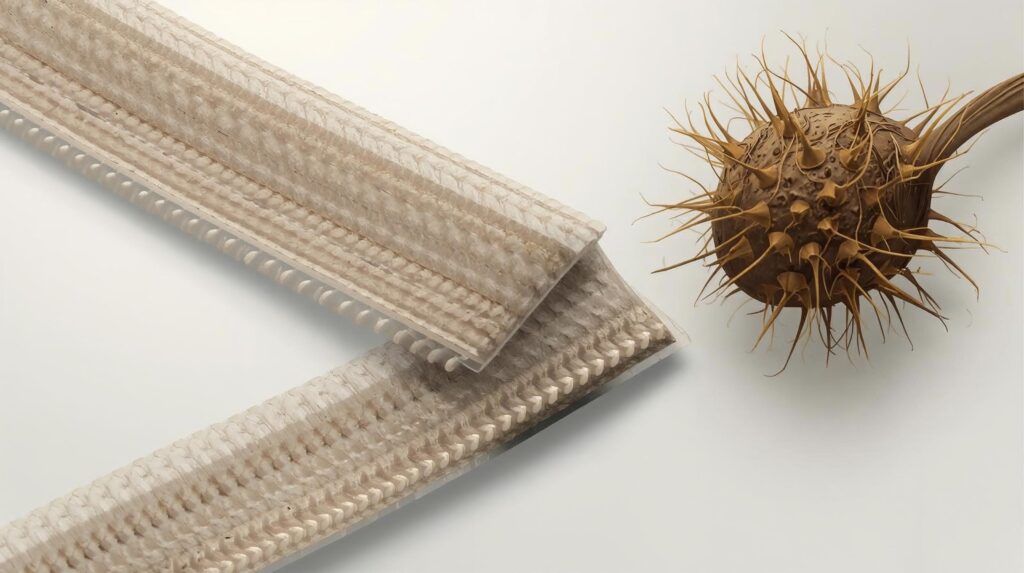
The surface of each burr was covered with tiny hook-shaped structures. These hooks easily grabbed onto loops found in fabric fibers or animal fur.
The burr wasn’t just sticky — it was mechanically attaching itself.
That discovery sparked a powerful idea.
If nature could create a simple hook-and-loop system, perhaps humans could replicate it.
🧵 From Plant to Product
Turning that observation into a practical invention was not easy.
De Mestral spent years experimenting with different materials that could mimic the burr’s tiny hooks while remaining durable enough for everyday use.
Eventually he found that nylon worked well for creating both the hooks and the loops.
The design consisted of two strips:
– One covered with tiny hooks
– The other covered with soft loops
When pressed together, the hooks caught the loops and formed a secure but temporary bond.
Pull them apart, and the connection released.
Simple, reusable, and surprisingly strong.
🏷️ The Birth of the Name “Velcro”
The name Velcro comes from a combination of two French words:
– Velours (velvet)
– Crochet (hook)
Together they formed the brand name that would soon become famous worldwide.
Though “Velcro” is technically a trademark, the word has become so common that many people use it to describe all hook-and-loop fasteners.
It’s a rare case where a brand name becomes part of everyday language.
🚀 Velcro Reaches Space
One of Velcro’s biggest boosts in popularity came from an unexpected place — NASA.
During the early years of space exploration, astronauts needed a way to secure objects in the zero-gravity environment of spacecraft.
Velcro turned out to be perfect.
It allowed tools, equipment, and even food packets to be attached to surfaces and easily removed when needed.
As images of astronauts using Velcro circulated around the world, the invention gained global attention.
Soon it appeared everywhere — from clothing to sports gear.
👟 Everyday Uses Everywhere
Today Velcro appears in countless everyday products.
You can find it in:
– Shoes and sneakers
– Jackets and outdoor gear
– Medical braces and bandages
– Bags and backpacks
– Cable organizers
– Children’s clothing
– Military equipment
Its combination of simplicity, reliability, and reusability makes it incredibly versatile.
Sometimes the simplest mechanical ideas turn out to be the most powerful.
🧠 A Perfect Example of Biomimicry
Velcro is one of the earliest and most famous examples of biomimicry — the practice of designing technology inspired by natural systems.
Nature has spent billions of years evolving solutions to problems.
By studying plants, animals, and ecosystems, engineers can discover efficient designs that humans might never invent from scratch.
Velcro shows how careful observation of nature can lead to revolutionary ideas.
🌍 Innovation Hidden in Plain Sight
What makes the Velcro story so inspiring is how ordinary its origin was.
A walk in the countryside.
A curious observation.
A closer look through a microscope.
Many breakthroughs begin not with complex theories, but with simple questions about how the world works.
Sometimes innovation hides in the smallest details of everyday life.
💡 The Power of Curiosity
George de Mestral could easily have ignored the burrs stuck to his clothes.
Instead, he asked a simple question: How does this work?
That curiosity led to an invention now used around the globe.
Velcro reminds us that inspiration often comes from paying attention to the natural world — and being curious enough to explore what we see.
Continue Exploring on Trivialwiki
If you enjoyed discovering how everyday inventions can shape our world, don’t miss our previous post:
👉 Coffee: The Drink That Built Modern Work Culture
Explore how a simple beverage helped shape modern workplaces, trade networks, and intellectual movements.
📬 Stay Connected with Trivialwiki
👉 Facebook: https://facebook.com/Trivialwiki
👉 Instagram: https://instagram.com/trivialwiki
👉 YouTube: https://youtube.com/@trivialwiki
👉 Pinterest: https://pinterest.com/Trivialwiki
Learn. Explore. Discover.
Velcro was inspired by a tiny plant burr — what everyday objects do you think might have surprising stories behind them? Share your thoughts in the comments!