
Every day, without thinking, we live inside an ancient mathematical decision.
We divide hours into 60 minutes. Minutes into 60 seconds. We split the day into two halves of 12 hours each. We glance at clocks, set alarms, schedule meetings — all guided by numbers that feel completely natural.
What’s surprising is that none of this is obvious or inevitable.
Humans could have measured time in tens, hundreds, or any other neat decimal system. In fact, some tried. Yet thousands of years later, we still follow a structure shaped long before mechanical clocks, calendars, or modern science existed.
So why did 60s and 12s win — and why did they never leave?
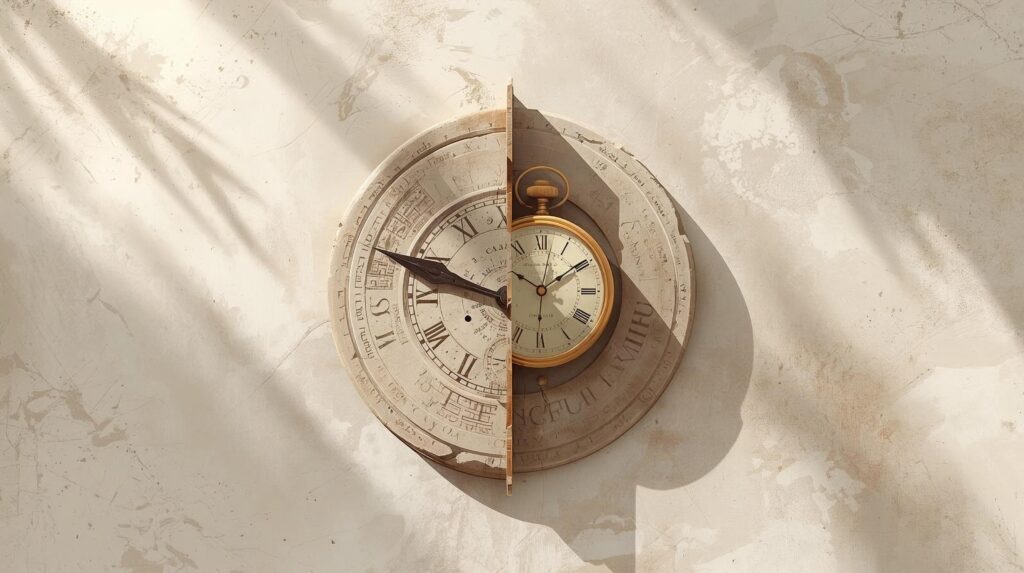
⏳ Time Was Measured Before Clocks Existed
Long before clocks ticked on walls, people still needed to measure time.
Farmers tracked daylight. Priests timed rituals. Traders coordinated markets. Sailors navigated using the sky. All of this required dividing the day into predictable parts.
Early civilizations turned to what they knew best: the Sun, the Moon, and numbers that were easy to work with.
Time wasn’t abstract. It was physical, visible, and deeply tied to daily survival.
🧮 The Hidden Power of 60
The number 60 might seem arbitrary today, but mathematically, it’s incredibly practical.
Sixty can be divided evenly by:
2, 3, 4, 5, 6, 10, 12, 15, 20, and 30.
This flexibility made calculations far easier in a world without calculators or written decimals. Fractions were common, and clean divisions mattered.
When ancient scholars divided circles, tracked stars, or measured angles, 60 made life simpler. That same logic quietly carried over into timekeeping.
What looks strange now once felt elegant and efficient.
🌙 Why 12 Fit the Natural World
The number 12 wasn’t chosen randomly either.
Ancient observers noticed patterns:
- Roughly 12 full moon cycles in a year
- Day and night naturally splitting into two parts
- The Sun’s movement creating repeating cycles
Twelve is also highly divisible — by 2, 3, 4, and 6 — making it practical for sharing time into halves, thirds, or quarters.
Dividing daylight into 12 parts felt intuitive. Doing the same for night completed the cycle.
Together, 12 and 60 formed a system that mirrored both nature and convenience.
🕰️ When Math, Astronomy, and Habit Collided
Once early civilizations adopted these divisions, they spread through trade, religion, and education.
Later cultures inherited the system not because they questioned it — but because it already worked. Sundials, water clocks, and early mechanical clocks were all built around these established units.
By the time clocks became precise, the structure was no longer up for debate.
The system didn’t survive because it was perfect.
It survived because everyone already agreed on it.
🔄 Attempts to Change Time — and Why They Failed
At various points in history, people tried to redesign time.
One notable attempt introduced decimal time, dividing days into 10 hours, hours into 100 minutes, and minutes into 100 seconds. On paper, it looked logical.
In practice, it failed.
People struggled to relearn rhythms tied to sleep, work, and social life. Clocks had to be redesigned. Habits broke. Confusion followed.
The problem wasn’t math — it was human behavior.
Timekeeping isn’t just a system. It’s a shared language.
🧠 Why Familiar Systems Are Hard to Replace
Once a system becomes embedded in daily life, changing it becomes costly.
Every schedule, timetable, habit, and expectation depends on it. Children learn it early. Societies synchronize around it.
Even if a new system is technically superior, the transition pain often outweighs the benefits.
This is a recurring theme in human history: standards persist not because they’re optimal, but because they’re universal.
⌛ Timekeeping Is About Coordination, Not Precision
Modern technology can measure time down to billionths of a second. Yet our daily lives still run on ancient divisions.
That’s because everyday timekeeping isn’t about scientific precision — it’s about coordination.
When everyone agrees on what “an hour” means, society functions smoothly. The moment that agreement breaks, confusion spreads.
60s and 12s provide a common rhythm that has synchronized humans for millennia.
🌍 A Global Habit Older Than Most Nations
Borders changed. Empires rose and fell. Languages evolved.
But time stayed familiar.
No matter where you travel, hours, minutes, and seconds feel recognizable. That continuity is rare in human systems.
It’s one of the few standards that truly became global without force — passed down simply because it worked well enough for everyone.
💡 A Quiet Example of Ancient Wisdom
It’s tempting to think modern life is entirely disconnected from the ancient world.
But every glance at a clock proves otherwise.
We still live inside decisions made by people who watched the sky, counted shadows, and divided days with nothing more than observation and logic.
The tools changed.
The structure stayed.
🧠 What Time Teaches Us About Human Design
The story of 60s and 12s reveals something important about how humans build systems.
We don’t always choose what’s newest. We choose what’s reliable, shared, and familiar. Once a system becomes woven into daily life, it gains momentum of its own.
Timekeeping isn’t frozen because it’s outdated.
It’s stable because it’s deeply human.
Continue Exploring on Trivialwiki
If you enjoyed uncovering how ancient decisions still shape modern life, don’t miss our previous post:
👉 Computer Bugs: How a Tiny Mistake Became a Global Tech Term
A fascinating look at how human error quietly became part of the language of technology.
📬 Stay Connected with Trivialwiki
–––––––––––––––––––––––––––––
👉 Facebook: https://facebook.com/Trivialwiki
👉 Instagram: https://instagram.com/trivialwiki
👉 YouTube: https://youtube.com/@trivialwiki
👉 Pinterest: https://pinterest.com/Trivialwiki
Learn. Explore. Discover.
–––––––––––––––––––––––––––––
We still measure time using ancient numbers without questioning them — what other everyday systems do you think survive mostly because we’re used to them?
Share your thoughts in the comments and keep the curiosity alive.
1 thought on “Time in 60s and 12s: An Ancient System We Still Live By”