
If you zoomed into a drop of water from a moss-covered rock or a damp patch of soil, you might encounter one of the toughest creatures on Earth.
It wouldn’t look impressive.
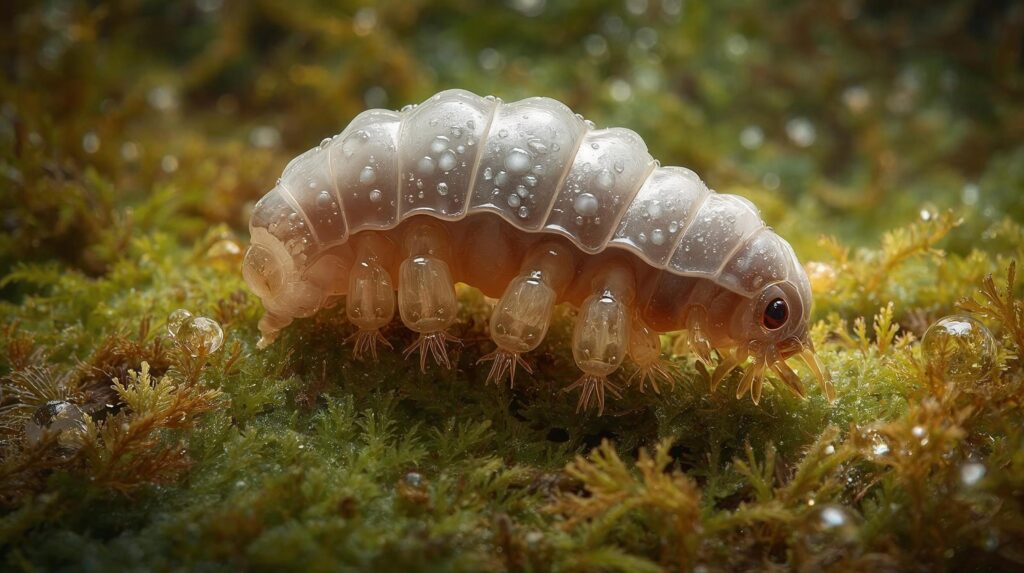
Tiny, slow-moving, and barely visible to the naked eye, this microscopic animal resembles a plump little bear with eight stubby legs. Scientists call them tardigrades, but they are often nicknamed water bears or moss piglets.
Despite their humble appearance, tardigrades possess an almost unbelievable ability: they can survive conditions that would destroy nearly every other living organism on the planet.
From freezing temperatures to intense radiation — even the vacuum of space — these tiny creatures have proven astonishingly resilient.
🐻 What Exactly Is a Tardigrade?
Tardigrades are microscopic animals typically measuring less than one millimeter long. They belong to their own unique phylum, meaning they are not insects, worms, or crustaceans.
Scientists have identified more than 1,300 species of tardigrades living all over the world.
You can find them in:
– Moss and lichens
– Freshwater ponds
– Ocean sediments
– Soil and leaf litter
Essentially, wherever there is a bit of moisture, tardigrades might be hiding.
Under a microscope, they look almost cartoonish — with a segmented body, tiny claws on their feet, and a slow waddling movement that gives them their nickname.
But beneath that simple appearance lies a remarkable survival strategy.
❄️ Surviving the Deep Freeze
Tardigrades can withstand extremely cold environments that would normally destroy living cells.
Scientists have found that these creatures can survive temperatures close to absolute zero for short periods. At such temperatures, most biological activity completely stops.
Yet tardigrades manage to endure it.
Their secret lies in the ability to shut down their metabolism and enter a protective state where their internal structures remain stable until conditions improve.
When the environment becomes hospitable again, they simply resume life.
🔥 Heat That Would Kill Most Life
Cold resistance alone would be impressive, but tardigrades are also surprisingly tolerant of heat.
Some species have survived temperatures well above what most organisms can endure — over 150°C (302°F) for short bursts.
While this isn’t typical for their natural habitats, laboratory experiments have demonstrated their extraordinary resilience.
It’s another example of how these creatures can push the limits of survival.
🚀 Surviving the Vacuum of Space
Perhaps the most famous tardigrade experiment happened beyond Earth.
In 2007, scientists sent tardigrades into outer space aboard a European Space Agency mission. The creatures were exposed directly to the vacuum of space and intense solar radiation.
When they returned to Earth, many of them survived.
Even more astonishing, some were able to reproduce afterward.
Few complex organisms can claim such an achievement.
💧 The Secret: A Survival Mode Called Cryptobiosis
The real reason tardigrades can endure extreme conditions lies in a remarkable ability called cryptobiosis.
When their environment becomes hostile — for example, when water disappears — tardigrades enter a dormant state known as a tun.
In this form:
– Their body dries out
– Metabolism slows to nearly zero
– Cellular processes effectively pause
They curl into a tiny dehydrated ball and remain in this suspended state until water returns.
Scientists have revived tardigrades from cryptobiosis years later, bringing them back to life simply by rehydrating them.
It’s not immortality, but it’s remarkably close to biological pause.
🧬 Natural Protection Against Radiation
Another extraordinary trait of tardigrades is their resistance to radiation.
Exposure to high levels of radiation typically damages DNA, causing fatal mutations. But tardigrades possess special proteins that help protect and repair their genetic material.
One such protein, known as Dsup, appears to shield DNA from damage.
Researchers are studying these proteins to better understand how cells protect themselves — knowledge that could one day contribute to advances in medicine or space travel.
🌍 Tiny Creatures, Global Presence
Despite their microscopic size, tardigrades are incredibly widespread.
They exist on every continent — from tropical forests to Antarctic ice. Some species live in deep ocean environments, while others thrive in temporary puddles.
Their resilience allows them to disperse easily. Wind, water, and animals can carry them to new environments where they patiently wait for suitable conditions.
Tardigrades may be small, but they are remarkably successful survivors.
🧠 What Tardigrades Teach Us About Life
The study of tardigrades has expanded our understanding of life’s limits.
Scientists once assumed complex animals required stable environments to survive. Tardigrades prove otherwise. Life can adapt in ways that seem almost impossible.
Their biology also raises fascinating questions for future exploration.
If organisms like tardigrades can survive such extreme conditions, it suggests that life elsewhere in the universe might exist in places once thought completely inhospitable.
Sometimes the smallest creatures expand the biggest possibilities.
💡 Nature’s Ultimate Survival Specialists
Tardigrades remind us that resilience doesn’t always come from strength or size.
These tiny animals lack speed, teeth, or defenses. Yet their ability to pause life itself when conditions turn hostile gives them a remarkable advantage.
In a world where environments constantly change, survival often belongs not to the strongest — but to the most adaptable.
Few organisms demonstrate that truth better than the humble tardigrade.
Continue Exploring on Trivialwiki
If you enjoyed learning about one of nature’s most resilient creatures, don’t miss our previous post:
👉 Honey Never Spoils: The Food That Refuses to Go Bad
Discover how a simple natural food can remain edible for centuries thanks to remarkable chemistry.
📬 Stay Connected with Trivialwiki
📬 Stay Connected with Trivialwiki
👉 Facebook: https://facebook.com/Trivialwiki
👉 Instagram: https://instagram.com/trivialwiki
👉 YouTube: https://youtube.com/@trivialwiki
👉 Pinterest: https://pinterest.com/Trivialwiki
Learn. Explore. Discover.
Tardigrades show that even microscopic life can achieve incredible feats — what other tiny organisms do you think might hold surprising secrets? Share your thoughts in the comments!
Good info
Great info