
Today, salt sits quietly on dining tables around the world, stored in small shakers or ceramic jars.
It’s easy to think of it as just another kitchen ingredient — something we sprinkle on food without much thought.
But for most of human history, salt was anything but ordinary.
This simple mineral shaped economies, influenced trade routes, sparked wars, and helped build entire cities. At times, it was so valuable that it was used as currency.
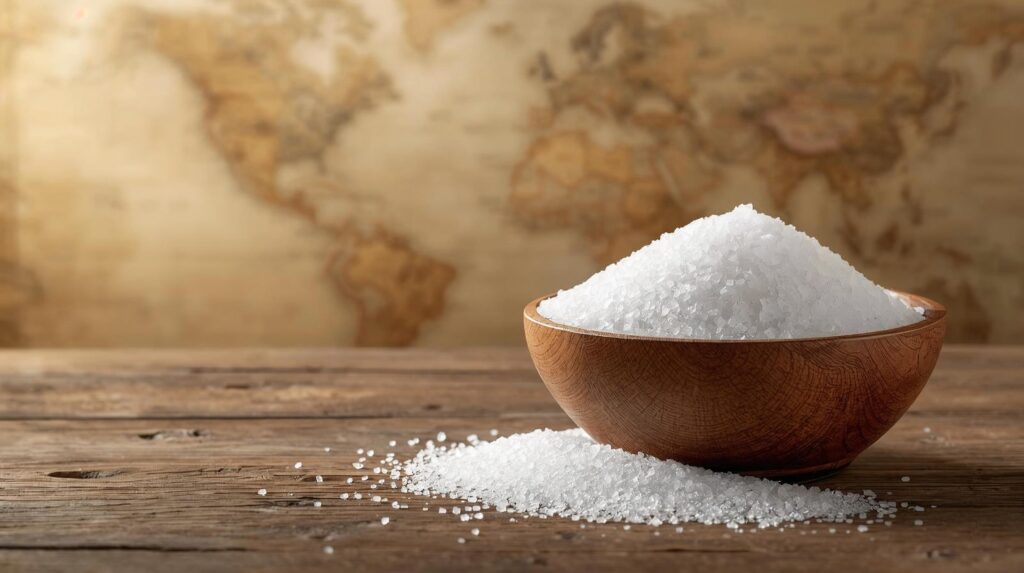
Few everyday substances have played such a powerful role in human civilization.
🧂 Why Salt Was Once More Valuable Than Gold
Before refrigeration, preserving food was one of humanity’s greatest challenges.
Fresh meat, fish, and vegetables spoiled quickly. Without reliable ways to store food, societies struggled to survive long winters, long journeys, or periods of famine.
Salt changed that.
By drawing moisture out of food and preventing bacterial growth, salt made long-term preservation possible. Salted fish, cured meats, and preserved vegetables could last for months or even years.
This ability turned salt into a vital survival resource.
Communities that controlled salt supplies held tremendous power.
🌍 The Birth of Ancient Trade Routes
Because salt was so essential, people traveled great distances to obtain it.
Ancient trade routes formed specifically for transporting salt from mines and coastal regions to inland settlements. One of the most famous examples is the Via Salaria, an ancient Roman road used to transport salt into Rome.
Across Africa, vast caravans crossed the Sahara Desert carrying blocks of salt between trading cities.
Salt was not just a seasoning. It was a cornerstone of commerce.
Entire economic networks developed around its production and distribution.
💰 Salt as Currency
In several ancient societies, salt became so valuable that it was used as a form of payment.
Roman soldiers were sometimes given a salt allowance known as salarium, which is believed to be the origin of the English word salary.
In parts of Africa and Asia, salt blocks were traded directly for goods, livestock, or labor.
The mineral’s value came from its necessity. Everyone needed salt — regardless of wealth, culture, or geography.
Few commodities were so universally demanded.
🏰 Salt Taxes and Political Power
Governments quickly realized that controlling salt could generate enormous revenue.
Many rulers imposed heavy salt taxes, forcing citizens to buy salt from state-controlled sources.
One of the most famous examples occurred in colonial India, where the British government taxed salt production. In 1930, Mahatma Gandhi led the historic Salt March, protesting the tax by walking over 200 miles to the sea to produce salt illegally.
The protest became a powerful symbol of resistance and played a key role in India’s independence movement.
A simple mineral had become a political weapon.
🧊 The Science Behind Salt’s Preservation Power
Salt’s effectiveness as a preservative comes from basic chemistry.
When salt contacts bacteria or microorganisms, it draws water out of their cells through osmosis. Without water, these organisms cannot grow or reproduce.
This simple process explains why salted foods resist spoilage.
Long before people understood microbiology, they recognized salt’s remarkable ability to keep food safe.
It was early food science — discovered through observation and necessity.
🐟 The Salt That Fed Empires
Salt preservation enabled entire industries.
Fishing communities could catch large quantities of fish and preserve them with salt, allowing the food to be transported long distances.
This helped feed growing urban populations and armies. Salted fish became a staple food across Europe and Asia.
Without salt preservation, long-distance trade in perishable food would have been nearly impossible.
Salt helped feed expanding civilizations.
🌊 Where Salt Comes From
Today, salt is so common that its origins are easy to overlook.
Most salt comes from two main sources:
– Seawater evaporation, where ocean water is dried in large shallow ponds
– Underground salt deposits, formed from ancient seas that evaporated millions of years ago
Large salt mines exist around the world, some stretching deep underground in vast crystalline chambers.
What we sprinkle on food often comes from geological formations older than human civilization itself.
🧠 A Mineral That Shaped Language and Culture
Salt’s historical importance left marks on language and culture.
Many expressions trace back to salt’s value:
– “Worth your salt” meaning someone who earns their pay
– “Salt of the earth” referring to reliable, honest people
– “Take it with a grain of salt” suggesting skepticism
Even today, these phrases echo a time when salt represented wealth, survival, and trust.
Few minerals have shaped language so deeply.
💡 From Precious Commodity to Everyday Ingredient
Modern refrigeration and industrial food production transformed salt’s role.
What was once rare and precious became abundant and inexpensive.
Yet its historical impact remains extraordinary.
Salt preserved food before modern technology existed. It connected distant civilizations through trade. It influenced taxation, politics, and even independence movements.
All from a simple crystalline mineral.
Continue Exploring on Trivialwiki
If you enjoyed discovering how everyday substances can shape entire civilizations, don’t miss our previous post:
👉 Iceland: The Country Powered by Volcanoes
Explore how volcanic forces and geothermal energy shaped one of the most unique countries on Earth.
📬 Stay Connected with Trivialwiki
👉 Facebook: https://facebook.com/Trivialwiki
👉 Instagram: https://instagram.com/trivialwiki
👉 YouTube: https://youtube.com/@trivialwiki
👉 Pinterest: https://pinterest.com/Trivialwiki
Learn. Explore. Discover.
Salt once shaped trade routes, politics, and survival — what other everyday ingredients do you think had a surprising impact on human history? Share your thoughts in the comments!
1 thought on “Salt: The Ingredient That Changed Human History”