
Most living creatures follow the same basic rule: they are born, they grow, and eventually they die.
Nature has a rhythm built around that cycle.
But deep in the oceans, there exists a tiny jellyfish that appears to bend that rule. Instead of aging and dying in the usual way, this remarkable creature can reverse its life cycle and start again.
Scientists call it Turritopsis dohrnii, but it is more famously known as the immortal jellyfish.
While it is not truly immortal in every sense, its ability to reset its biological clock makes it one of the most fascinating organisms in the animal kingdom.
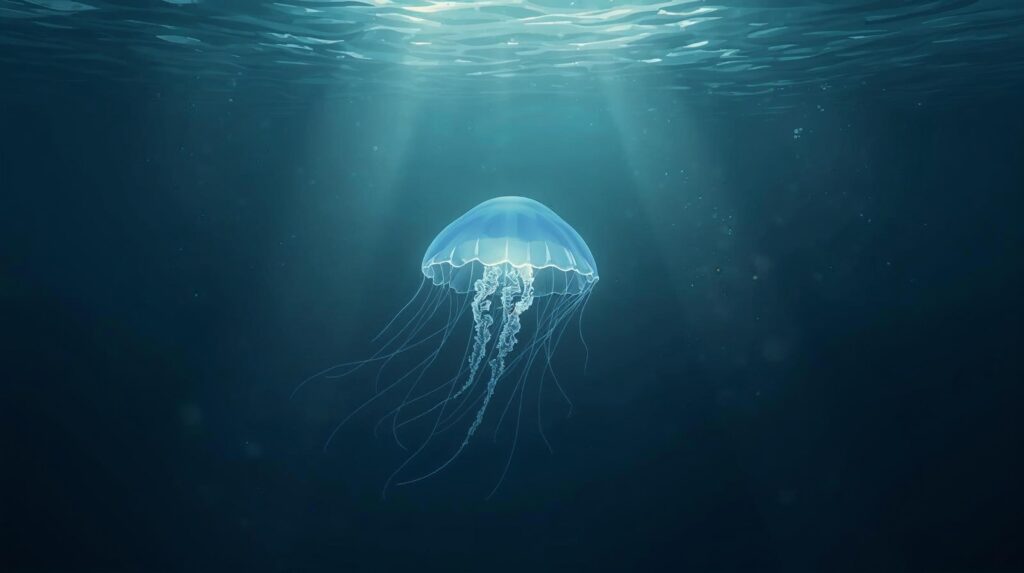
🌊 A Jellyfish Unlike Any Other
The immortal jellyfish is extremely small — typically only about 4 to 5 millimeters wide, roughly the size of a pencil eraser.
It lives in oceans around the world, drifting through warm waters in places like the Mediterranean Sea and the Pacific Ocean.
At first glance, it looks like any other tiny jellyfish: a transparent bell-shaped body with delicate tentacles trailing behind it.
But inside that simple form lies an extraordinary biological trick.
🔄 Reversing the Aging Process
Most jellyfish follow a life cycle that begins as larvae, develops into polyps attached to the sea floor, and eventually grows into free-swimming adult jellyfish.
For the immortal jellyfish, that cycle can go in reverse.
When the adult jellyfish experiences stress — such as injury, starvation, or environmental changes — it can transform its cells and revert back to the earlier polyp stage.
This process essentially resets the organism’s life cycle, allowing it to grow again from the beginning.
Instead of aging toward death, it returns to youth.
🧬 The Science of Cellular Reprogramming
The key to this remarkable ability lies in a biological process called transdifferentiation.
In most animals, cells specialize into specific roles — muscle cells, nerve cells, skin cells, and so on. Once a cell adopts a role, it usually stays that way.
But in the immortal jellyfish, cells can change from one type to another.
Adult jellyfish cells can transform into completely different cell types needed for the earlier life stage. It’s almost like biological recycling at the cellular level.
Scientists study this phenomenon because it may offer insights into regeneration, aging, and even medical therapies.
Nature sometimes solves problems long before humans understand them.
⚠️ Not Truly Immortal
Despite its nickname, the immortal jellyfish is not invincible.
It can still be eaten by predators, killed by disease, or die from environmental hazards. Fish, turtles, and other marine creatures frequently consume jellyfish.
What makes this species special is that it doesn’t appear to die from old age.
If conditions are favorable, it could theoretically repeat its life cycle indefinitely.
In practice, few jellyfish survive long enough to do so many times.
Still, the possibility alone makes this creature extraordinary.
🌍 A Global Traveler
Though originally identified in the Mediterranean Sea, immortal jellyfish have now been found in oceans around the world.
Scientists believe they spread by hitching rides in ship ballast water — the water carried in large cargo ships to stabilize them during travel.
When ships release ballast water in distant ports, tiny marine organisms can be released as well.
As a result, this tiny jellyfish has quietly expanded its presence across many ocean regions.
Even the smallest species can become global travelers.
🧠 A Window Into Aging Research
The immortal jellyfish has captured the attention of biologists and medical researchers alike.
If scientists can understand how its cells reprogram themselves, the discoveries could potentially influence studies related to:
– Tissue regeneration
– Aging processes
– Stem cell biology
– Cellular repair mechanisms
While humans are far more complex organisms, studying simpler life forms often provides clues about fundamental biological processes.
Sometimes the secrets of longevity are hidden in the smallest creatures.
🌌 A Reminder of Nature’s Surprises
Nature constantly challenges our assumptions.
For centuries, humans believed aging and death were unavoidable biological certainties. The immortal jellyfish doesn’t completely overturn that idea, but it certainly stretches the boundaries of what life can do.
This tiny organism demonstrates that life is capable of remarkable flexibility — even rewriting its own timeline.
It’s a reminder that the natural world still holds countless mysteries waiting to be explored.
💡 Small Creatures, Big Discoveries
At only a few millimeters in size, the immortal jellyfish might seem insignificant.
Yet its unusual life cycle has sparked global scientific interest and forced researchers to reconsider how aging works in living organisms.
In the vast oceans of Earth, some of the most fascinating discoveries come from creatures almost too small to see.
Sometimes, the smallest animals carry the biggest scientific surprises.
Continue Exploring on Trivialwiki
If you enjoyed discovering one of the ocean’s strangest survival strategies, don’t miss our previous post:
👉 Salt: The Ingredient That Changed Human History
A look at how a simple mineral shaped trade routes, economies, and entire civilizations.
📬 Stay Connected with Trivialwiki
👉 Facebook: https://facebook.com/Trivialwiki
👉 Instagram: https://instagram.com/trivialwiki
👉 YouTube: https://youtube.com/@trivialwiki
👉 Pinterest: https://pinterest.com/Trivialwiki
Learn. Explore. Discover.
The immortal jellyfish shows how strange life can be beneath the ocean’s surface — what other animals do you think have surprising survival abilities? Share your thoughts in the comments! 🌊
1 thought on “Immortal Jellyfish: The Creature That Can Reset Its Own Life”